
As a lifelong sailor and licensed 100-ton captain, I’ve spent years around boats—with plenty of scraping, sanding, and painting under my belt—but it wasn’t until I purchased my own boat, a 30′ sloop, in November 2024, that I have had the opportunity to make all the decisions myself. ADVENTURESS is a 1959 Gulfstream 30 designed by Sparkman & Stephens and built by Norman Hodgdon in East Boothbay, Maine. She is mahogany planked on oak frames and had been in covered storage for almost two decades by the time I found her—or, really, by the time she found me. She was structurally sound but long overdue for attention, and her peeling and blistering bottom paint was a clear sign she was yearning for a clean, fresh bottom-paint system to start her first season back in the water.
Living and having grown up in coastal Maine, I’m fortunate to be surrounded by experienced builders, Maine windjammer captains, and lifelong wooden-boat enthusiasts. Still, when I began asking around about the best way to build up a bottom-paint system from bare wood, I got a wide range of answers—most of them contradictory. No one claimed to be an expert, and everyone assured me someone else would know better. After weeks of research and deliberation, it occurred to me that the true experts might just be the companies that design these coatings in the first place.
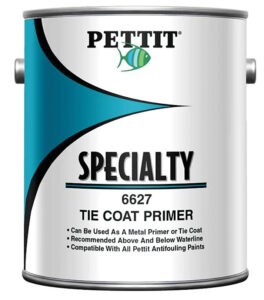
That led me to Pettit Paints, and ultimately to their Tie Coat 6627 primer—a chlorinated rubber-based bonding primer designed to serve as the interface between bare wood or previously painted surfaces and antifouling paint and topside enamels. It can be used above or below the waterline and as a metal primer. I was already a fan of Pettit’s products, and 6627’s formulation and physical flexibility seemed to be the right choice for ADVENTURESS.