
 Geoff Henderson
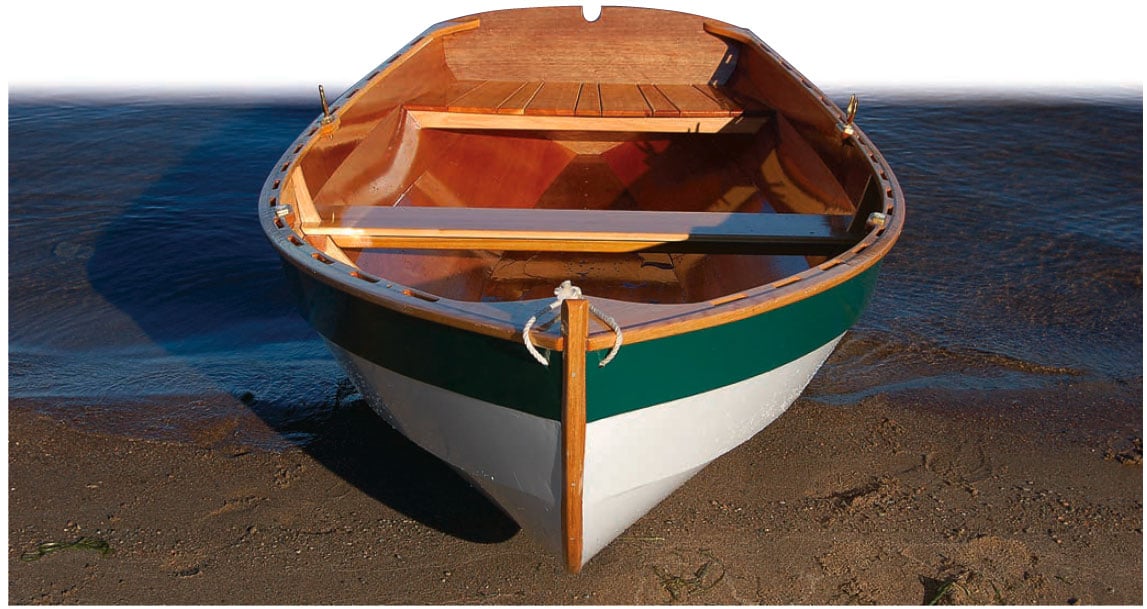
This Shellback dinghy, built purely for rowing, has a clean, bright-finished interior unmarred by temporary fastenings.
For a winter project last year, I decided to build the Joel White-designed Shellback dinghy. I was drawn to the boat's elegant lines and lapstrake plywood construction. The plans were excellent and Eric Dow's book How to Build the Shellback Dinghy was very helpful.
Conventional lapstrake planking is fastened together with rivets. Glued lapstrake planking is just what it sounds like: strakes of plywood are glued together over temporary molds or permanent frames and glued together with epoxy. There are no permanent mechanical fastenings but, typically, temporary screws driven through the laps hold the planks together while the glue cures; the screws are then removed and their holes filled. Because plywood is dimensionally stable—that is, it doesn’t swell and shrink when wetted and dried—the glued plank lap seams remain durable and watertight.