
My preferred way to build hollow masts has been, for two decades, the bird’s-mouth method (see WoodenBoat Nos. 268 and 149). I have also made traditional box-sectioned hollow spars using solid wood. The common box-spar method involves making the forward and after components from thick material, the edges of which are rabbeted to receive thinner material for the sides. Many thousands of spars have been made with this method, which dates to the mid-19th century.
I have designed several rotating wing masts of plywood, but a few years ago it occurred to me that box-sectioned spars of lighter weight than the usual solid-wood construction could be designed and built of plywood and solid-wood corners. Because the loads on masts are primarily vertical and circumferential, plywood intuitively seems a good choice. Solid wood has only moderate tensile strength across the grain, while marine plywood has excellent tensile strength in all directions. Hence, I developed a “new” mast design based on this concept. (I do not doubt that other spar-makers have thought of this and utilized it).
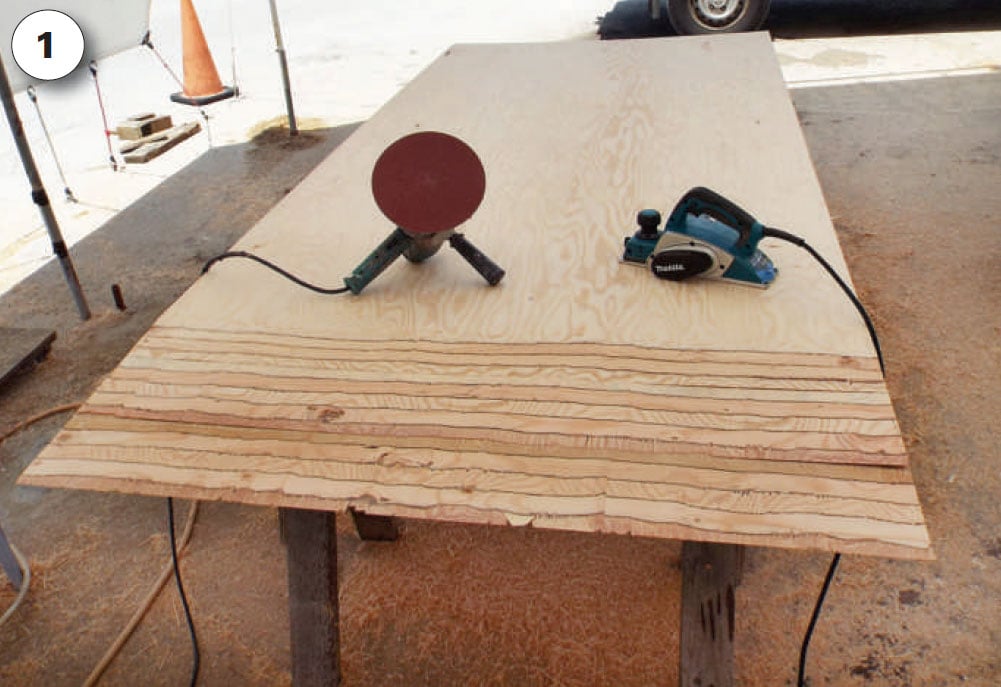
1. I chose Douglas-fir for my solid corners and Douglas-fir AB marine plywood for the front, back, sides, and also for the internal blocking. All the joints were glued with epoxy, backed up with pneumatically driven stainless-steel brads. My scarf ratio was 8:1, which resulted in a 4”-long joint for the 1⁄2”-thick plywood and 3” long for the 3⁄8” plywood. I used a power planer and a sander-polisher with 8" stick-on sanding disks to shape the scarfs.