
Maritime Life and Traditions No. 4
Download one to read anywhere
A digital PDF of this issue is available to purchase from the WoodenBoat Store.
Join to Read Magazine Purchase Issue No. 4
Table of Contents
WOODEN TRAWLERS IN SCOTLAND
By Peter Rolt
Many of the small coastal towns of northeast Scotland have held on to their fisheries-dependent traditions, yet most of today’s fish are landed in a few very successful local ports that can accommodate the larger boats. Similarly, the shipbuilding yards are few and far between and struggle for work. Yet, in Macduff the shipyards are still building several new commercial fishing boats every year, and at least one or two of those are in wood.
THE DRONTHEIMS OF DONEGAL
By Dnal MacPolin
When they consider Ireland’s traditional boats, most people think of the west coast — the Galway Hookers, the canvas-hulled currachs. Yet for centuries, the boatbuilders of the north and east of Ireland worked and built clinker-hulled boats of which the Drontheim, or Greencastle yawl, is perhaps the most remarkable.
STAR OF INDIA
By Brooks Townes
Ship-rigged and named Euterpe, she was launched from the Isle of Man in 1864, and, like so many of her contemporaries, her history was eventful but not particularly remarkable. Today, however, she is one of the best-known surviving commercial sailing ships — moored at San Diego, it is thought that the renamed Star of India is the oldest, actively sailing barque in the world.
SOLWAY MAID
By Iain McAllister
The name, William Fife, is one of the most famous in the history of yachting — the designer from Fairlie produced some of the finest yachts the world has ever seen. Solway Maid was one of those yachts and, while she was neither the biggest, nor the fastest, nor the most expensive, she was undoubtedly a classic yacht of unsurpassed elegance... she was further guaranteed fame by being Fife’s last masterpiece.
THE WORK OF WINSLOW HOMER
By Peter H. Spectre
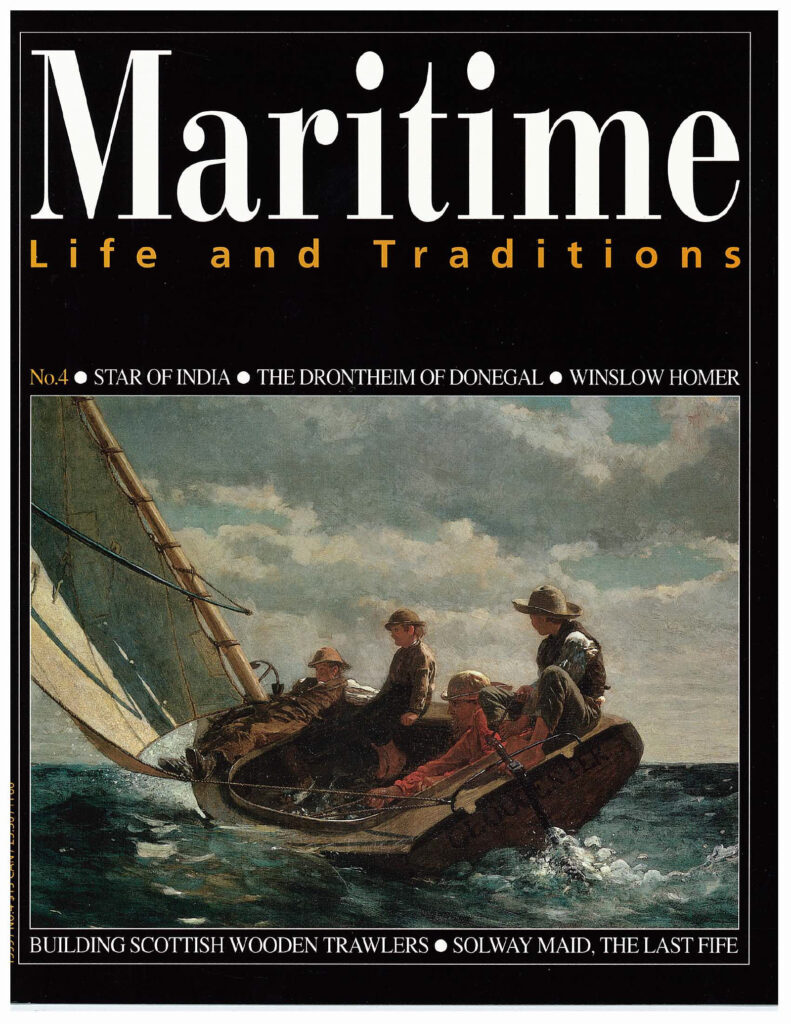
While his peers painted stylized scenes and considered art a noble endeavour, Winslow Homer concentrated on depictions of contemporary life in America — agriculture, city life, the social scene — and saw art as a way of making a living. When he turned his attentions to maritime subjects his talent superceded all who had gone before and, though he had no formal training and, indeed, was self-taught, he became recognized as America's foremost maritime artist.
WINSLOW HOMER IN CULLERCOATS
By Adrian Osler
For some twenty months, Winslow Homer lived among and painted the fishermen, their wives and daughters, in the village of Cullercoats, northeast England. The visit led to some of his most powerful yet least-known works.