
Posted August 30th, 2026
—Sam Johnson, 81, March 22, 2026, Astoria, Oregon. Among Mr. Johnson’s many deep interests was a fascination with boats and boatbuilding, starting at a young age while growing up on his family’s ranch in Santa Clara Valley, California, south of San Francisco Bay. His formal education was in the sciences; he held a bachelor’s degree in geology and a PhD in marine biology from Stanford University. Later, while serving for a time as an assistant professor at Clark University in Worcester, Massachusetts, he often went to Mystic Seaport Museum in Connecticut, where he was inspired by John Gardner’s work in small-craft research and education. He also served as a researcher at the Bermuda Biological Research Station (renamed the Bermuda Institute of Ocean Science in 2006) before returning to the West Coast.
Boatbuilding and maritime history remained two of his key interests; there were many others—most notably, late in life, botanical illustration. A job with The Nature Conservancy took him to Oregon in the 1970s, and Oregon remained his home for the rest of his life, except for a couple of years when he lived aboard a small floating woodworking shop off the Lake Washington Ship Canal near the Fremont Bridge in Seattle, Washington.
A charismatic and engaging conversationalist, he became an exceptional and gifted fundraiser for nonprofit organizations, starting with The Nature Conservancy. In the early 1990s, amid his other duties while working in that capacity at the Oregon Historical Society in Portland, he led a crew of volunteers for two years working with the boat historian and designer Greg Foster of British Columbia in building three replicas of ship’s boats—one American, one British, and one Spanish. The project commemorated the threads of the 18th-century European exploration of the Pacific Northwest, timed with the bicentennial of the first entry into the Columbia River, accomplished by the American merchant Robert Gray in 1792. Mr. Johnson went on to serve the Oregon Health & Science University Foundation in Portland in a planned-giving program. He also served on numerous state boards.
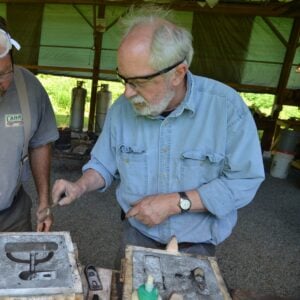
All the while, he maintained his interest in boatbuilding. He favored small, traditionally built craft such as his 12’ Providence River boat, AGASSIZ. He also worked to restore a vintage 26’ powerboat; however, he very much favored the woodworking involved in new construction. He became enthralled with casting custom bronze boat hardware, and he led workshops in the subject for many years, including at The Center for Wooden Boats in Seattle and WoodenBoat School in Brooklin, Maine. He was an inveterate collector of vintage woodworking and boatbuilding tools and also had an impressive library of some 4,000 volumes of American and European boatbuilding and maritime history.
In 2009, his interests and experience fused anew with his appointment—at the age of 65—as executive director of the Columbia River Maritime Museum in Astoria (www.crmm.org). He served in the role until retiring at age 79 in 2023. On his watch, he raised prodigious funds—said to be $40 million for capital improvements and $14 million in endowments—for a wide array of projects, all accomplished without incurring debt. Among those was reworking a derelict former railroad station into what is now the Barbey Maritime Center (see Currents, WB No. 232), which includes a well-equipped woodworking shop named in his honor.
Also on his watch, the exhibits underwent their most thorough overhaul since the museum’s founding in 1963, including a gallery devoted to the native peoples of the region. On the grounds, a pool was built for pond-yacht sailing, a former hardware store across the street was acquired and repurposed as a vast hall for boat and collections storage (including the three boats built at the Oregon Historical Society), and a retired Columbia River Bar pilot boat was installed in an exhibit ashore. The crowning achievement, a new Mariners’ Hall exhibit building of more than 24,000 sq ft, is scheduled to open in fall 2026. He saw the building’s construction under way but didn’t live to see the fulfillment of his vision for its primary exhibit objective: more boats.
-written by Tom Jackson