
The inclined plane is not only an ancient device, but also a powerful and adaptable one. Boatwrights use inclined planes, in the form of wedges, to slowly lift great weights, to plug holes, and to expand and secure the ends of the trunnels that hold their boats together.
The inclined plane is also a screw. We credit the Greek mathematician Archimedes with the first practical use of screws: he used an “Archimedes Screw” to pump water up a slope. And we know Romans cut wooden screws for grape and olive presses. These ancient hand-cut screws were useful and powerful, but because they were custom-made they were not interchangeable.
The advent of the machine lathe and the possibility of making precisely duplicated screws changed the world. Slightly turn a finely threaded machine screw and it advances a tiny distance. This small, predictable adjustment made precise instruments possible; surveyor’s transits and navigation sextants were used to chart the world because the screw was reliable. Likewise, the many variations of the screw have, over the decades and centuries, changed the way wooden boats are fastened.
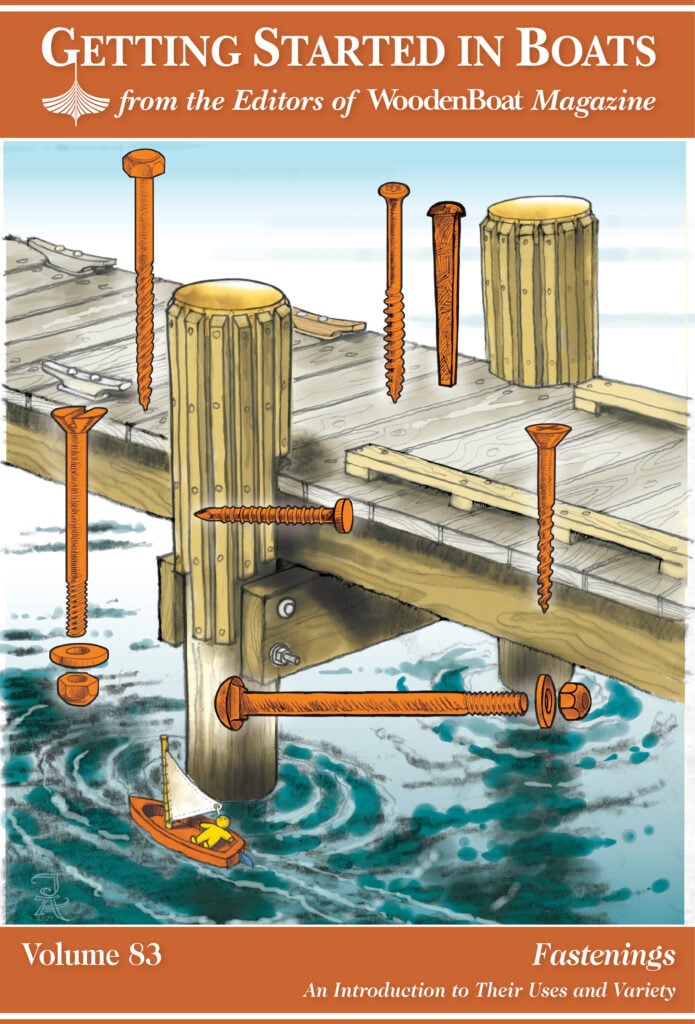
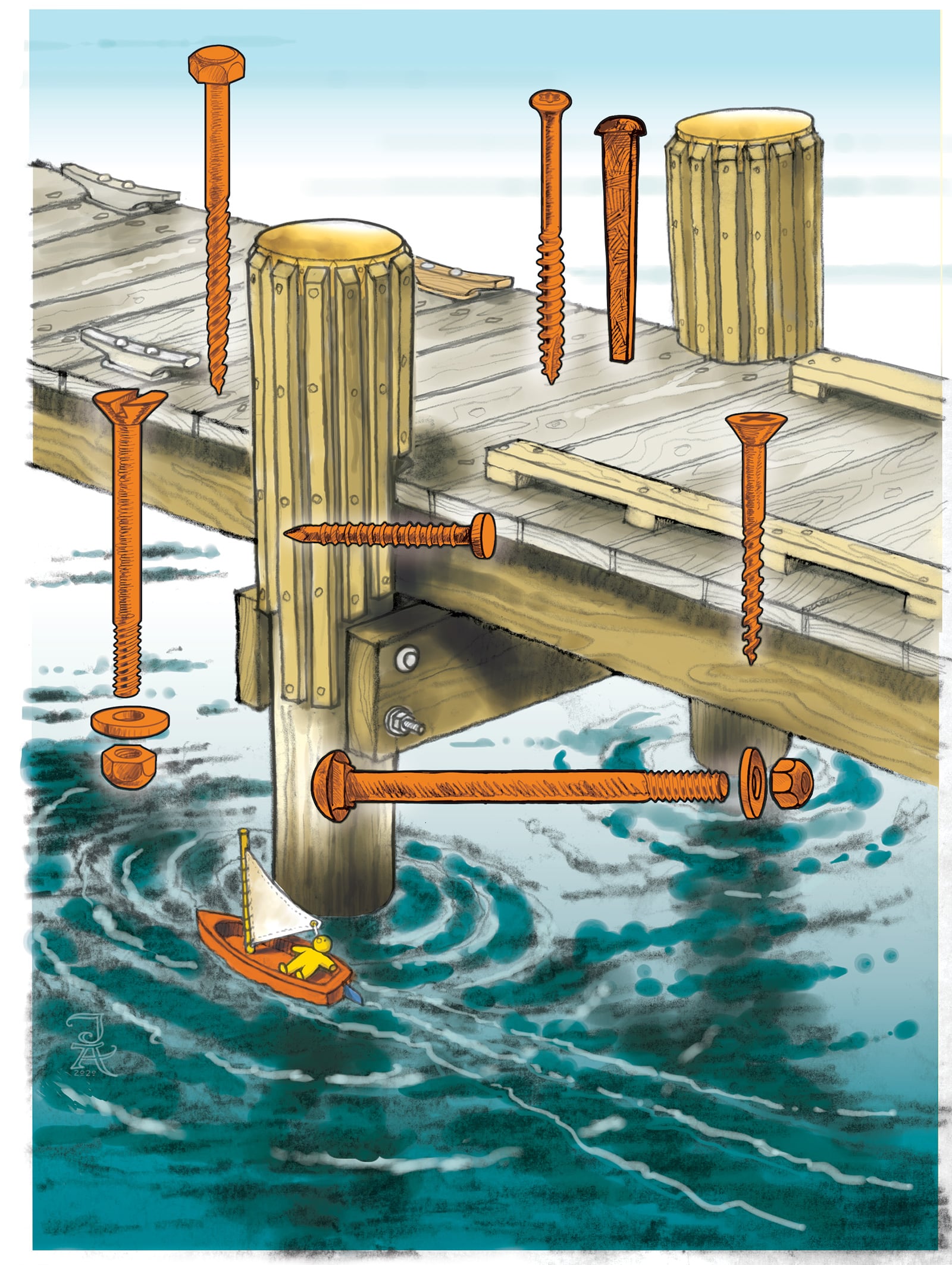
The drawing of a pier on our cover presents a gallery of fastenings. The crossbeams between paired pilings are fastened with robust carriage bolts, washers, and nuts of galvanized steel. They’ll begin to rust in a season or two, lasting marginally longer than ungalvanized steel. The long stringers between pilings are connected with the same nuts and bolts. The plank walkway is attached to the stringers with ring nails or cut nails. In contemporary construction, the planks would be fastened with long, coated “deck screws,” which are not unlike drywall screws. These are in no way stronger or more durable than the nails. The chafe-guard laths around the piling are fastened with ring nails. The dinghy tie rail is probably fastened with hefty stainless-steel screws to resist the tug of the little boats (since those deck screws are thin and brittle). The cleats are lag-screwed through the planks and into the stringers, or they’re bolted directly to the planks. However they’re fastened, care was taken to use the same material: galvanized to galvanized, or stainless to stainless, so that no electrolytic destruction caused by unlike metals was set up in the saltwater environment.