
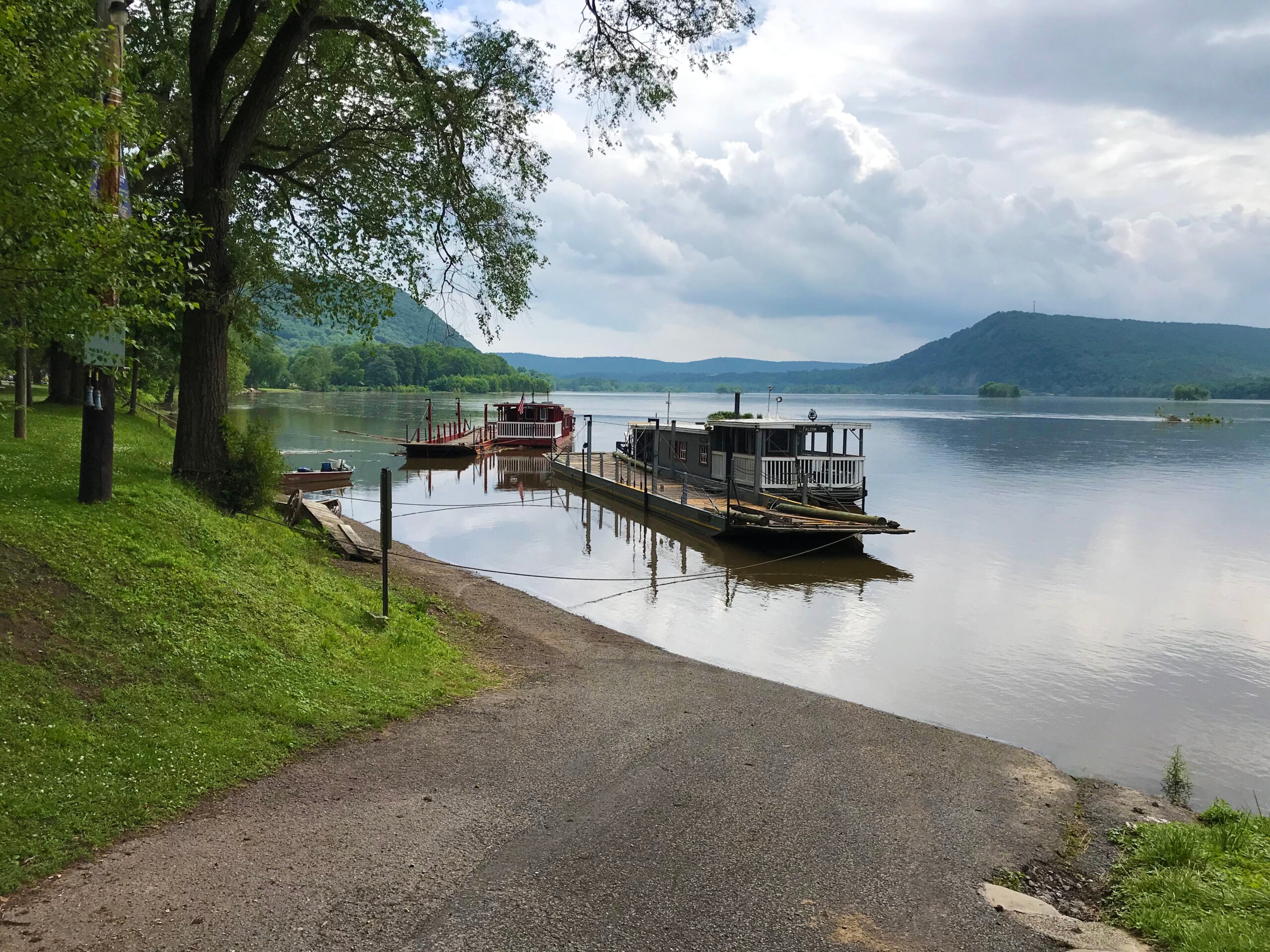
 COURTESY OF MILLERSBURG FERRYBOAT ASSOCIATION
ROARING BULL V, left, and FALCON, right, both built in the 1920s, are the last stern-wheeler ferryboats in the United States; they operate seasonally on a bucolic stretch of the Susquehanna River in Millersburg, Pennsylvania.
Too often, people think about rivers only in casting a glance out the driver’s-side window while crossing a bridge and on the other side wondering casually what river that was. A traveler with time and a taste for getting off the freeways can get a deeper sense of a storied river—Mississippi, Missouri, Columbia, Shenandoah; the list is endless and reads to some like poetry or song.
One way to savor a river is to cross by ferry. Such boats are rare these days, but finding one presents an urge to take it. An unusual example is found on another famous river, the Susquehanna, the longest river on the U.S. East Coast, which rises in New York and passes through Pennsylvania and Maryland on its course to Chesapeake Bay. In Millersburg, Pennsylvania, about 22 miles north of Harrisburg and Interstate 81, the last two wooden-hulled stern-wheeler ferries still operating in the United States continue to make this crossing during summers. They are also the last ferries on the Susquehanna.
 TOM JACKSON
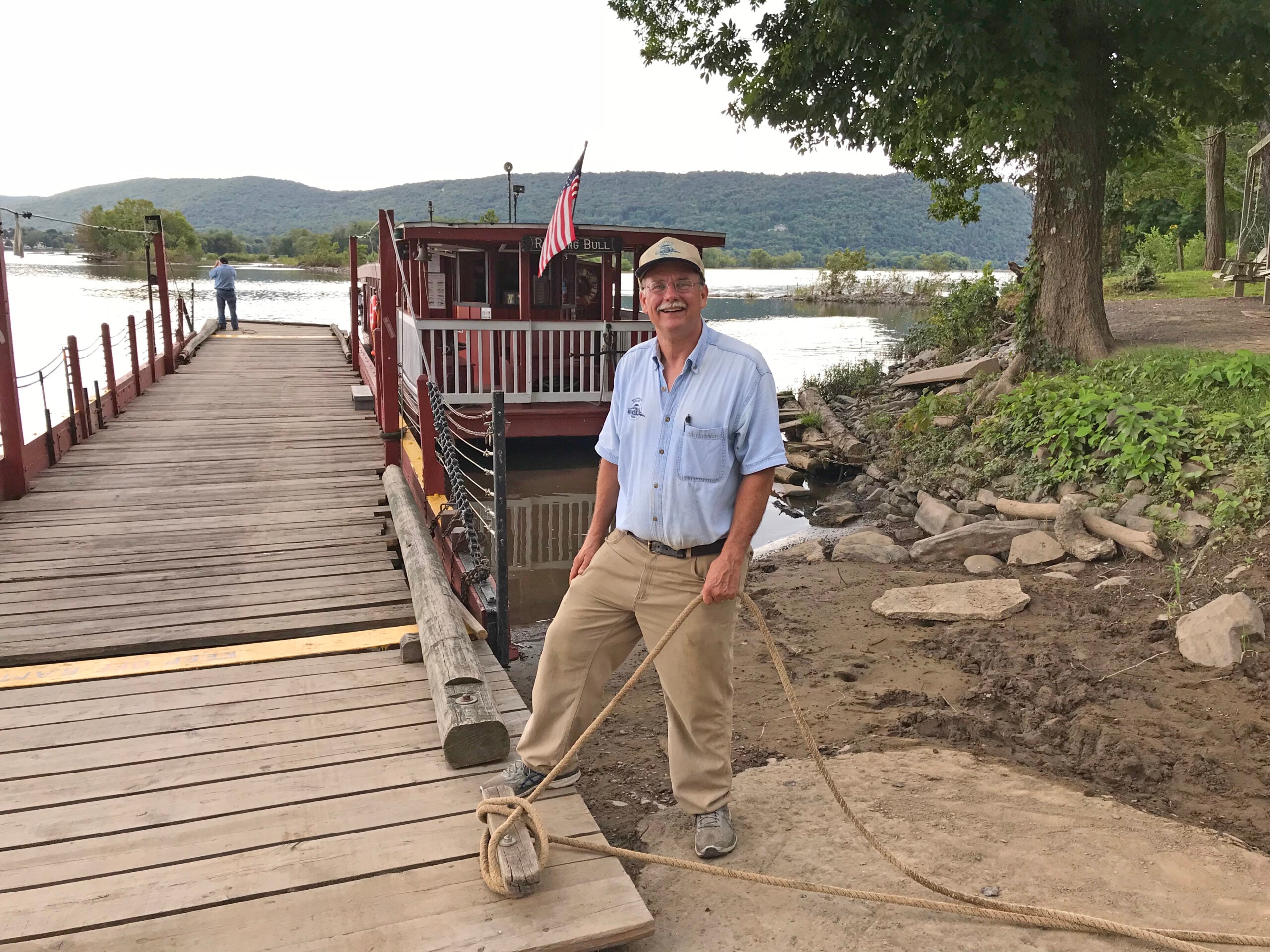
Tom Mallonee is one of five licensed captains for the Millersburg Ferryboat Association and volunteers his time in administrative roles.
Ferries have made the crossing here continually since at least 1817, and possibly much earlier, Tom Mallonee told me during a visit in spring 2026. He holds a U.S. Coast Guard 100-ton master’s license and is one of five licensed captains for the boats, which are certified to carry 55 including crew and passengers. “These particular iterations of the Millersburg ferryboats were built in 1920,” he said. They’ve been rebuilt many times, and annual winter haulouts always involve spring refits to make repairs and freshen them up for the season, which runs from May to early September.
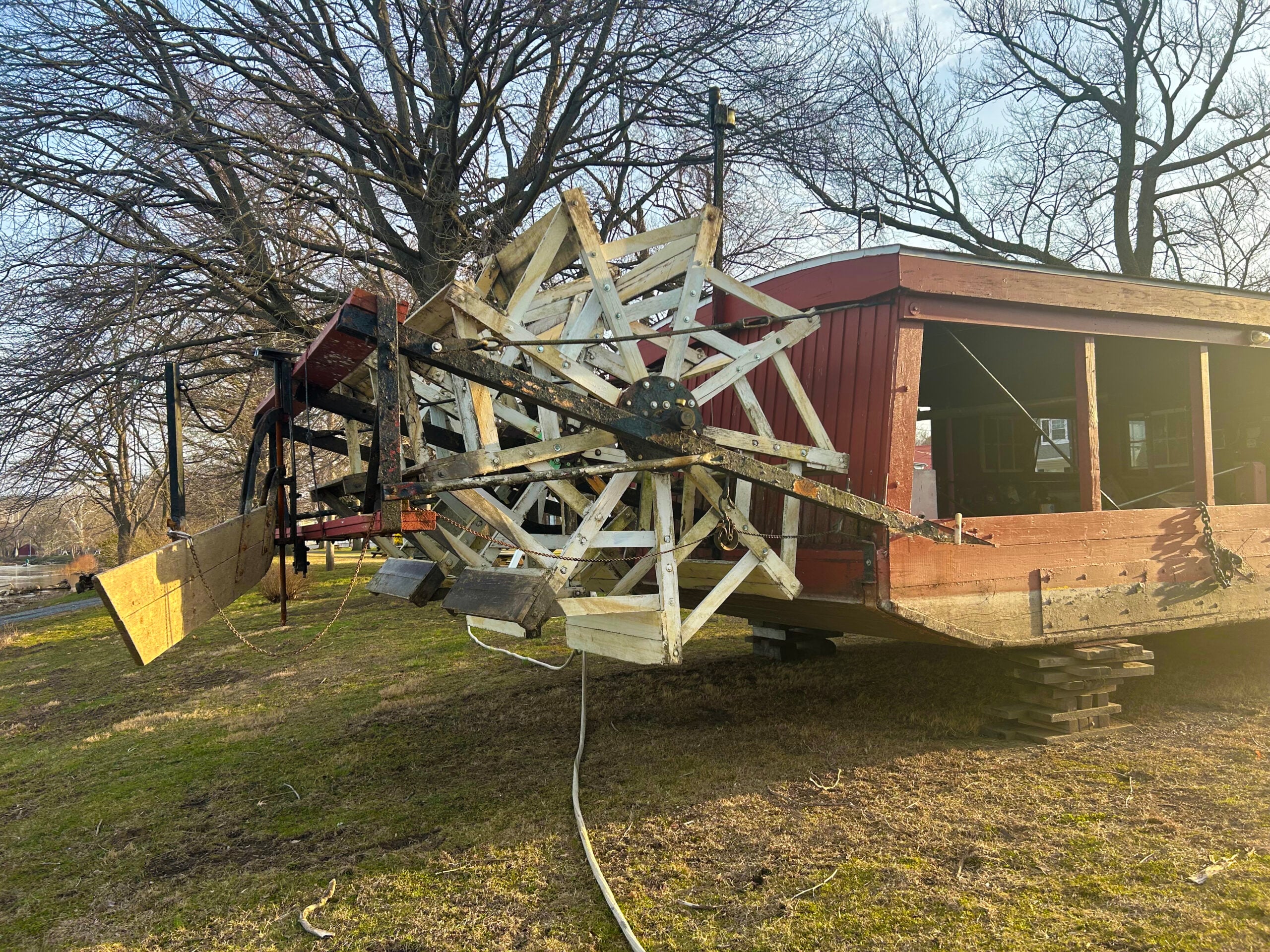
I saw the ferries during their refits ashore on the riverbank in March 2026, and work was well under way for a May relaunching. ROARING BULL V is 83’ long and FALCON III is about 80’, and both are double-paddle stern-wheelers, meaning that the wheel has port and starboard sections that operate in unison from an amidships drive chain. The barge-like hulls draw only about 15”, and the paddlewheels turn well above the level of the bottom. They also have long, horizontal sweep rudders aft of the wheels; the steering chain runs along both sides to connect in the wheelhouse forward to the helm, which is a vertical wheel on ROARING BULL V and a horizontal one in FALCON III. The boats take walk-on deck passengers, some of whom are destined only for a campground on the western shore of the river. Barges chained alongside have loading ramps at both ends and can carry up to four vehicles, perhaps 20 motorcycles, or the occasional horse-drawn wagon. One-way walk-ons are $5, and a car and driver is $10 plus $5 per passenger.
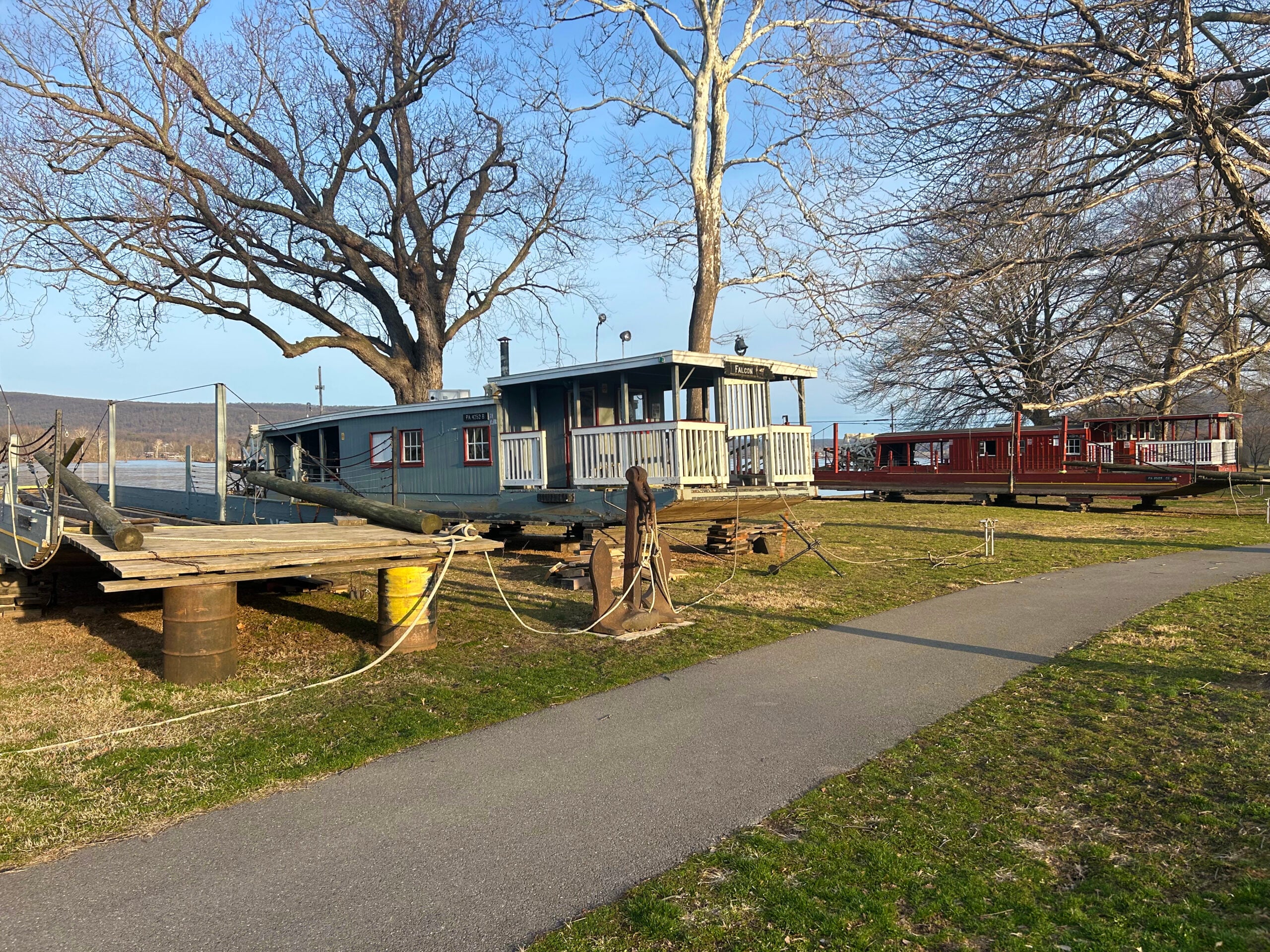 TOM JACKSON
Hauled out on the riverbank each fall, FALCON III, left, and ROARING BULL V, right, and their associated car barges undergo refits each spring before relaunching in May.
“We have extra maintenance this year—more than normal,” Mallonee said. The hulls have vertical sides built-up of heavy Douglas-fir timbers and bottoms cross-planked with 3”-thick white pine. This year, the work has included an experimental replacement of longitudinal timbers in one of the car barges with marine-grade glued-laminate beams instead of Douglas-fir, and if successful the same technique may eventually incorporate such laminates into the stern-wheelers themselves. For ROARING BULL V, this year’s work has also involved replacing some side timbers with Douglas-fir.
The engines are Deutz air-cooled four-cylinder diesels of about 57 hp running hydraulic drive systems.
A crew of two or three paid carpenters typically work five days a week for four to six weeks beginning in March to make necessary repairs and get the boats ready for the season. About 40 volunteers help launch them in the spring and retrieve them in the fall, using planks, 6” well-pipe rollers, and a tractor-trailer.
 TOM JACKSON
The boats have dual stern wheels and long, horizontal sweep rudders.
Mallonee said that the reason the boats survived so long—they were run by a private business until 1990—has to do with bridge construction. “There were hundreds of these along the Susquehanna River between New York and Havre de Grace, Maryland. When the bridges came, the need for the ferryboats diminished.” But the fact that from Millersburg the nearest bridge to the south is 20 miles distant, and to the north 30 miles, meant that for a long time travelers still chose the ferry crossing. “They would run them up until there was slush on the river,” Mallonee said.
After the business closed, Mallonee said, “One of the banks in town bought the boats and gave them to the Millersburg Ferryboat Association,” a nonprofit organization formed to accept them (see www.millersburgferry.org). “These boats got adopted with a lot of love from the community. We couldn’t do this without the community here.”
The boats ran seven days a week during the season up until about 15 years ago. After Covid-19, the runs diminished to two or three days a week. Now, however, with a full complement of five captains, Mallonee anticipates that the boats can run six days a week this year.
People come from all around to help during fall haulouts and spring relaunchings. “It’s a pleasant sight,” Mallonee said. “There’s a young couple that comes from Pittsburgh,” more than 200 miles west, “because they enjoy the camaraderie, and they want to keep the boats going, too. And everybody that comes on the boat when we’re operating always has a smile. Because you’re out in nature. We’ll see eagles. And twice since I’ve been running the boats, we have actually had fish jump onto the boat.”
And you can’t see any of that from the freeway.
Tom Jackson is WoodenBoat’s senior editor.