
 TOM JACKSON
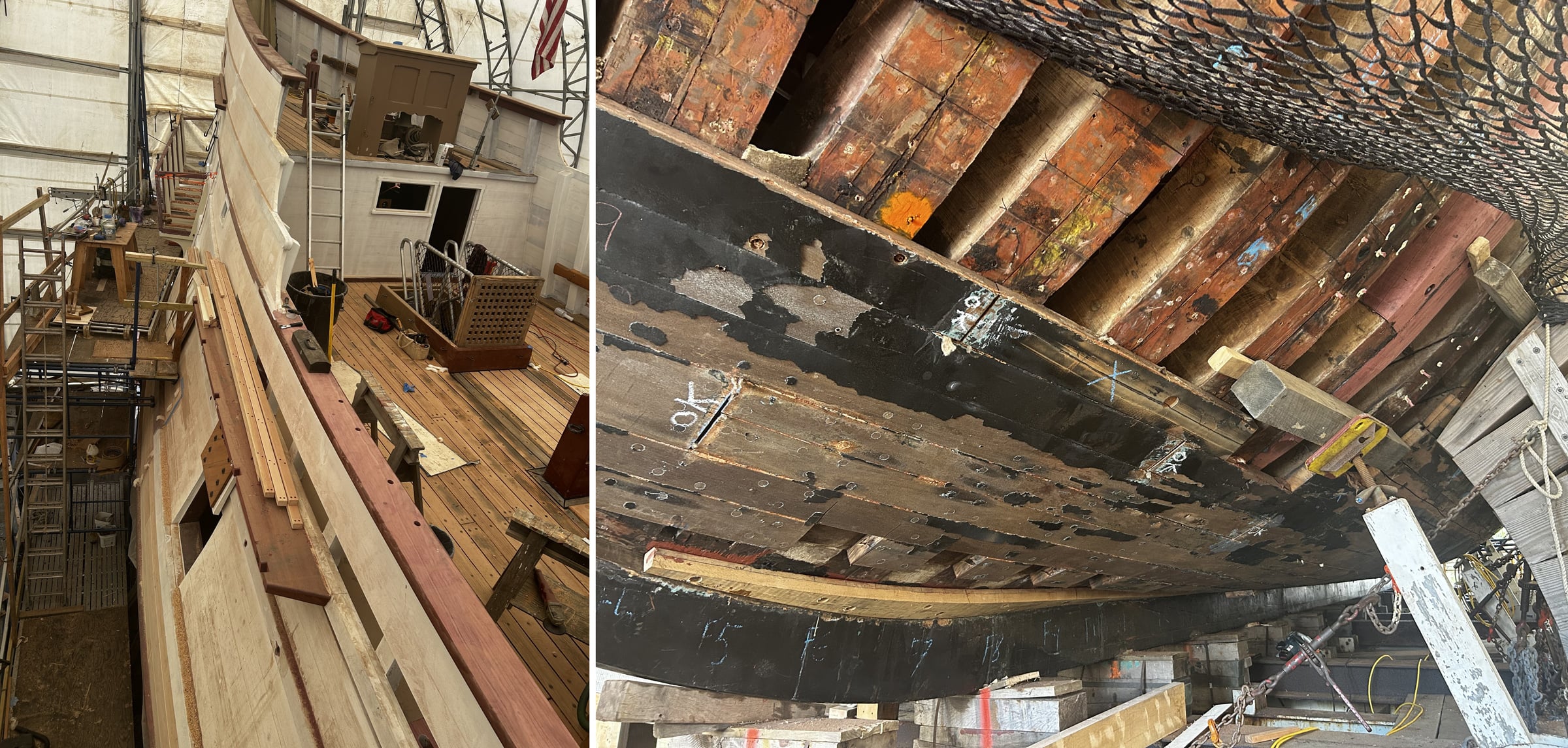
At Mystic Seaport Museum, the extensive refit of SUSAN CONSTANT, a replica of a 17th-century colonial ship belonging to the Jamestown-Yorktown Foundation in Virginia, has expanded from replacing her topside planking (left) to replacing of all her bottom planking (right), using cypress.
—It’s an old truism that when work begins on a hull, expect the project to expand as problems are uncovered. The truism is proved anew with the restoration of the replica 17th-century ship SUSAN CONSTANT at the Henry B. duPont Preservation Shipyard at Mystic Seaport Museum in Connecticut. Eric Speth, director of maritime operations for the Jamestown-Yorktown Foundation in Virginia, said that SUSAN CONSTANT will stay in the shipyard a year longer than anticipated, with relaunching expected in mid-2027. The ship is a star attraction at the Jamestown Settlement (www.jyfmuseums.org), founded in 1957 to honor the first permanent English settlement in the New World and the three ships that brought the settlers there. In her absence, the smaller GODSPEED and DISCOVERY replicas remain in place, together with added interpretive displays about life aboard.
An earlier replica of SUSAN CONSTANT was built in 1957, but by the late 1980s was judged too far gone to repair. This new replica, launched in 1991, was brought to the Mystic Seaport shipyard in June 2024 for a throughgoing refit after more than three decades of service at Jamestown Settlement. The main focus of work was replacing the topside planking, using cypress this time instead of juniper. Deck planking has also been replaced as needed, bulkheads have been rebuilt, and mainmast partners replaced. In late June, the stern gallery reconstruction was nearly complete, with its new structure sheathed with copper flashing. “We were just starting to get ahead of schedule as the winter approached,” Speth said. Then work moved to the bottom planking.
Speth had identified about a dozen bottom planks, of courbaril, that would need to be replaced. “But as we started taking that off,” he said, “it became a much larger project.” Deterioration showed up in many kerfed planks forward and aft. Enough suspicious plank butts and seams were found to trigger an extensive investigation. The problems proved to be widespread. After removing the caulking from every butt, “We created a special tool that could be used to inspect the condition of the butt,” which the shipyard crew promptly nicknamed the “butt scratcher,” which is something like a hooked gimlet used to probe the innermost wood of the butts. The galvanized ship spikes, however, were in perfect condition—thanks to the James River’s mildly brackish water—so iron sickness was not the issue.
Attention also turned to the purpleheart futtocks of the double-sawn frames after one of them proved to be compromised; however, that frame turned out to have contained sapwood when installed (see Wood Technology, WB No. 311). Speth anticipates the possibility of finding more sapwood futtocks to replace, but not the daunting prospect of extensive reframing.
“What we found is work that would need to be done either now or at some point in the very near future,” he said. “So while we’re here, and the vessel is in the tent, and the yard has the capability and time to do it, this is the time to get it done. It works more efficiently for us to just extend the project.” The entire bottom will be replanked using mostly cypress, with some white oak in the bow and stern, where the required bending is severe. Finding suitable wood is as much a part of the project as installing it.
SUSAN CONSTANT is nearly ready to start a second life, and she has already served as long as the original replica. The hot, humid environment of Virginia is a challenge for wooden hulls, plus the fresh James River water, though kind to fastenings, is harsh for wood preservation, Speth said. “By replacing the planking below the waterline, we have a lot of confidence in the condition of the bottom,” he said. “And once that’s done, the entire skin of the vessel will be the same age. So in 30, 35 years, we’ll be back here at Mystic Seaport to do it all over again.”
—Written by Tom Jackson for Currents in WB No. 312, September/October 2026.