
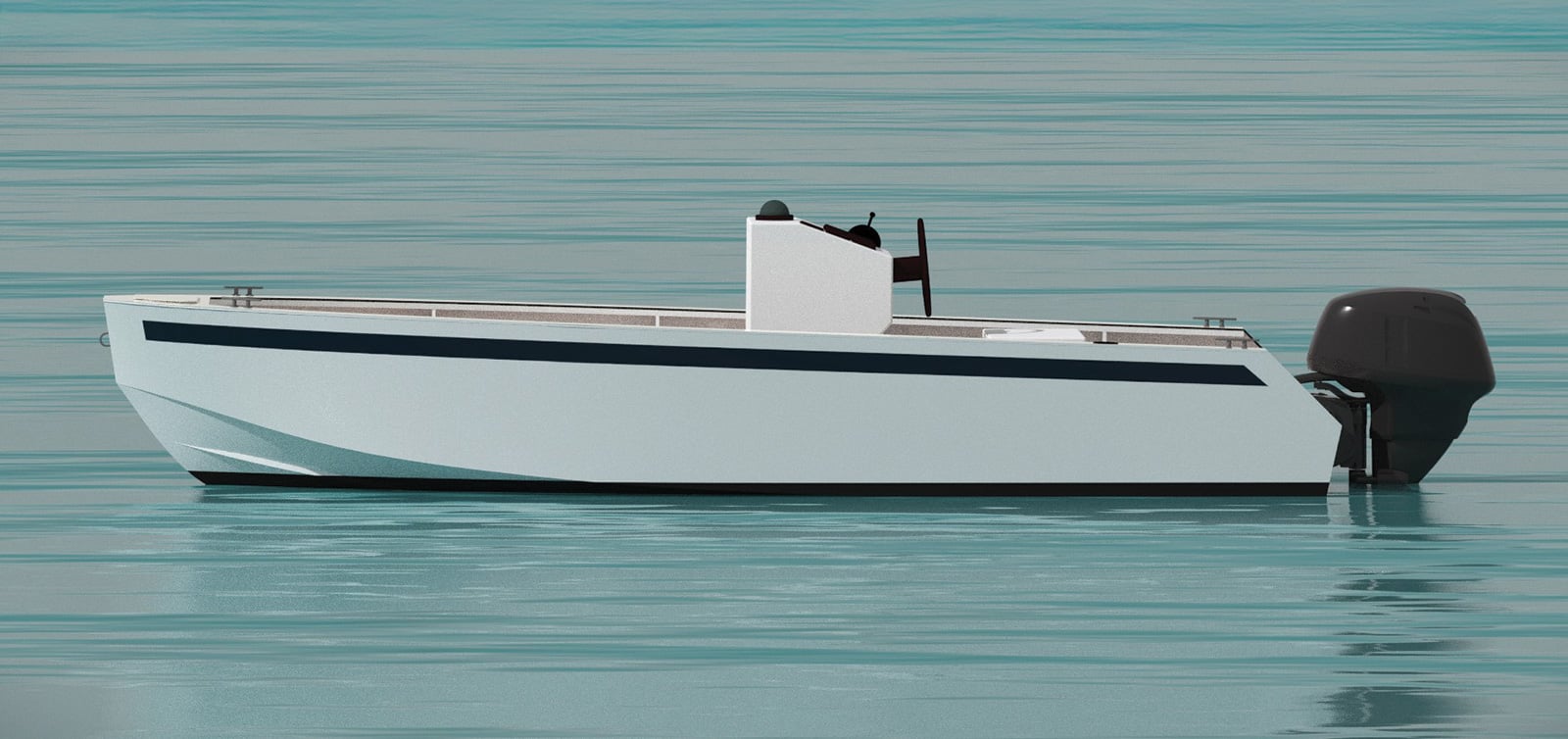
The Crispy 440 is a true utility boat in a 14′ package; it can get under way quickly, is self-bailing, and can deal with modest open-water conditions.
Particulars
- LOA: 14′5″
- Beam: 6′1″
- Design displacement: 1,540 lbs
- Power: 10- to 40-hp outboard motor
- Top speed: 27-29 knots
It is often said that the smallest boats get the most use, and in my experience this is always true. A boat you can step into, cast off a couple of lines, glance at the fuel situation, and go, is the obvious easy-to-use choice. A boat that eliminates rainwater in the bilge adds to this ease of use and lack of worries. And if that boat has some capability to deal with open-water chop, then we have something.
Cristian Pilo’s Crispy 440 (4.40m in length) offers all these things in a straightforward design package aimed at the amateur builder. This would be a particularly good choice for a first construction, because it’s small enough to be attainable with limited space and budget and offers the above-mentioned capabilities. The Crispy is also a boat you could keep on using as your experience grows.
The 440 has two alternative arrangements: one is a center-console option with remote steering and a raised helm seat, and the other is an open version to make use of a tiller-steered motor. I would strongly recommend the remote-steering option for motors at the top end of the horsepower range; the tiller can become quite heavy at high speed. Adding an additional low seat forward of the steering consol would make seating more
versatile and keep weight centered.
With a dead-straight sheer and moderate freeboard, the boat’s character is both modern and capable. Although not intended for open water, the Crispy can manage some weather and chop with three or four people aboard. Fishing, diving, or commuting coastwise would be fine uses, and I can see the open version, which doesn’t have an amidship thwart, as a great camp-cruiser for two, especially with a folding canvas dodger or Bimini top.
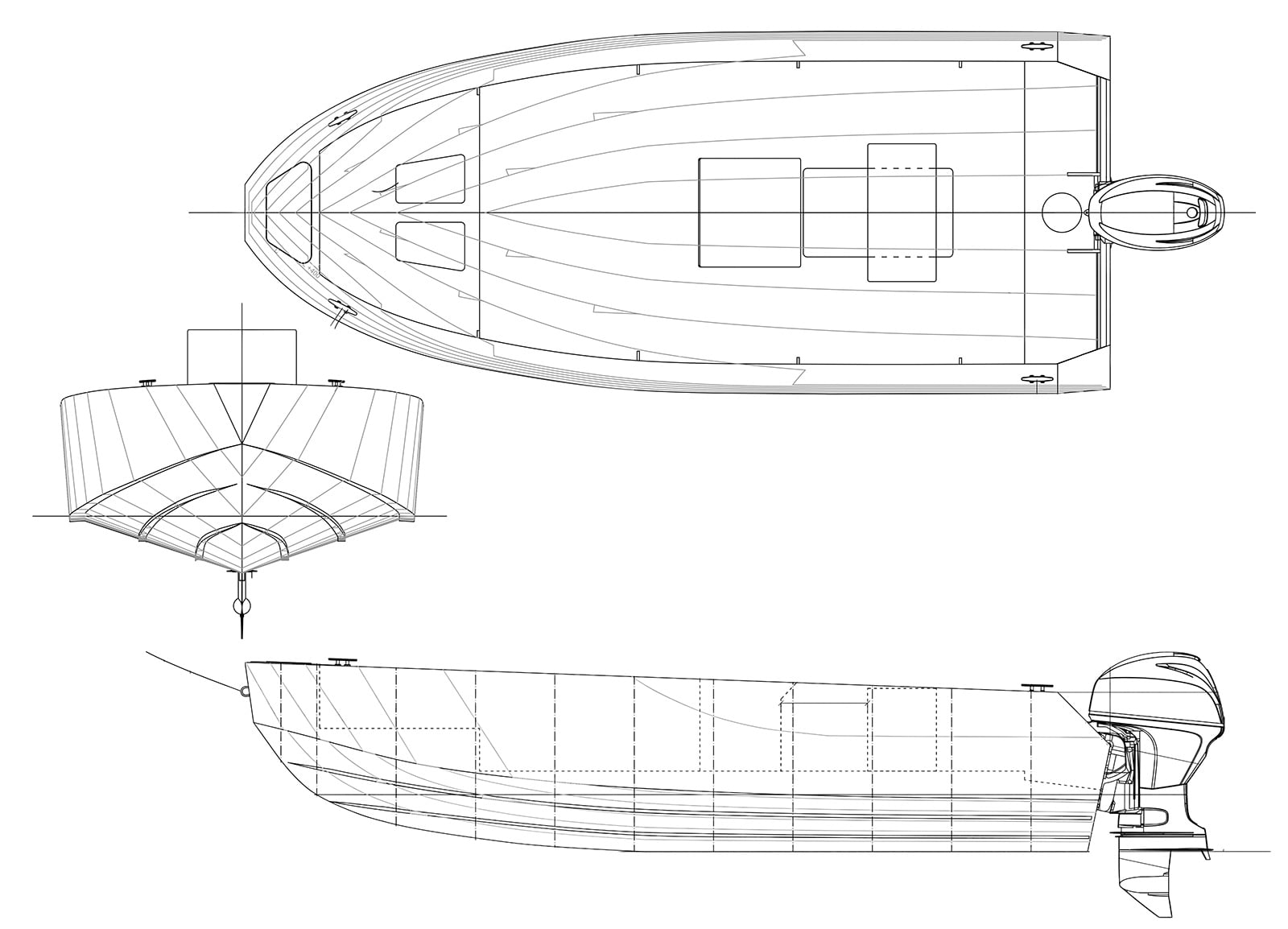
The straight sheer and moderate freeboard indicate a modern and capable character. The bottom sections show high deadrise, and the bottom has narrow chine flats and two lifting strakes on each side.
I really like the tiny bow transom on this boat. It adds that snubbed modern look that is popular today, and there are some practical benefits. Within the given overall length, having the bow transom increases interior volume over a pointed-stem boat with finer deck lines. And having that extra volume up at the sheer means the bow lifts over waves rather than plunging through them.
The bottom sections have high deadrise throughout, culminating in 17 degrees at the transom. This is popularly a “deep-V” hull, which usually includes anything from 17 to 22 (or more) degrees of deadrise at the transom. The bottom has narrow horizontal chine flats and two narrow lifting strakes on each side of the sharp centerline. Modern design seems to seesaw back and forth between straight high-deadrise (as this is), and modified hulls with low-deadrise surfaces to aid early planing. I see a lot of centerline pads and really wide chine flats from designers willing to put up with a harder riding boat that runs faster in flat water. On the other hand, the Crispy’s high-deadrise hull will be softer riding but will require more power for the same speed.
At rest and loaded with fuel and three people, the Crispy’s chine flats are right at the waterline. This is a good compromise, because it provides the largest waterplane possible at rest, thus maximum stability, and wetted surface will be quickly reduced as the hull lifts under way.
The designer’s data gives a bare hull weight of 660 lbs; with the engine and controls, it reaches 880 lbs.
The design displacement of 1,540 lbs accounts for 16 gallons of fuel and three people aboard. I can see a great deal of variation possible here. My temptation would be to build with a careful eye on excess weight by choosing lightweight wood species and being sparing with the epoxy and fiberglass. Then look seriously at smaller motors; a 9.9- or 20-hp outboard could bring a light version of this boat up on plane with one person aboard.
Many builders want a boat capable of maximum power and speed. Under Transport Canada regulations, this boat would be allowed a maximum of 44 hp if tiller steered and 85 hp for the center-console version. This is based on hull length, beam, and deadrise. Built as designed and with full fuel plus three people aboard, the Crispy should manage a top speed of 27–29 knots with a 40-hp motor. A heavily built version with 85 hp might approach 30 knots.
Unfortunately, the operational envelope of this boat does not yet fit with reasonably priced electric outboards. Electric outboards in the 10- to 40-hp range are available but are prohibitively expensive for the average user. This will change, and possibly soon.
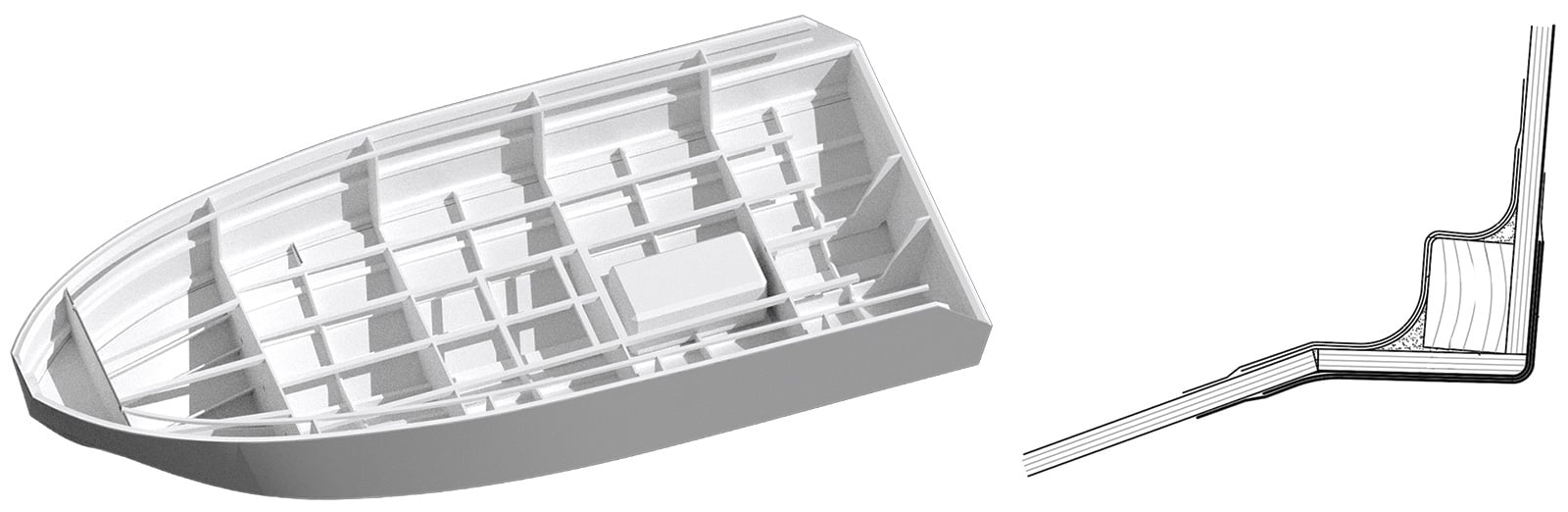
Left—A framework of longitudinal solid-wood stringers placed over widely spaced plywood bulkheads supports the thin plywood hull skin, and everything is glued with epoxy. Right—The chine flats are supported by a combination of the chine logs, bulkheads, fillets, and fiberglass tape.
While the Crispy is a plywood boat, construction is not stitch-and-glue in the usual sense. Pilo lays out a construction system using longitudinal solid-timber stringers over widely spaced plywood bulkheads, all bonded together using epoxy. Exterior joints are bonded with fiberglass tape set in epoxy, and the entire exterior should be sheathed in light fiberglass for the best lifespan.
The benefit of these stringers, which are 1¼″ square, is that the plywood planking can be thinner than what would typically be required for stitch-and-glue construction. In this case, the framing provides structural support, and the plywood planking skin keeps the water out. This is a bit more complex to build, but overall it’s a lighter structure of equal strength. The hull bottom, topsides, deck, and cockpit sole require nine 4′×8′ sheets of 8mm plywood. In North America, you will find 6mm or 9mm, so the builder must decide if they want a light boat for a small motor, or a slightly heavier boat able to handle more power and higher speed at sea. Pilo also specifies two sheets of 4mm plywood laminated to form the twisted forward topsides.
The bulkheads and transom require five sheets of ½″ (12mm) plywood, and you can add two more sheets of ½″ for the center console and seat. That plywood, 10 gallons of epoxy, a roll or two of 6- to 12-oz fiberglass cloth, and about 100 bd ft of clear lumber will make up the basics of a material list for the Crispy 440.
The transom on this boat is low, but the high deadrise means it requires a 20″ long-shaft motor. There is only a shallow splash well with no upper bulkhead between the ocean and the boat’s interior. In this case, I am fine with the open transom, because the cockpit sole is sealed and well above the at-rest waterline. This means any water that does find it’s way aboard can run off downhill.
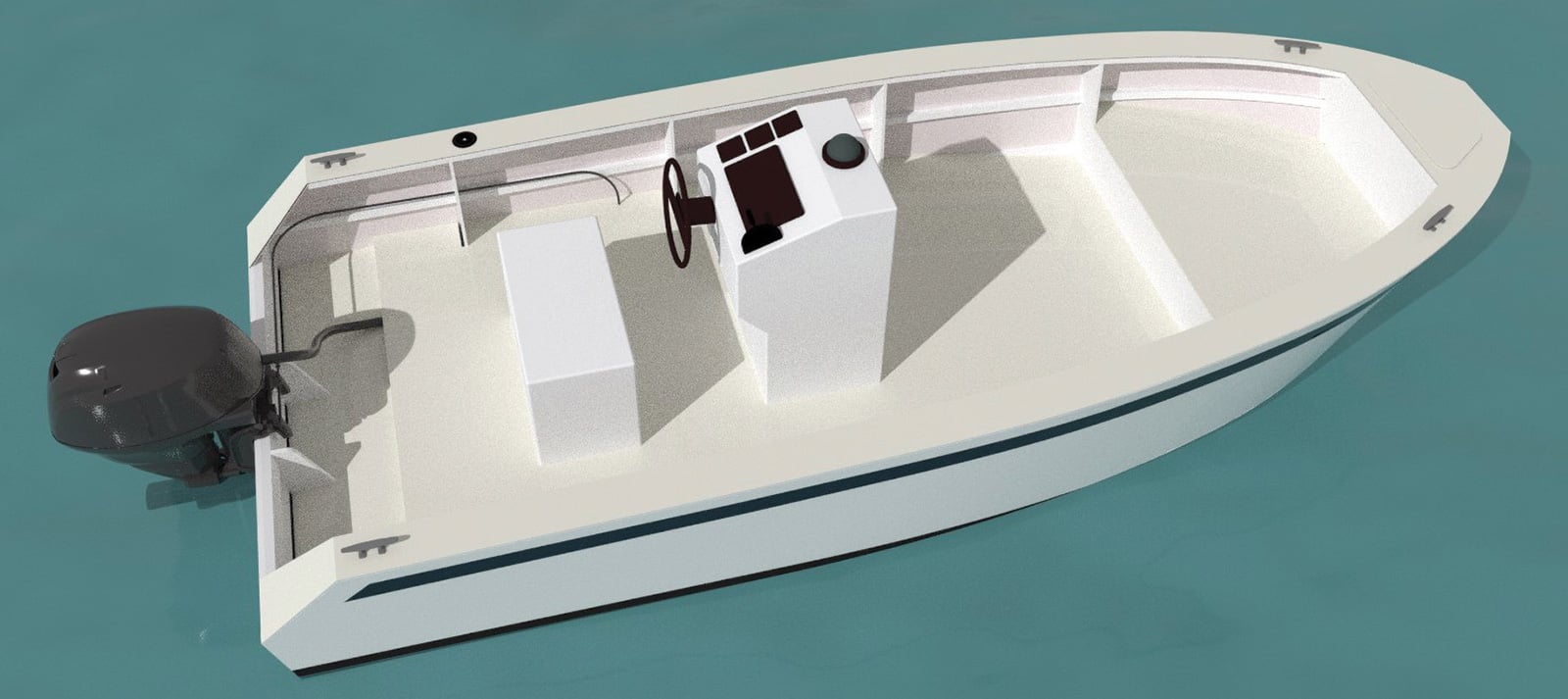
The center console and seat are low; the boat is too small for a stand-up configuration. The one-level watertight cockpit sole provides excellent self-bailing.
A high watertight sole is an important safety feature in this design; its downside is a comparatively high center of gravity, accounting for the weight of the structure and crew. This is somewhat mitigated with a built-in, under-sole 16-gallon fuel tank. In further efforts to get weight low in the boat, it would be tempting to arrange a below-sole watertight battery box aft, close to the motor. A good anchor locker forward would be another key safety feature.
The designer has made a wise choice to keep the center console and seat low in this boat; the hull is just too small to handle a tall stand-up console. And the simplicity of a one-level watertight cockpit sole is excellent. While the console is attractive for some uses, I would still favor the more versatile open version and a motor on the small end of the range. With a moderate investment and winter’s worth of weekends in construction time, the Crispy 440 could take you on some wonderful alongshore voyages. 
Tad Roberts is WoodenBoat’s boat design editor.
To order plans for the Crispy 440, please visit www.nautikit.com/barche-a-motore/crispy-440-open.html.