
 Ben Parson
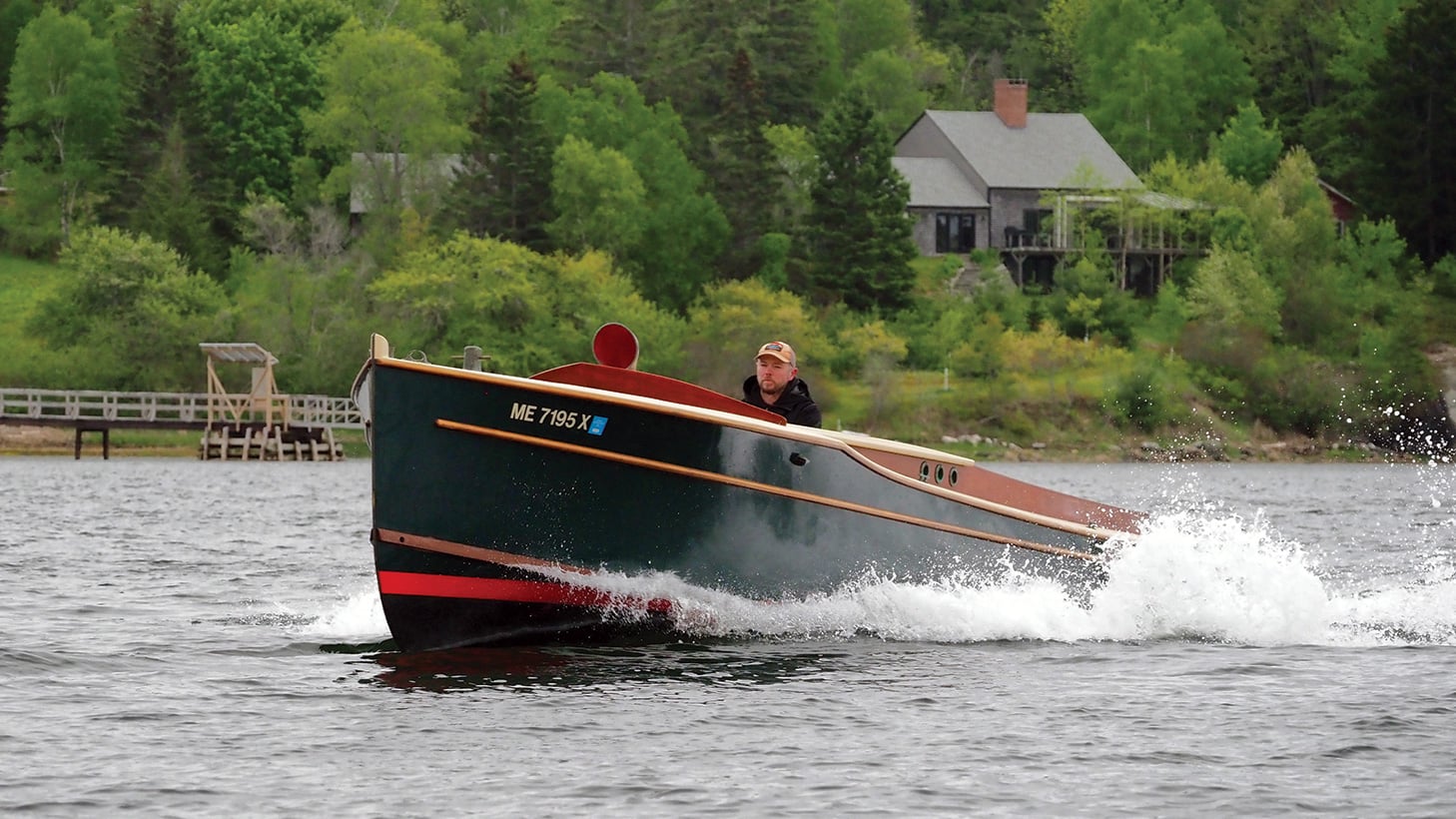
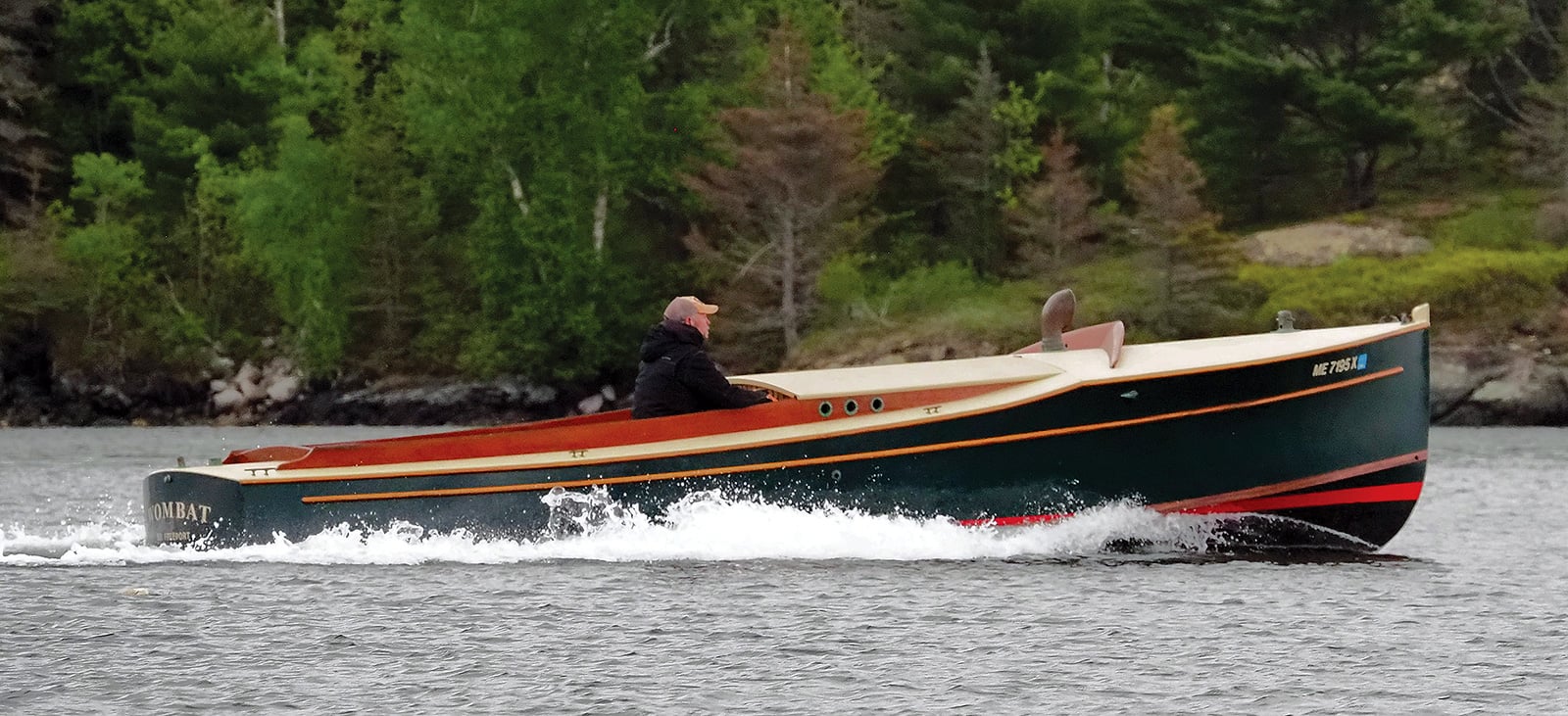
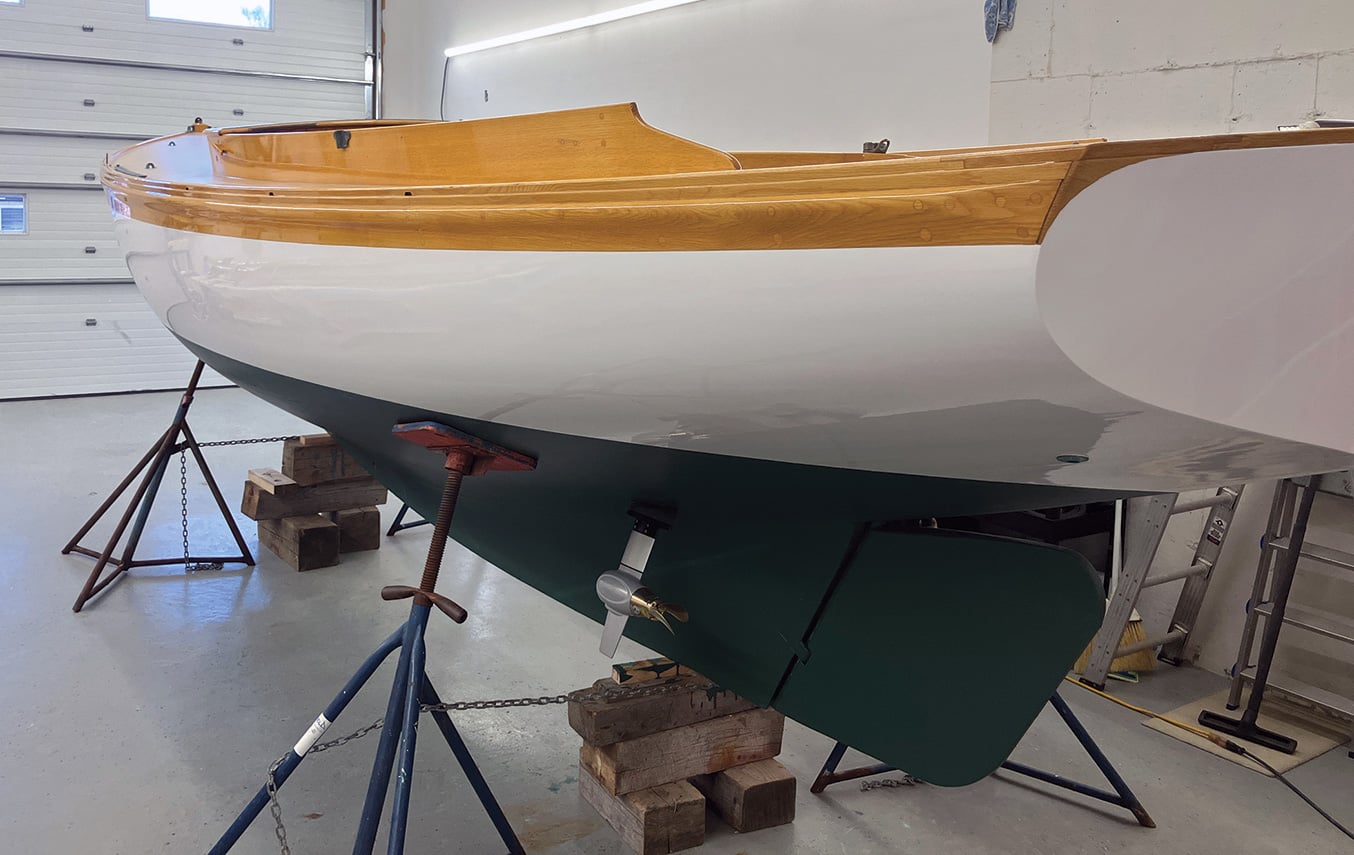
Classic boat designs—both power and sail—often make ideal candidates for electric repowering. WOMBAT is a cold-molded version of William Hand’s Piute III that was recently repowered with a 40kW ePropulsion electric motor powered by two 23kWh batteries. Her refurbishing included the addition of spray rails.
In our shop, we’ve been lucky that our customers usually approach us with aspirations for electric power, with no hard sell needed. Most don’t have electric cars, and although green-energy ideas do inspire some, for many the attraction of electric power in a boat is about the experience, not the carbon credits.
Many wooden boat owners are drawn to the sensory experience of being afloat. The appeal might lie in the honey glow of a varnished coaming, the soft roughness of a bare wood sole, or the splash of water against a lapstrake hull. A quiet electric motor complements the subtleties that many of us appreciate about wooden boats.
While sleek, futuristic speedsters or complicated foiling runabouts might grab the headlines, I’d bet most people’s first electric boat will be one they already own. Over the past several years, the shop I work for, Hylan & Brown Boatbuilders in Brooklin, Maine, has completed a number of electric repowers of conventionally powered boats. We’ve learned through these projects that, while not every boat or scenario is right for electric power, the applications are wider than many people realize. We’ve also learned that many wooden boat owners have no qualms about installing a brand-new electric propulsion system in a century-old boat. Updating an old classic with today’s technology isn’t anachronistic; it’s an investment that can help ensure a boat’s survival—a commitment to the value of the journey, not the destination.
This is not a how-to article. Rather, it’s an examination of “how we do it.” Bolting an electric outboard with a built-in battery to the transom of a dinghy is well within the capabilities of most boatowners, but putting together a bigger system can be a substantial project, and the installation is only part of it. Project evaluation and planning are critical steps, and not all yards have the experience, or the willingness, to guide an owner through this process. For owners or installers trying to learn about electric propulsion, the internet can be a minefield, filled with boastful performance claims and computer renderings of products that might never reach production. We try something new on almost every project and always manage to learn something, which is both gratifying and humbling. On the following pages, I hope to demystify electric boats, and provide enough background to guide owners in evaluating their own boat’s potential for electrification.
Project Evaluation
 Ben Parson
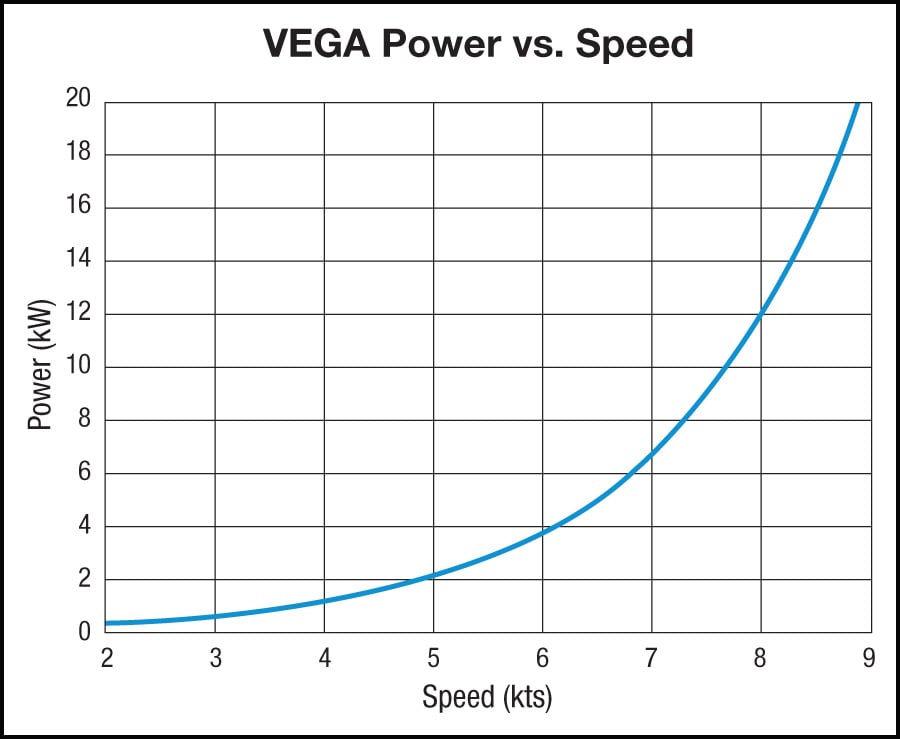
Very little power is required to move an efficiently shaped hull through the water. VEGA, a 1930s launch, can make almost 5 knots with only 2kW of power.
Every electric-conversion project we conduct starts with an informal customer interview. Our goal is to learn about the boat, its current use, how it might be used in the future, and what ideas, if any, the owner already has about electric propulsion. Some owners are starting from scratch and want to know what’s possible. Others have been reading online and come equipped with enthusiasm—but in some cases unfortunate misconceptions. Marketing claims abound, and most of us have forgotten enough of our high-school physics to make fact-checking those claims a head-scratching affair (see Volts, Amps, Watts, and “-hours” at the end of this article).
Our discussion typically starts with the boat, and the project hinges on three factors: speed, range, and charging scenario.
Speed
Currently, electric propulsion is not a good fit for every use. Though costs are coming down, electric motors, batteries, and supporting equipment are still generally more expensive than their internal-combustion counterparts. Electric-propulsion systems are also often less capable than similarly priced internal-combustion systems. What makes these electric-conversion projects work, though, is the fact that many gas- and diesel-powered boats markedly exceed our clients’ typical needs.
Most people who find our shop aren’t trying to go fast. Many of our early electric adopters, in fact, are sailors or former sailors who are perfectly happy with 5–7 knots if they don’t have to listen to a diesel. Most local sailors who have small auxiliaries don’t come close to taking full advantage of them. The engines are too unpleasant to listen to at full throttle, and even a small fuel tank is enough for an entire season’s use. If they convert to an electric motor, matching the old system’s capabilities isn’t necessary. They can get by, and have been getting by, with less.
 Ben Parson
TOODLIN’ is a planing runabout; her large battery bank occupies the space that would otherwise be taken by machinery and fuel.
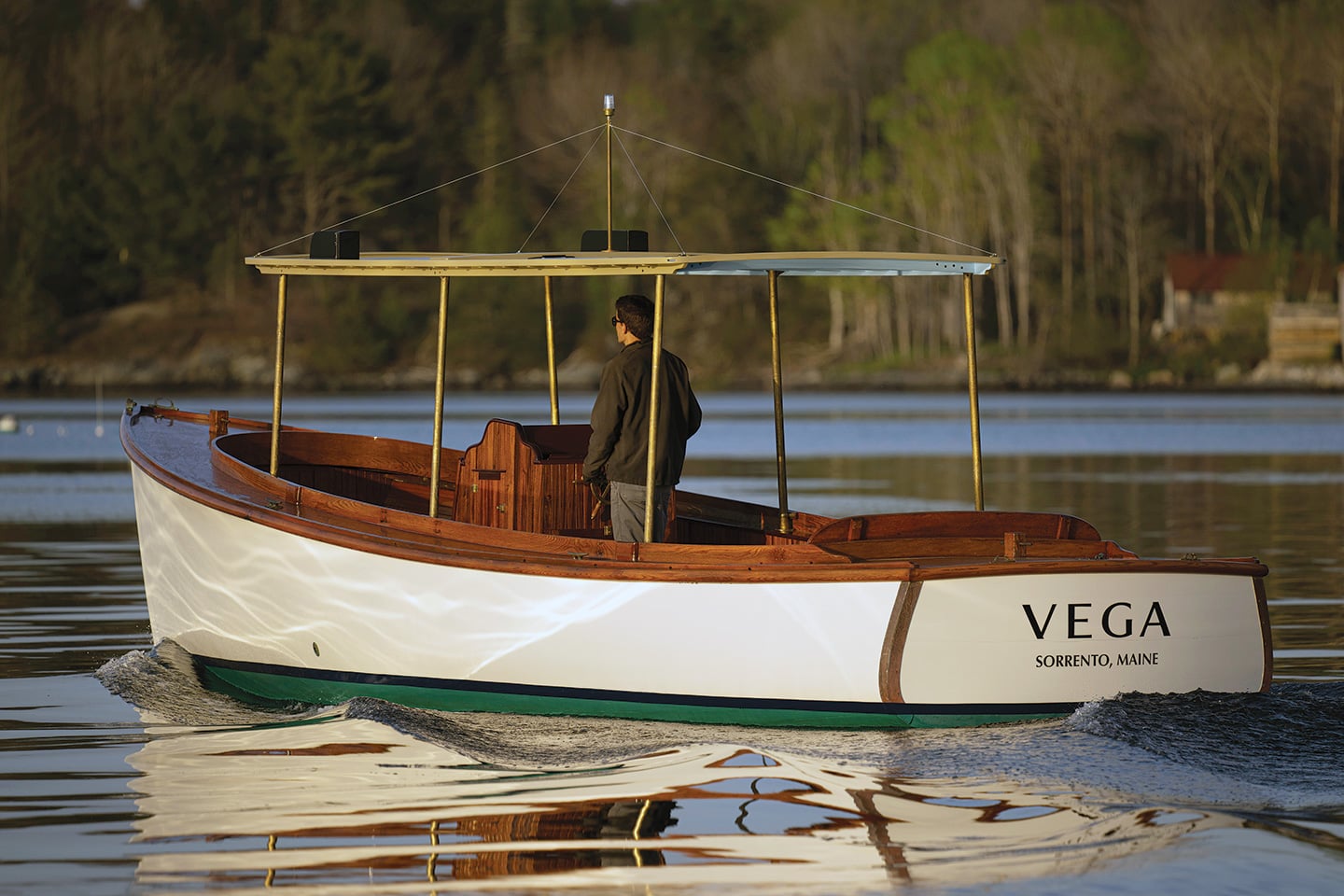
The tradeoffs for powerboaters converting to electric motors are a little more obvious. Most of us are familiar with the idea of hull speed—the speed at which a vessel’s bow-wave length matches its waterline. Going faster than hull speed is enormously costly in terms of energy use, no matter the energy source. Accepting a reasonable top speed for an electric repower can save a lot of money: smaller motor, smaller wires, fewer batteries, and easier installation. You might be surprised at how little power it takes to move an efficiently shaped hull at displacement speeds. VEGA, a 1930s Cranberry Island launch that we converted to electric power, can do almost 5 knots with only 2kW of power—that’s two-thirds of her hull speed for only 1⁄10 of her maximum power. Old displacement-speed launches are often good candidates for electric motors, but many modern powerboat designs are built for planing speeds and are not particularly efficient when run slower.
 Ben Parson
WOMBAT’s narrow, efficient hull hit a top speed of 17 knots on sea trials.
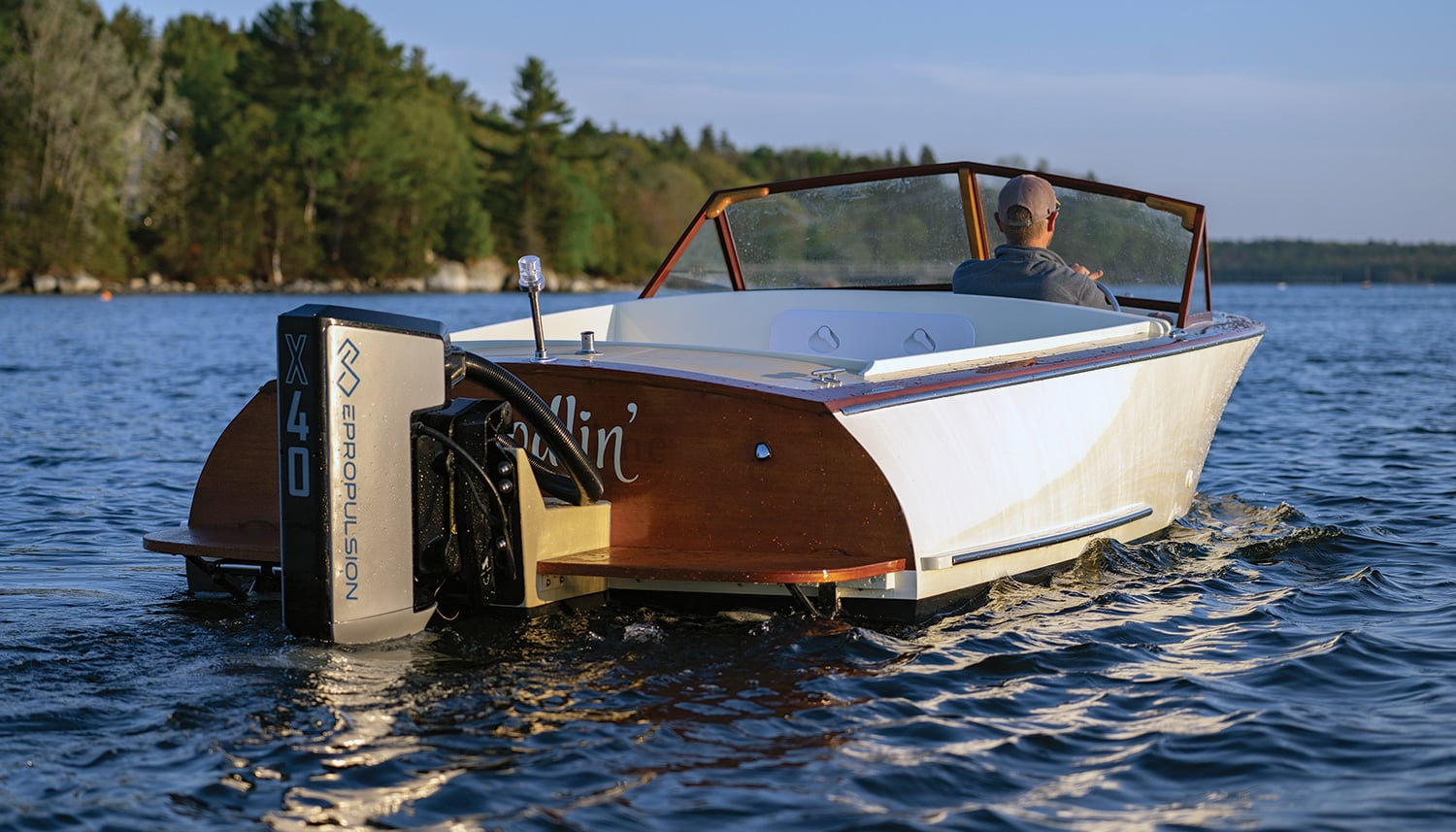
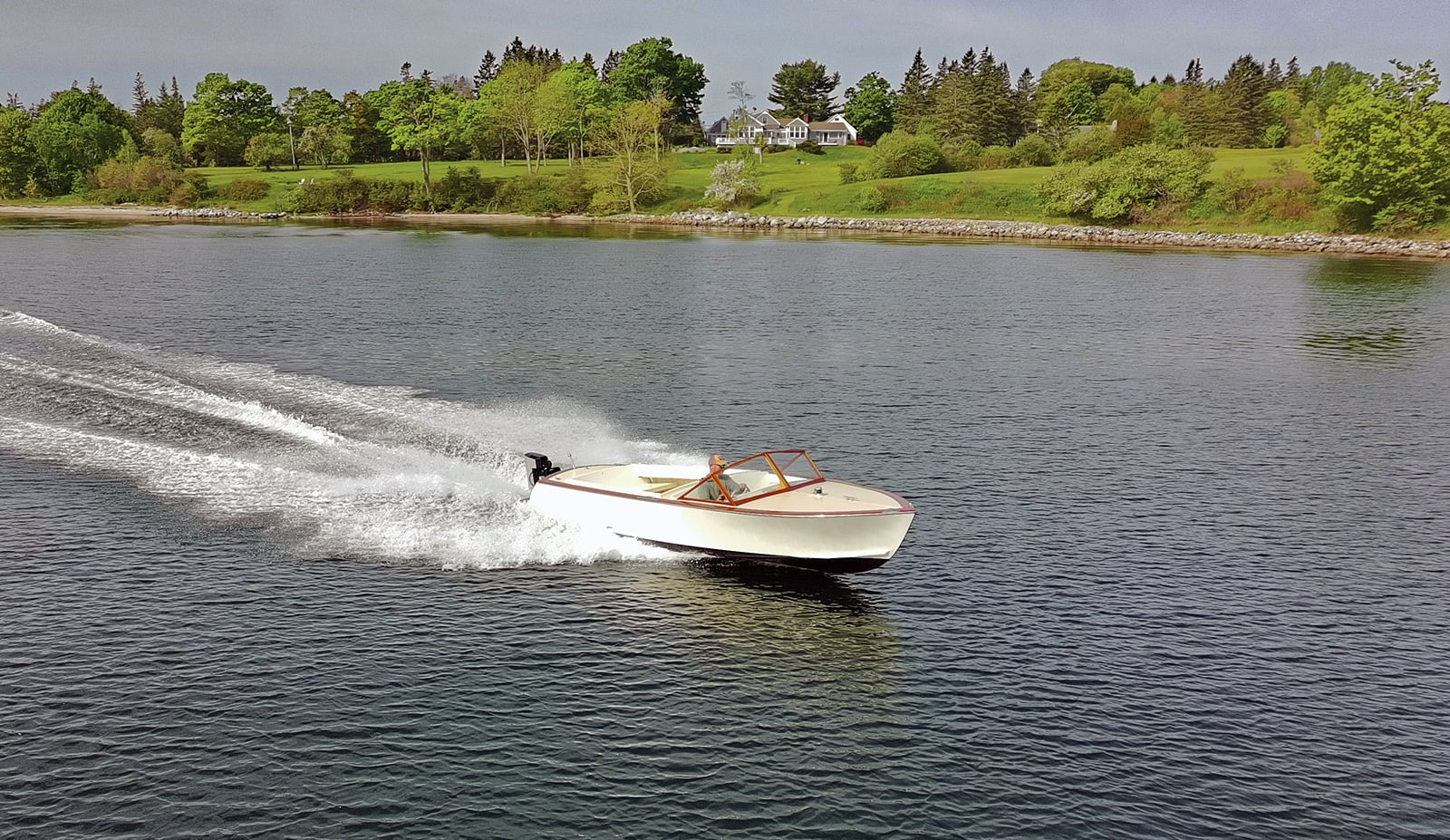
We have some experience with electric conversions above hull speed, and though we’re proud of the results, the experience has reinforced our preference for lower-power systems. This past winter, we repowered two boats whose owners requested performance well above hull speed. Predicting performance in the realm of semi-displacement or planing hulls can be tricky, but a careful look at the shape of the hull can provide a good hint as to whether a boat will plane easily or not. Both boats have modified-V hulls with fairly flat sections aft; flat or downward-trending buttock lines are another useful trait, not ideal for low-speed efficiency but necessary to do more than simply squat with the application of more power. Of the two boats, TOODLIN’, a 19′ Glen-L runabout, is both lighter and beamier, so we predicted close to 25 knots for her, but only 14 knots for WOMBAT, a narrow 25′ Piute III. Our speed predictions for these boats ended up being slightly conservative, but not so much that we’d consider the boats over-powered. Big power requires big batteries, though—each one weighs 400 lbs and is almost 5′ long, and both boats have two.
Range
Once we’ve negotiated a reasonable top speed, range is the next hurdle. The energy density—meaning the amount of energy available per pound of fuel weight—of gasoline or diesel is significantly higher than that of a lithium battery, and the battery bank is often the most expensive part of the system (see related article in this issue From Lead to Lithium Batteries). Because of these physics and economics, dialing in range requirements is important to avoid eye-popping estimates or a very heavy boat. Range discussions can also be clouded with charged emotions, for several reasons. The first is the often-exaggerated, but nonetheless real, phenomenon of range anxiety.
Even though many trips are just an hour or two, most new electric-boat owners are understandably nervous about battery capacity. In good conditions, running out of power might mean just a sheepish call to a friend for help, and missing the start of cocktail hour. But if there’s weather on the horizon, or you’re being pushed by the wind and waves onto a lee shore, a “low voltage” warning on your multi-function display takes on a more ominous tone. The preventive measure for this range anxiety is not complicated: it’s good planning and careful attention.
 Ben Parson
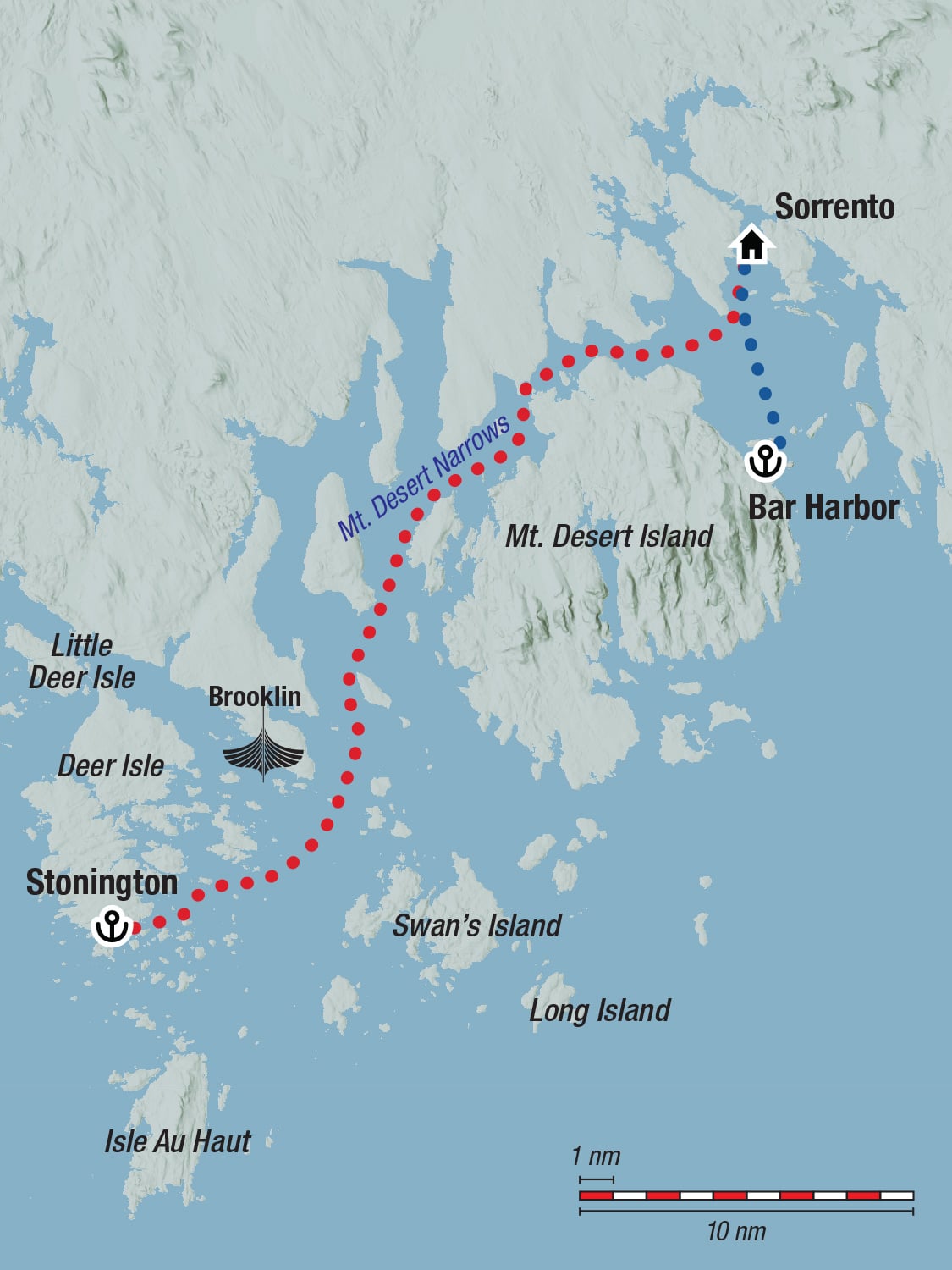
The blue course line shows the usual trip for the launch VEGA, a 15-mile round trip from Sorrento, Maine, to Bar Harbor. She’ll occasionally make a 60-mile round trip to Stonington, which she can handle at 5 knots without charging—or at 7 knots with an overnight charge in Stonington.
Unlike with gas or diesel engines, there’s no need to dip the tank and struggle to recall your fuel burn at 2,800 rpm. All electric-propulsion systems should have an easy-to-understand range- or time-remaining readout, updated in real time. Here, the speed-versus-power curve (VEGA Power vs. Speed graph above) that might have seemed limiting can function as a magical range extender. Are there only 5 miles of range left, but you’re still 10 miles from your mooring? You can go farther if you go slower, so decrease speed until the numbers match, and then slow down a bit more to be safe. You might be late for dinner, but at least you’ll get home. Replenishing battery power is not as easy as adding fuel from a jerry can; running out of electric power is usually a situation for a tow, unless you have a genset aboard.
Beyond range anxiety, we also encounter the common divergence between fantasy and reality. Here, fantasy is how we think we use our boats, or the voyages we might make “someday.” Reality, often, is a little closer to home. The constraints of modern summer schedules mean that short trips out to the local sandbar for a picnic are much more common than two-week cruises down the coast. We help prospective electric boaters break their projected use down into “typical” trips and “outlier” trips. The outlier trip isn’t meant to be a pie-in-the-sky dream, but more of a “stretch” goal: a trip that may require a little planning, and some concessions, to make it work. This might include recharging along the way or simply taking some extra time and slowing down. VEGA is a useful illustration of why we separate typical trips from outlier trips when we talk about range. Her typical run on the coast of Maine is from Sorrento to Bar Harbor and back—about a 15-mile round trip—while her outlier is an overnight round-trip of about 60-miles to Stonington. Planning the project as if that trip were the norm would have driven battery size (and cost and weight) much higher than necessary. In practice, VEGA’s 30kWh battery bank covers the typical trip at close to full speed, while the Stonington trip can either be done at about 7 knots with an overnight charge, or at 5 knots with no charge needed until she’s back home.
Charging
Next to speed and range, charging is the biggest factor in determining whether electric power will be satisfying in real use. In practice, charging is not about achieving the fastest possible refill, but about matching recovery time to actual patterns of use. Most boats spend far more time sitting idle than under way, and electric systems can take advantage of that. If a boat can be brought to a useful state of charge during the time it would otherwise be sitting unused, then charging speed stops being a limitation and becomes just another planning parameter.
Broadly speaking, most repower candidates fall into one of three charging contexts. First, boats kept on docks with shore power available can typically recharge quickly (though for most smaller systems, not at DC fast-charging speeds). Second, boats kept on moorings usually recharge slowly, whether by solar panels or by occasional access to shore power, and count on either infrequent use or frequent but less-depleting use (typical trips that are only shallow discharges). The third category includes boats that rely on portable batteries charged off the boat; here, battery size and power are constrained less by the charging speed than by what can be safely moved and handled.
Each of these scenarios can support a successful electric repower, but they lead to quite different system designs. Problems arise when the charging plan is vague, overly optimistic, or disconnected from how the boat is used. Expecting rapid turnaround without shore power or planning for long, high-speed trips with infrequent recharge opportunities will almost always drive battery size, cost, and complexity in the wrong direction. We’re often asked about hybrid solutions, genset integration, and wind- and hydro-generation, but for the boats we’ve electrified, none of these has made it past brief consideration. If the typical use of the boat calls for one of those options, it’s worth going back a step and reconsidering speed and range requirements or whether electric power really makes sense for your situation. It might still be a compelling choice, but in our experience the benefits don’t always stack up well against rising cost and complexity.
 Nick Parson
Vintage displacement-speed launches such as VEGA are ideal candidates for electric motors; they are easily driven, and don’t demand the power of planing hulls.
System design
After working with the customer to determine speed and range requirements and charging options, we usually have a good sense of whether the project is suitable for electric power. If it is, there’s plenty of designing and planning to do. This is where the theoretical, numbers-based project evaluation meets the damp reality of the boat’s shape and physical dimensions. The big factors to consider are the same as in the evaluation section: speed requirements guide motor choice, range requirements determine the battery bank, and charging is still critical enough to get its own few paragraphs.
Motor
The motor is usually the first component to be selected, unless battery form or charging methods are more-limiting factors. As part of the project evaluation, we do basic speed and power calculations, so we have a preliminary idea of how much power we need (recall VEGA’s speed/power curve). If you’re handy with a spreadsheet or calculator, you can do these calculations for your own boat, but many motor manufacturers or dealers will assist with performance predictions, and my advice is to take advantage of these forecasts. Compare them with your own numbers, and after checking the ratings for a few different motors you’ll get a sense of how much power you need. Electric motors are rated in kilowatts, which is easily converted to horsepower (1 hp equals 746W), but electric motors are usually advertised as being equivalent to higher horsepower ratings than simple math would dictate. There are real reasons for this, so it’s not all marketing fluff. But when comparing electric motors, stick to kilowatts; it’s about time we leave the horses alone.
 Ben Parson
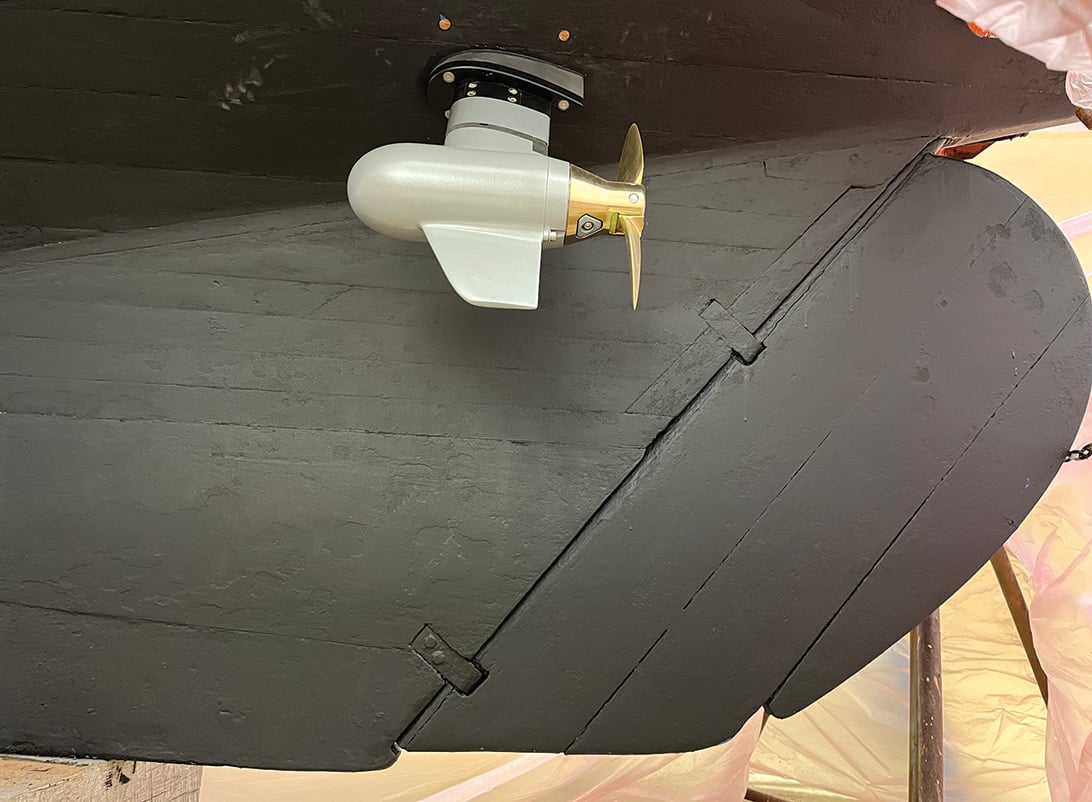
One of the primary considerations when choosing an electric motor is whether it will be an inboard, outboard, or pod drive. For a sailboat such as THETIS, a pod takes no space in the hull. The boat has no access to shore power, so the battery is portable and can be charged at home between outings.
In your motor shopping, watch out for continuous versus intermittent power ratings. Manufacturers vary in which number they advertise most prominently, though the continuous (lower) rating feels more honest to me. Don’t count on maintaining the intermittent rating for long; heat buildup in the motor or motor controller is usually the limiting factor. On modern systems, it won’t hurt anything to hit that thermal saturation point, but power output will gradually be lowered until the temperature stabilizes. Liquid-cooled systems are better able to get rid of the heat, at the cost of extra plumbing and maintenance. A pod motor is easily cooled, being underwater, but cooling for the controller mounted inside the boat still requires attention.
SEIWA, a classically styled fiberglass-hulled boat, was repowered for the same customer as VEGA, and presented a good opportunity to apply lessons learned on the first project. The two issues we most wanted to avoid were noise and cooling limitations. VEGA’s 20kW inboard could hardly be considered loud, but it’s right under the helm, and you can hear it at high rpms. We also felt limited by the motor’s air cooling, which in sea trials could not maintain her 16kW continuous output rating. In practice, however, she is not usually going so fast for hours on end, so it’s not a significant limitation. Choosing a pod drive for SEIWA seemed to check both boxes. The motor, located 16′ aft of the helm and underwater, is very quiet, and has no trouble staying cool in Maine waters. However, on our first sea trial, the motor controller reached its thermal limit within 20 minutes of full-throttle operation. We were pulling 285 amps at full throttle, and this output was gradually lowered until the temperature stabilized at only 60 amps. That’s roughly 3kW—a far cry from the 15kW the motor is rated for. The motor controller had come with no cooling system or mounting instructions; in hindsight, the unspoken implication was that the installer is responsible for designing a suitable solution. We ended up solving the problem with the addition of some large aluminum brackets, finned heatsinks, thermal paste, and thermostatic cooling fans, but it was a frustrating, and entirely avoidable, delay to project delivery.
 Ben Parson
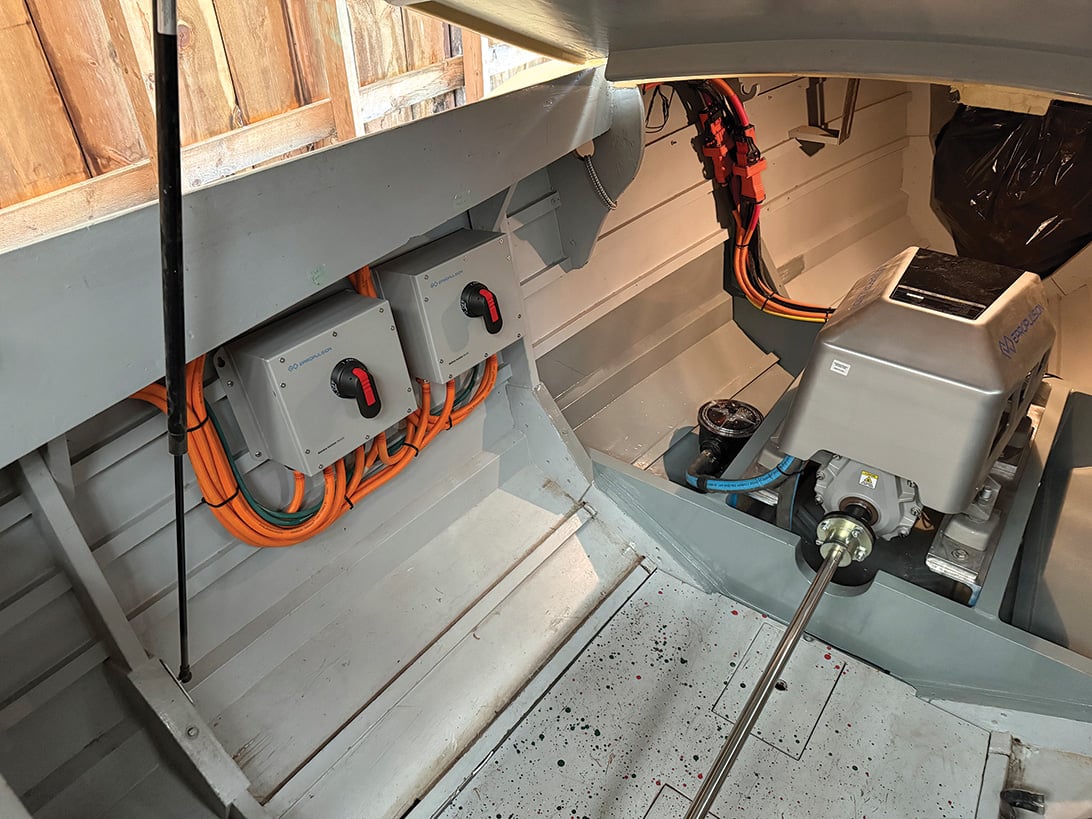
WOMBAT’s inboard motor occupied the space specified in the plans for an internal-combustion engine.
Beyond its power rating, the next detail to consider when choosing a motor is its form—that is, whether it’s an inboard, outboard, or pod drive. Often, we replace like with like, but sometimes a radical reconsideration opens up new possibilities. This conversation typically centers on the advantages of a pod drive over an inboard or outboard motor, particularly for sailboats. Compared to an inboard, the minimal installation space requirement is the primary advantage of outboards and pod drives, though ease of installation can also be an advantage. A pod takes up essentially no space in the boat, aside from the motor controller, which is about the size of a kid’s lunchbox. For a sailboat auxiliary where there wasn’t one before, there are significant cost savings in avoiding the work of boring for a shaft, building engine beds, and all the other work of an inboard-motor installation. There are risks to putting an expensive electric motor underwater, but the pods have fewer moving parts than saildrives, and some are even fully waterproof without the use of seals or O-rings. Compared to an outboard on a bracket, the invisible pod is much more attractive, and thrust is available at a moment’s notice.
Batteries
While electric-motor technology has improved in recent years, it is the advances in battery technology, and falling battery prices, that have catalyzed the growing popularity of electric boats. Forget flooded lead-acid, or even absorbed glass mat (AGM) batteries; lithium batteries are well-established in the marine market (see related article, page 50) and are the standard for propulsion battery banks. Lithium-iron-phosphate (LiFePO4, or LFP) is the most widely recommended chemistry due to its long life (2,500+ cycles) and safety. There are other lithium chemistries such as nickel-manganese-cobalt (NMC) that are sometimes used by manufacturers in applications where weight or size is a primary concern; think portable batteries, or batteries integrated into small outboards. Good product design and manufacturing can mitigate the safety risks, but their cycle life will be a third to half that of an LFP battery. New solid-state batteries offer long life and high power densities, at considerable up-front cost. The technology looks promising, but they don’t make sense for most of our projects yet.
 Nick Parson
TOODLIN’s ePropulsion outboard motor is in keeping with the boat’s styling; she required a large battery bank to have adequate range at planing speed; no space in the boat is consumed by the motor itself.
If you’re putting an outboard on a dinghy or small sailboat, the battery is usually chosen for you. Batteries built into the motor, removable or not, are typically designed for light weight, at the cost of shorter cycles. Bigger systems are where we sometimes have more choice. Many motor manufacturers would like to sell you their own proprietary batteries. They often tout “plug and play” installation as a benefit of using their batteries, and for the DIY installer, this can be a real benefit. There’s nothing special about the power that OEM batteries provide—the difference is battery management system (BMS) communication and control, and sometimes built-in fusing. The BMS is a necessary part of any lithium battery. Its job is to monitor all sorts of parameters and ensure that they remain within safe bounds. The BMS measures current, and voltage and temperature down to the individual cell level, protecting against overcharging, over-discharging, overcurrent, under- and over-temperature conditions, and more. The most basic way a BMS can protect a battery is by shutting it down, immediately disconnecting all loads and charging sources. Because the BMS is tracking voltage, current, and temperature, it’s often the source for battery data displayed at the helm.
 Ben Parson
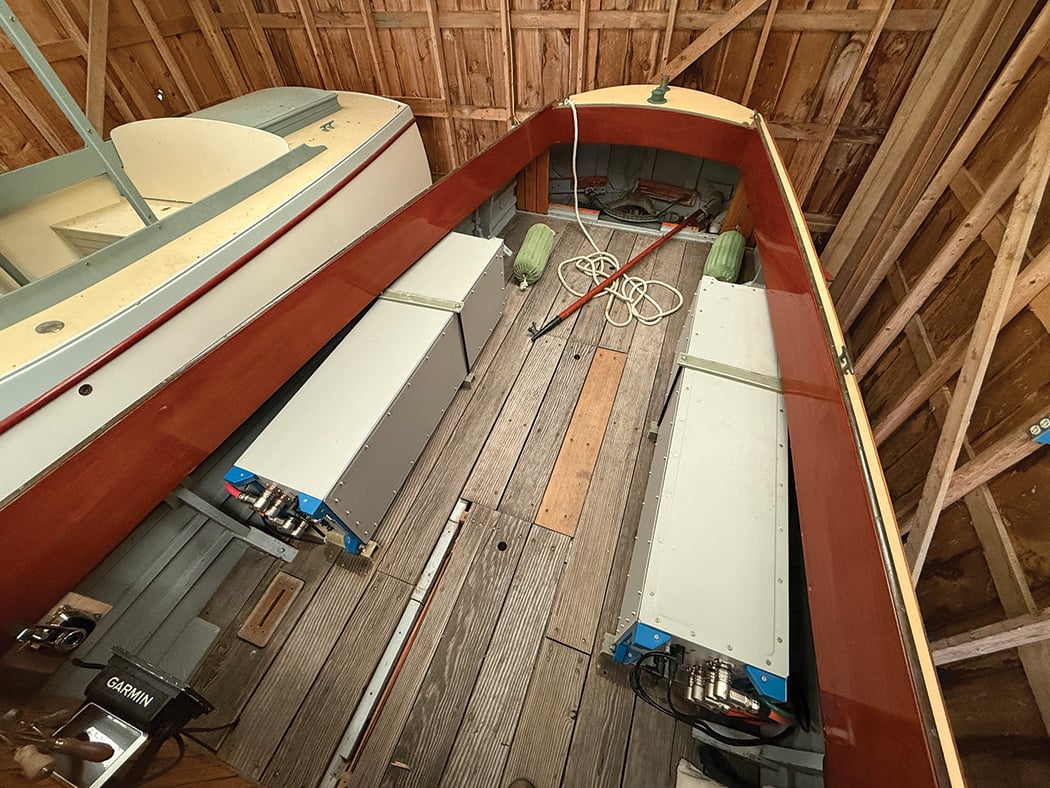
WOMBAT’s batteries occupy space that would otherwise be given over to fuel tanks.
Most of the systems we install are large and integrate equipment from multiple manufacturers. For us, “plug and play” efficiencies become roadblocks to work around. We’ve had better luck using third-party batteries from reputable companies. Most batteries you’ll find have a built-in BMS, though some rely on an external BMS. The difference in capability between the two has lessened over the years, and for small systems, the simplicity of an internal BMS is quite attractive. Make sure the battery has some form of communication, though. Bluetooth communication to an app on your phone is the most common setup, though some of the apps are bad. For big projects, look for NMEA2000, RS-485, Victron, or CAN communication; these protocols will let your batteries talk to chargers, loads, or instrumentation, and can enable deep integration with existing systems. There are lower-tier batteries with no communication, but troubleshooting with no insight into what the BMS is doing is a frustrating experience, one that is well worth spending a little extra money to avoid.
Another obvious aspect of battery selection is voltage. If you didn’t already have a system voltage in mind, your motor selection determined what you need. Electric motors will be at least 24V, but more likely 48V (or higher). Most large systems will use a bank of multiple batteries connected in series, in parallel, or both. A quick refresher: series connection increases voltage; parallel connection increases available amperage. You can make a 48V battery bank with four 12V batteries, but it’s better not to, because series strings of many batteries can have balancing problems. Two 24V batteries would be easier to manage, and one 48V battery easier still. The availability of 48V LFP batteries has increased greatly just in the past couple of years. They often come in the exact same case as a 24V battery, but the cells are wired differently to boost the voltage.
 Ben Parson
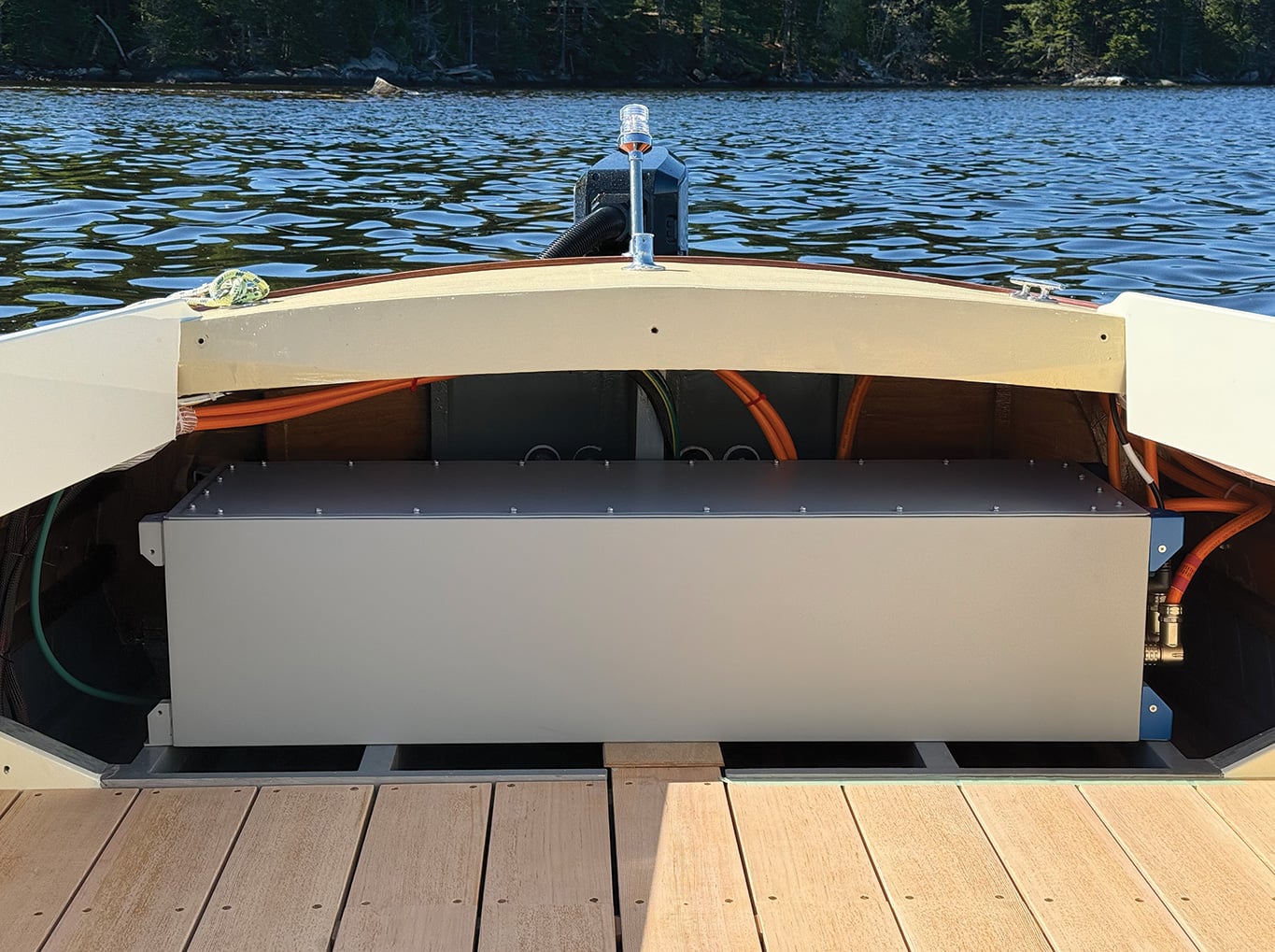
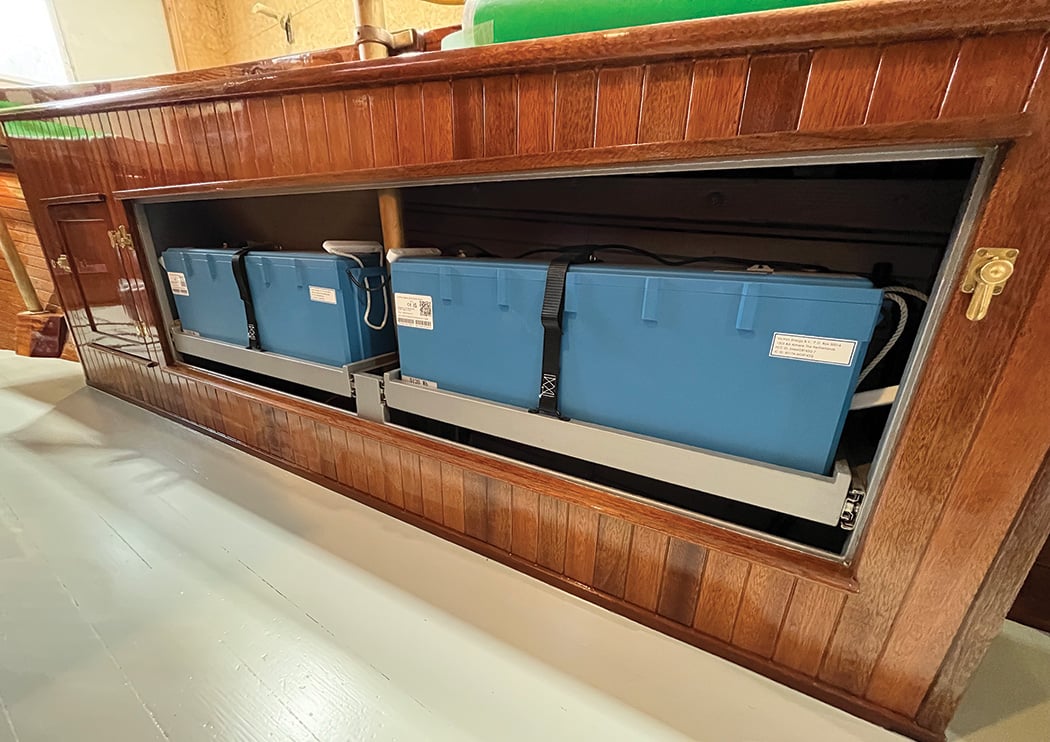
VEGA’s batteries are neatly concealed in lockers that match the boat’s styling and age.
Above 48V, building a custom system becomes much more difficult. There are additional American Boat and Yacht Council (ABYC) standards reflecting the danger of higher voltages, and finding components from the usual marine parts companies, tested and labeled for 72V, 96V, or higher, is almost impossible. A complete system package from one manufacturer is the best way to go.
Beyond the technical specifications of a battery, there are of course the physical dimensions to consider. Fitting batteries into the existing spaces of a boat can be challenging. Since using comparatively fewer, larger batteries is the easiest way to build a large bank, we’re typically using batteries that are significantly bigger in at least one dimension than a standard automotive-size 12V. Large powerboats may have sizable fuel tanks that, when removed, leave a nice space to locate batteries, and this swap has the added advantage of minimally affecting the boat’s trim by keeping weights in the same places. On small sailboats, it can be hard to find hidden spaces for batteries. Many batteries are “ingress protected,” or IP rated, but it’s still important to keep them dry, particularly at the terminals. Keeping wire runs short is good practice, and batteries should be accessible for periodic checks; cables can become loose over time, and loose connections create resistance, which causes heat.
Charging revisited
Charging is the final crucial part of an electric-propulsion system. We’ve already briefly touched on shore power, solar, or portable battery-charging methods. For shore power charging, the capacity of the source may be a limitation for large banks, because it takes a powerful charger, or multiple chargers, to keep charge times reasonable. A shore power connection of 30A/125V is good, but it can’t support the full output of some of the bigger chargers. Many chargers can run on 125VAC or 250VAC, but only reach full power at the higher voltage. A shore power connection of 50A/250V is a wonderful thing to have, but still rare at the docks we frequent. The fast DC charging used by electric cars is very slowly making inroads into the boating market, but it’s a long way from being common in our area of midcoast Maine.
 Ben Parson
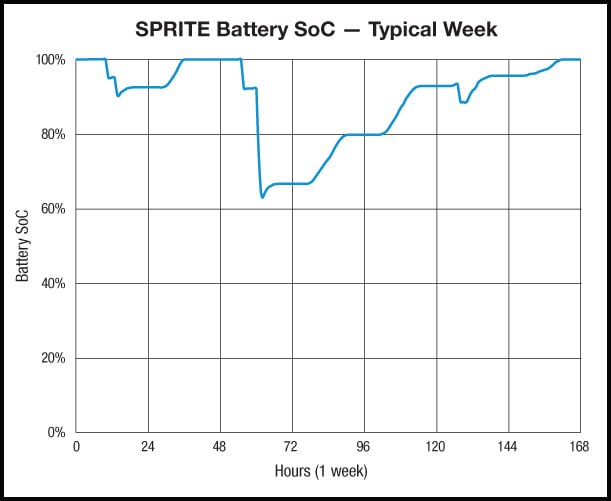
For the daysailer SPRITE, a modest battery bank is sufficient to handle the typical shallow discharge that results from leaving and returning to the mooring under power. Solar panels recharge the batteries during downtime on the mooring.
Boats that live on trailers can be charged via a regular extension cord from a 15A or 20A outlet, but a little caution is warranted when setting this up for the first time. The charger may be running at full output for hours at a time, so using only 80 percent of the circuit’s capacity is prudent. Make sure you have a good 12-gauge or heavier extension cord, and keep it short.
Chargers are rated by their output, in amps or watts, and simple math (keeping track of your units) can provide a guide for recharge times. A 10kWh battery bank discharged to 20 percent can be recharged by a 1,200W charger in about 6.6 hours (10,000Wh × 0.8 / 1,200W = 6.6h). The actual recharge time will be a bit longer because the rate of charge slows down as the battery approaches full, but we’re often looking at recharge times of several hours to several days, and the simple math is close enough for that order of magnitude.
 Ellery Brown
Although SPRITE’s primary charging source is solar, she has occasional access to shore power and so has an AC battery charger, too.
Consider the case of SPRITE, a daysailer that lives on a mooring. Although her owner has a dock, it’s tidal and has no power connection. We did install an AC charger, but we treated portable solar as the primary charging method, using an 80W panel on the foredeck and a 200W folding panel deployed along the furled mainsail. With a battery bank of 10kWh, a full recharge would take about 5.5 sunny days, so the system was sized so that most typical trips only make a small “dent” in state of charge. Charging at 280W for a 10,000Wh battery bank is not a lot, and when you consider the actual hours of peak production you can get over a 24-hour period, it makes sense that solar often supports recovery over days, not rapid recharge between outings.
As the example of SPRITE shows, solar charging for most refits is a multi-day affair. Consider your frequency of use, and the intensity of your typical use. If you use your sailboat several times a week but only use the motor for 10 minutes each time, you’re probably not draining the battery each trip. For such light-duty applications, even a modest battery bank might provide enough “cushion” to make a small array work. Powerboats are a different case; if your heart is set on solar, it may make sense to expand the scope of your repower and build some more space for panels. An array that’s well-matched to a boat’s use is a beautiful thing. Always silently charging, never plugging in; it’s the easiest way to charge, if the math works out in your favor.
Portable batteries are the final option to mention. They’re the default for small outboards, which are certainly the simplest electric propulsion systems to install. To charge, you bring the battery, or in some cases, the entire motor, home to plug in to a regular household outlet. To be truly portable, these batteries must be small and lightweight, and this limits their application to motors around 2kW and under. While they’re designed for use with outboards, some manufacturers allow them to be used with small pod motors, which presents a unique solution for charging-challenged boats.
THETIS, an N.G. Herreshoff–designed Alerion built by Beetle in 2009, presented a common challenge: a daysailer with limited systems space that lives on a mooring and has no access to shore power. Her owner’s needs are modest, though, and we decided to install a 1kW pod, entirely hidden below the sole, and powered by a portable battery. The pod installation is notable for being invisible and taking up no cockpit space, but the portable battery is the key to making this system work. There’s one combined power and communication cable with a simple twist-lock connector, and the battery lives in a small locker under the afterdeck that also houses the throttle and data display. There’s a spare battery below if needed, but if the motor is used only for getting off and on the mooring, or a little help bucking the current in the river, a single 1.2kWh battery has proven to be enough. It’s light enough to bring back to shore to charge, and it’s even supposed to float if dropped in the water.
Installation and Sea Trials
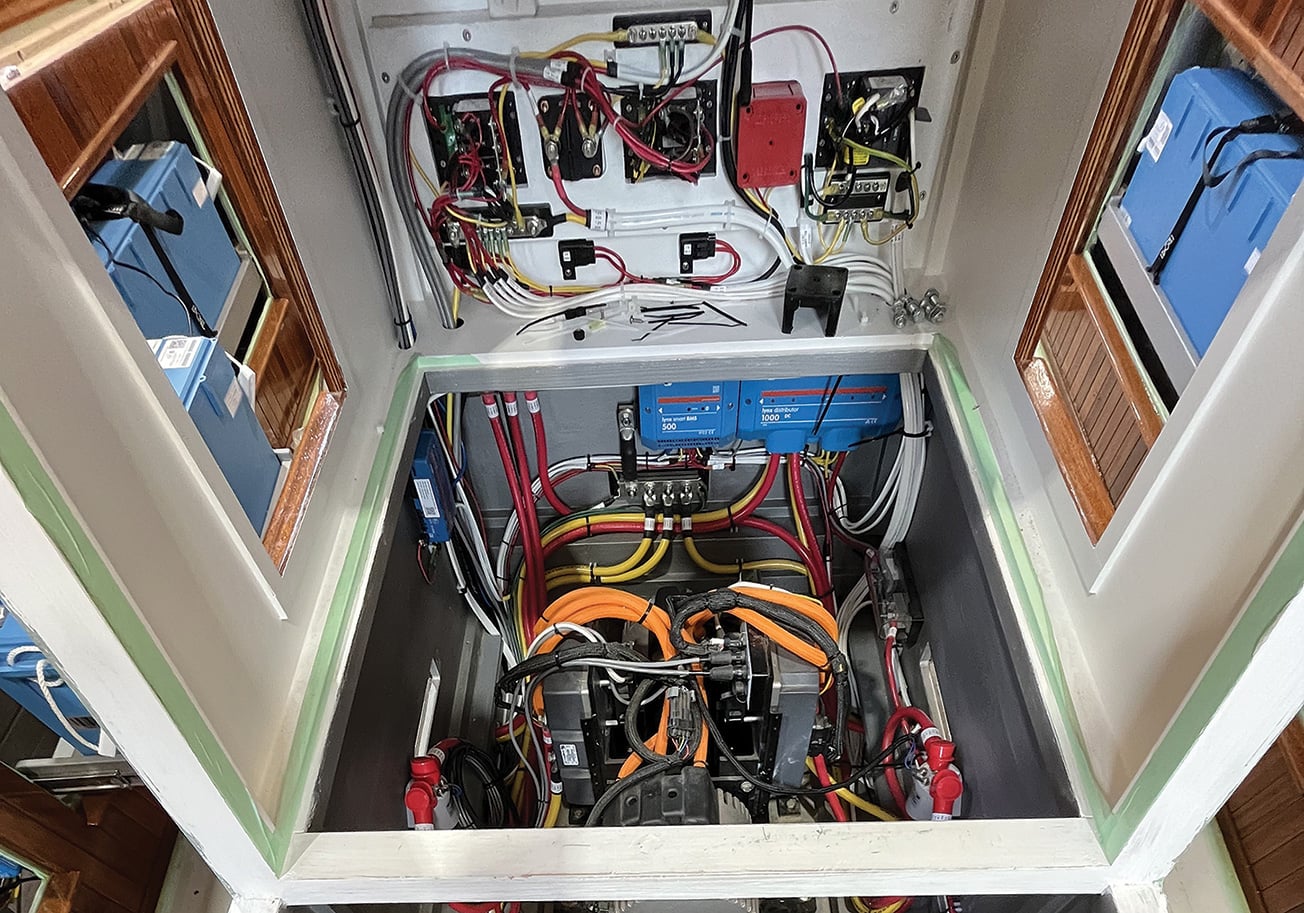
After all the evaluation and planning, it is time for the installation. I will keep this brief—it’s simultaneously simple and unforgiving of small mistakes. Below 60VDC, it’s like “regular” boat wiring, with a couple of caveats worth noting. One is the voltage rating of components—there are lots of fuses and switches on the market that aren’t rated for 48V, so read the specifications carefully. The other is the sustained current that we’re putting through these connections. A windlass or bow thruster can be big loads, but they’re only used briefly. A 20kW propulsion motor will pull 400A at 48V and can do so for hours at a time. This sort of current will expose any undersized cables, loose connections, or bad crimps. The evidence of the added resistance will be heat, sometime lots of it. This is one of the reasons extensive sea trials are necessary before we sign off on any installation; some problems don’t arise until an hour or two into trials. There are various ways to find resistance problems, such as measuring voltage drop under load, or using an infrared thermometer or thermal camera to check for heat buildup. This is one of the reasons that planning an installation with accessibility in mind is important. Being able to reach all high-current connections is critical, both for the initial sea trial and ongoing maintenance.
 Ben Parson
Putting it all together: VEGA’s electrical propulsion system is neatly concealed but accessible.
If electric propulsion is going to become common on the water, repowers will account for much of that growth. Most boat owners aren’t shopping for a brand-new, purpose-built electric boat; they’re trying to make the boat they already have quieter, cleaner, and more enjoyable to use. For most owners, the intended use is the key determinant of whether a project makes sense. When you set realistic speed expectations, separate typical trips from outlier trips, and choose a charging plan that matches the boat’s patterns of use, the system design stops feeling like a leap of faith and starts looking like any other well-scoped refit.
 Ben Parson
When the electric-outboard-powered Glen-L runabout TOODLIN’ lets loose, she can make 25 knots.
Classic wooden boats are often a natural fit for this sort of update. Many are efficient at displacement speeds, and that characteristic pairs naturally with the steep energy cost of pushing past hull speed—moderation is rewarded with dramatically reduced battery size, weight, and cost. Just as important, the quiet, low-vibration character of electric power complements what draws people to wooden boats in the first place: a more deliberate, less hurried kind of boating. The systems may be complex, but the user experience is anything but. Climb aboard, turn the key, and after the soft click of a solenoid: silence. In that sense, a thoughtful electric repower doesn’t change a wooden boat’s character. Grounded in a boat’s form and purpose, an electric motor fades into the background, keeping the focus where it belongs: on the boat.
Volts, Amps, Watts, and “-hours”
Volts (V): Voltage is electrical “pressure.” It tells you how hard the electricity is being pushed through the system. Higher voltage allows the same amount of power to be delivered with less current, which is why large electric propulsion systems often run at 48V or higher.
Amps (A): Amperage is the flow of electricity—the amount moving through a wire at any given moment. High current means thicker wire and the potential for more heat.
Watts (W): Watts are a measure of work, or power, and they combine volts and amps: Watts = Volts × Amps. A motor drawing 100A at 48V is using 4,800W, or 4.8kW. This relationship is the foundation for most electric propulsion calculations.
Adding “hours”: When you see a unit like watt-hours (Wh) or kilowatt-hours (kWh), it’s quantifying energy, or capacity to do work over time.
A battery rated at 10kWh can theoretically supply:
- 1 kW for 10 hours
- 2 kW for 5 hours
- 5 kW for 2 hours
- The same idea applies to amp-hours, though watt-hours are usually more helpful because they work across different system voltages. Amp-hour ratings only make sense when the voltage is specified, but if it is, the conversion to watt-hours is easy.

Ben Parson is a designer and boatbuilder at Hylan & Brown Boatbuilders in Brooklin, Maine. He specializes in drafting, yacht design, and innovative electrical systems for traditional (and tradition-inspired) boats.