
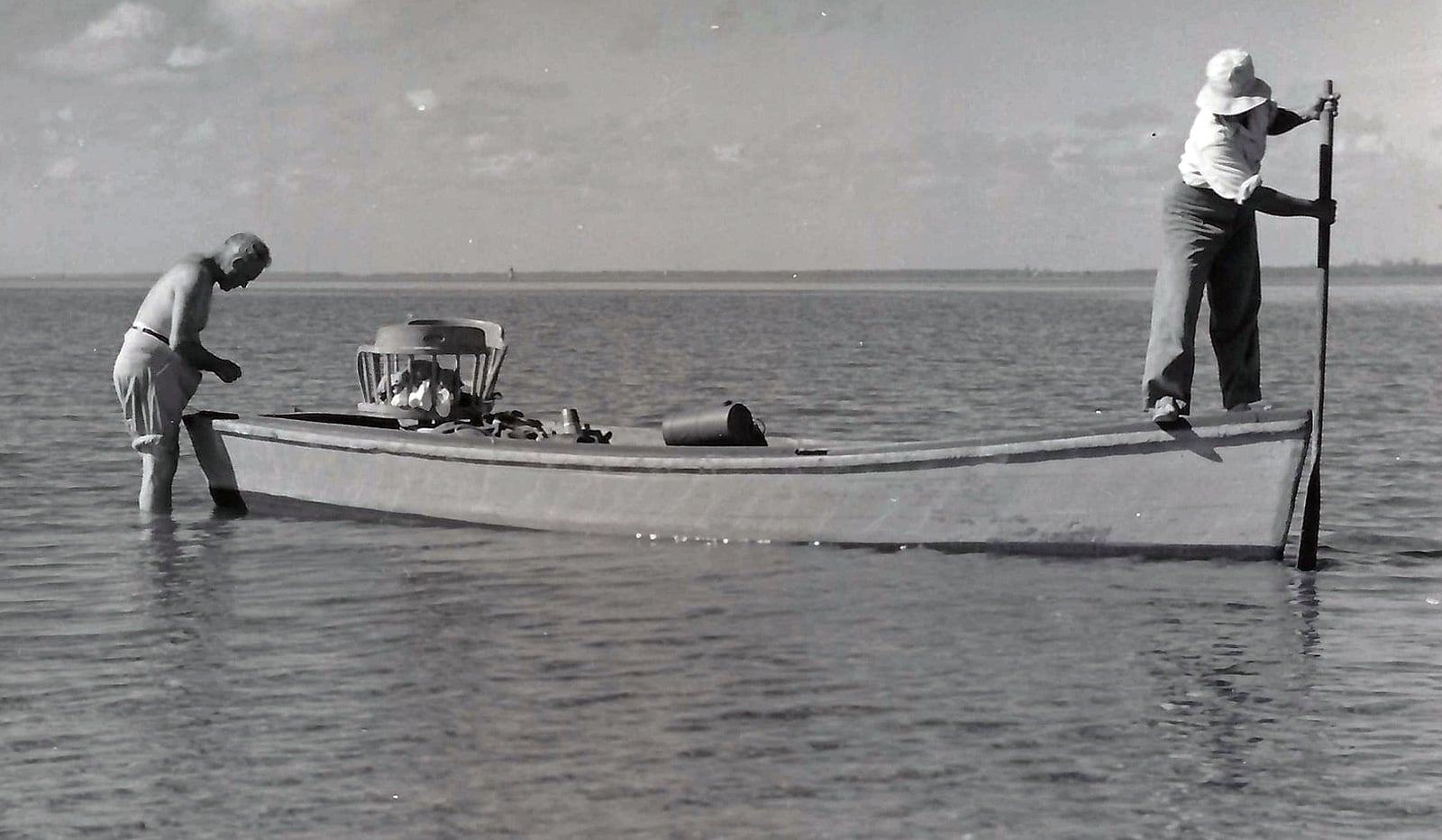
 Courtesy of “DING” Darling Wildlife Society
During a low tide at Tarpon Bay on Sanibel Island, Florida, in the 1950s, Esperanza Woodring poles her boat while Trimble McCullough, her neighbor and first customer for her fishing-guide business, gathers scallops. Prominent in the boat is the fuel tank of about 1½ gallons for the Briggs & Stratton air-cooled engine.
The view from Ralph Woodring’s house, close by the sandy shore on the north side of Sanibel Island, Florida, is of sparkling San Carlos Bay. There’s a little scrub-covered island out there, and beyond it in the distance, the green and red buoys marking the Intracoastal Waterway. On weekends the Waterway hosts an endless parade of noisy powerboats but on this calm midweek morning in late March, the bay is largely undisturbed and ripples with a pleasant whisper against the pilings of Ralph’s dock.
Close your eyes and it is not hard to imagine that the view from here isn’t too much different from what it was in 1888. That is when Ralph’s grandfather Sam, a Pennsylvania blacksmith and Union Army veteran, established a homestead on Sanibel. His son, also named Sam, built the sturdy house of rot-resistant Florida pine in 1918.