
 Penobscot Marine Museum
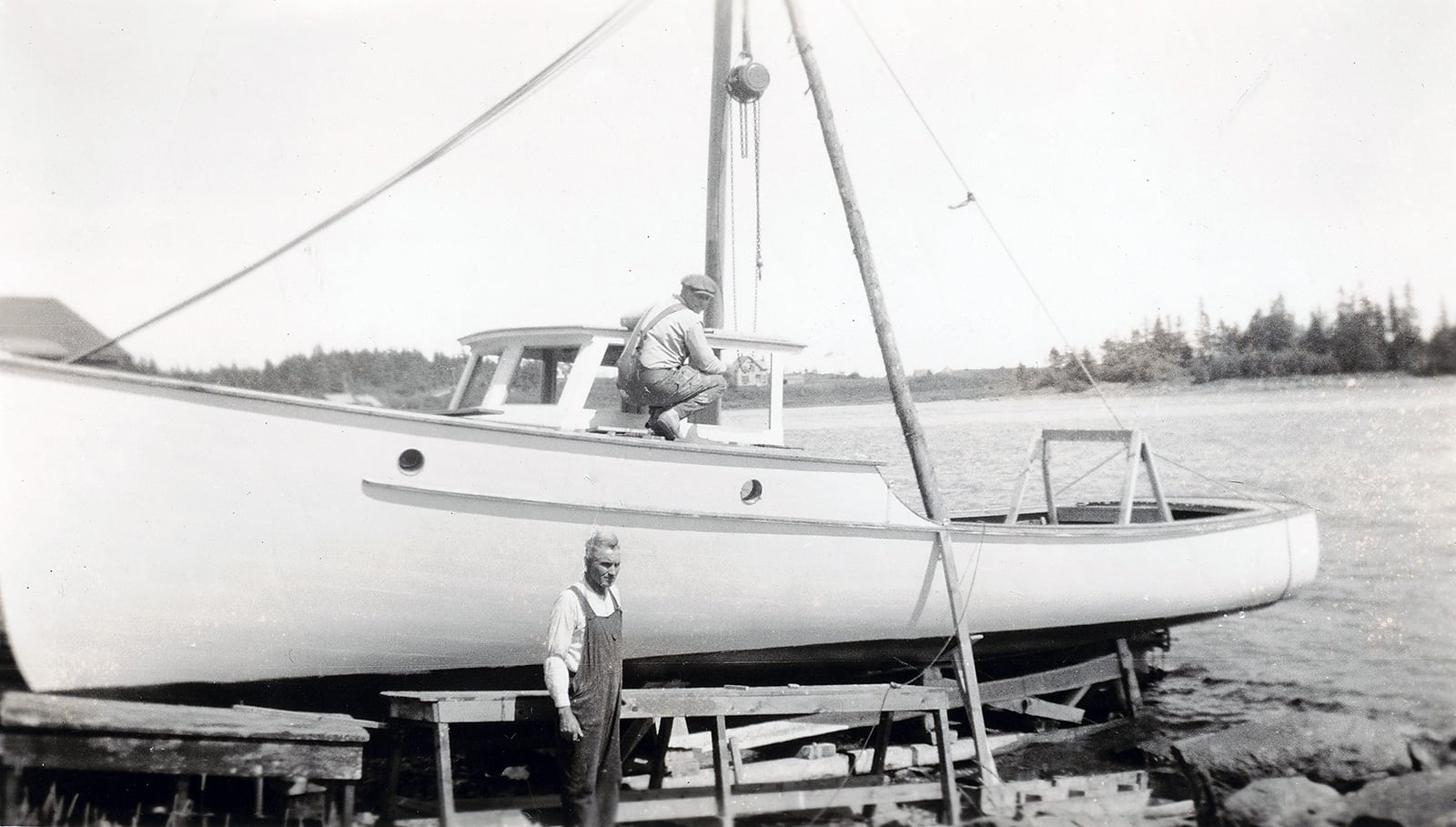
William Frost (standing) readies one of his “Jonesport model” lobsterboats for launching. Frost first started boatbuilding in Nova Scotia; this photograph shows his second location in Jonesport, Maine, in about 1933. Frost is widely credited with the creation of the modern lobsterboat, which became highly influential for both commercial and pleasure boats.
Maine is blessed with a pantheon of top-notch builders of working boats, but few have the legacy of the Lowell family, which extends beyond commercial fishing boats to yachts and government vessels. They are the descendants of William (Will) Frost, widely regarded as the inventor of the iconic Maine lobsterboat, and his grandsons also became noted boatbuilders and designers. They, and most of the region’s powerboat builders, have been influenced in some way by Frost’s signature semi-displacement, semi-planing hull.
Jamie Lowell, one of Frost’s great-grandsons, has become something of a curator of his family’s 400-year boatbuilding legacy, along with his wife, Ruth, and other family members. Their legacy, which continues to this day, has stretched from Nova Scotia to southern New England—but it is centered in Maine. They sat down with me on a bleak winter day early this year in the library of the Penobscot Marine Museum in Searsport, Maine, to discuss the Lowell dynasty.
The Godfather
 Lowell Family Collections (left), Penobscot Marine Museum (right)
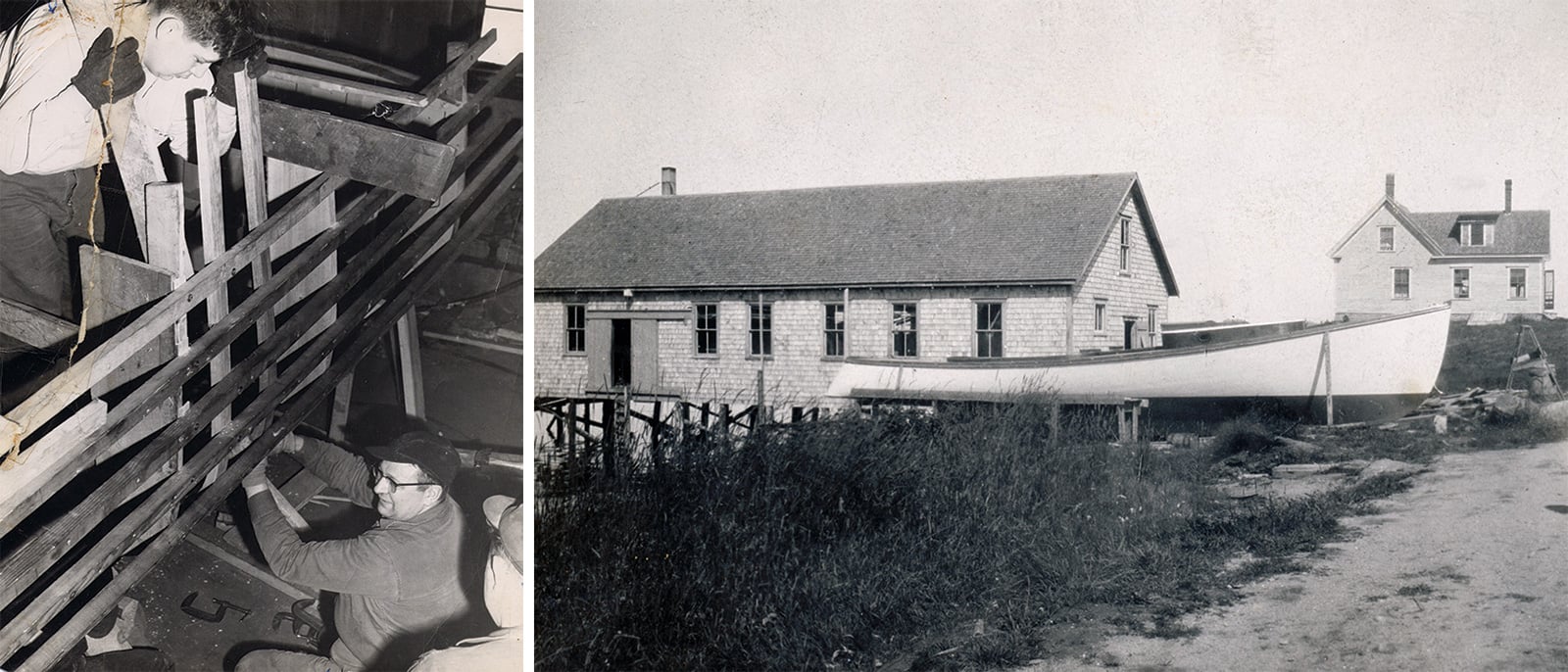
Left—Boatbuilding was a family business for the Lowells; here, Riley Lowell, center, frames a boat in 1956 with his sons Carroll, top left; Royal, bottom right; and, out of sight below the boat at bottom left, Malcolm. Right—Frost’s first boatshop in Maine, shown here in 1923, was at Beals Island.
Originally from Maine, the Frost branch of the family moved to Nova Scotia as Loyalists after the American Revolutionary War, but shipbuilding was always part of their heritage. The modern era begins with Will Frost, who was born in 1874 on Digby Neck, Nova Scotia; his grandfathers on both sides had been shipwrights.
Jamie says Frost learned boatbuilding from his grandfather and father, and his first boat was a 26′ sloop called IMITATOR, but the prospects of engine power quickly captured his attention. “When he was 18, he visited his sister in Boston, and while there he first saw the early make-and-break engines and their marine use,” he says.
As a young man, Frost fished commercially and experienced Nova Scotia’s prodigious tides and winds. “Grampy developed an appreciation of depending on engines over the winds,” Jamie says. In 1906, Frost designed and built his first powerboat, TORONTO, at his boatshop in Whale Cove. He moved to nearby Little River after his house and boatshop burned in 1909, and in about 1910 he inaugurated his most famous Digby Neck design class—starting with the ETHEL MAUDE. They were the hot boats of their day not only for fishing but also for racing.
Those heady times soon came to an end. “In 1912 Grampy Frost built a tugboat in Nova Scotia, and the deal led to his bankruptcy. Seeing little future on Digby Neck, he left for Beals Island, Maine, to join a cousin. World War I barge construction brought him back to Nova Scotia in 1914, and he also built fish boats. After his boatshop was destroyed by yet another fire, he moved back to Maine in 1920. In 1924, Frost’s oldest daughter, Wilhelmina, married a local boatbuilder, Riley Lowell, effectively merging the two boatbuilding families.
The Semi-displacement Hull
At the time Frost started building lobsterboats, torpedo-sterned designs prevailed; fishermen preferred them because they were good in following seas and protected waters, and Frost built large torpedo-sterned boats starting in 1917 and continuing until the early 1930s. But the sterns were complicated and time-consuming to build, and they were prone to leaking. Frost is believed to have introduced the familiar square, cambered transom of modern lobsterboats. As historian Daniel Sheldon Lee wrote, “Frost also introduced trunk cabins onto these boats that replaced traditional spray hoods. The cabins featured a couple of little octagonal windows.” Harold Gower, who worked for Frost, was the first to mount small pilothouses and small steering wheels on these boats.
Above all, most builders credit Frost with developing the semi-displacement hull that transformed the industry. Earlier displacement hulls were stable in rough waters and efficient at low speeds, but their speed was limited to “hull speed,” about 1.34 times the square root of the waterline length in feet. Frost’s innovation was to use a sharp bow to push water away from the hull combined with relatively flat sections aft to generate lift, similar to a planing hull, as speed increases. Such a boat rises slightly out of the water, reducing drag and allowing for much greater speeds.
Frost’s hull type was a game-changer not only for getting out to the fishing grounds efficiently but also for pleasure-cruising on a schedule.
Prohibition: A Dry Run for Advancing Boatbuilding
Frost’s fast hulls found a new market—rumrunners—after January 17, 1920, when the U.S. prohibition of alcohol took effect a year after the ratification of the 18th Amendment. What had been a legitimate business was now taken over by criminal smuggling enterprises, and they needed ever-faster boats to outrun the Customs and U.S. Coast Guard authorities.
Maine, with its long, convoluted coastline, many rivers, and inlets, was especially well positioned for rumrunning. Canada had its own version of Prohibition dating back to the World War I years, but it was legal to produce and export alcohol. Shiploads of alcohol went to “rum row” just outside the U.S. three-mile territorial limit for transshipment to smugglers. The tiny French islands of St. Pierre and Miquelon, off the coast of Newfoundland, also became transshipment entrepôts.
Frost recognized that the same semi-displacement hulls that worked so well for fishing might be just the ticket for rumrunning, since the Coast Guard’s displacement hulls could only go as fast as the theoretical hull speed that their lengths would allow. Powerful war-surplus aircraft engines such as the massive Sterling Viking and the 12-cylinder Liberty were popular. And the boats were fast: In 1930, The Newport (Rhode Island) Mercury noted that the 65′ GOOD LUCK was capable of speeds of more than 40 mph. “Pappy (Frost) never lost a rumrunner to lack of speed,” Jamie says. An additional selling point was that the boats could easily be disguised as humble fishing craft.
 Penobscot Marine Museum (left), Lowell Family Collections (right)
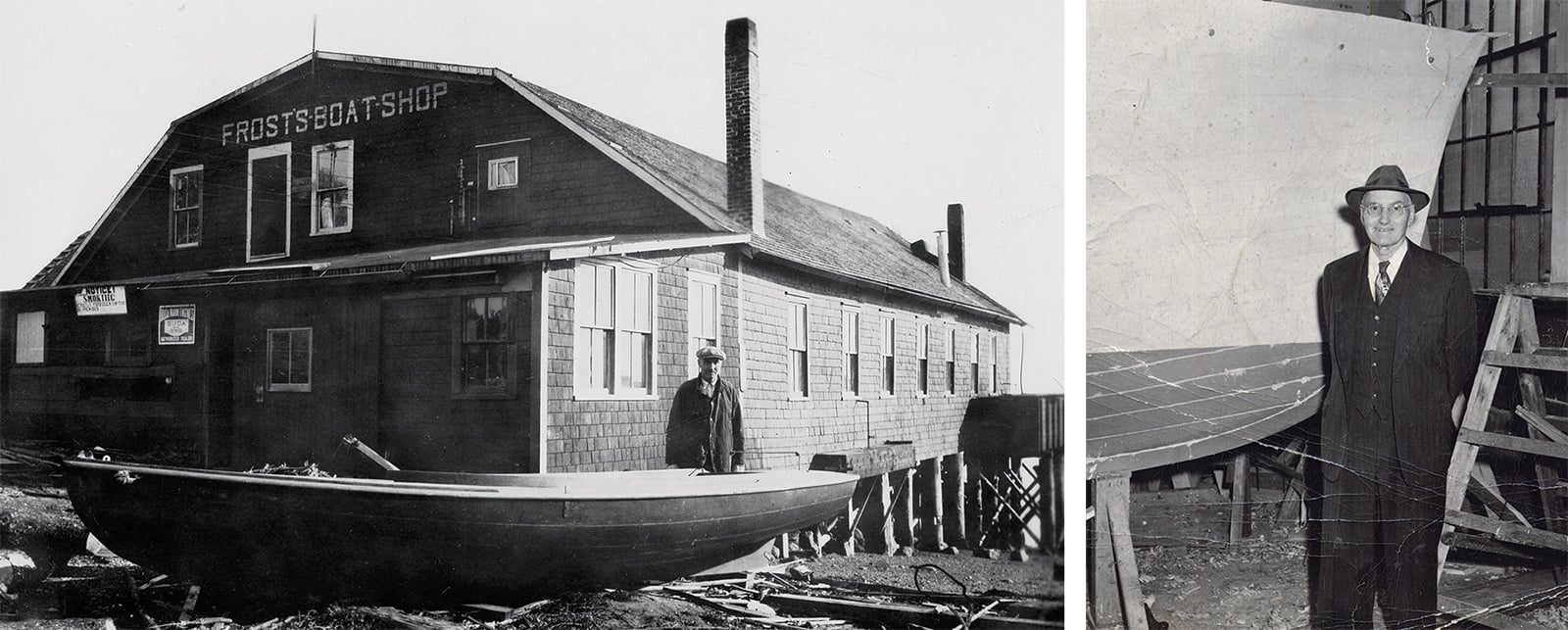
Left—At his first boatshop in Jonesport, Frost posed near an unknown boat in the early 1930s. Right—Frost was best known developing semi-displacement hulls.
“The buyers had pockets full of cash,” Jamie said, and everyone from small-time operators to mafia syndicates—even the Kennedy family, allegedly—all sought boats from Frost, most of them between 30′ and 80′ long and tailored to the rum trade. Frost worked first on Beals Island but moved to a larger shop across Moosebec Reach in Jonesport.
The Coast Guard was well aware of Frost and had an agent watching him. (Awkwardly, his son, Merrill, was a Coast Guardsman.) In 1930, The New York Times recounted the capture of the “long sought” and elusive 55′ Frost-built EVELYN RUTH. She had grounded in Boston Harbor, escaped, and was recaptured off Provincetown, Massachusetts, “after every available Coast Guard vessel from Portland, Maine, to Long Island Sound had been ordered to catch her.” After she was reassigned to law enforcement, the Coast Guard bought more boats from Frost. It was said that at one point Frost was building rumrunners in one end of his shop and Coast Guard boats in the other. Times were good, and money flowed as easily as rum.
The rug was pulled out from under the Jonesport boatshop with the repeal of Prohibition on December 5, 1933. The next year, the Frosts and Lowells sought greener pastures to the south.
To Massachusetts and Back Again
 Lowell Family Collections (bottom), Penobscot Marine Museum (right)
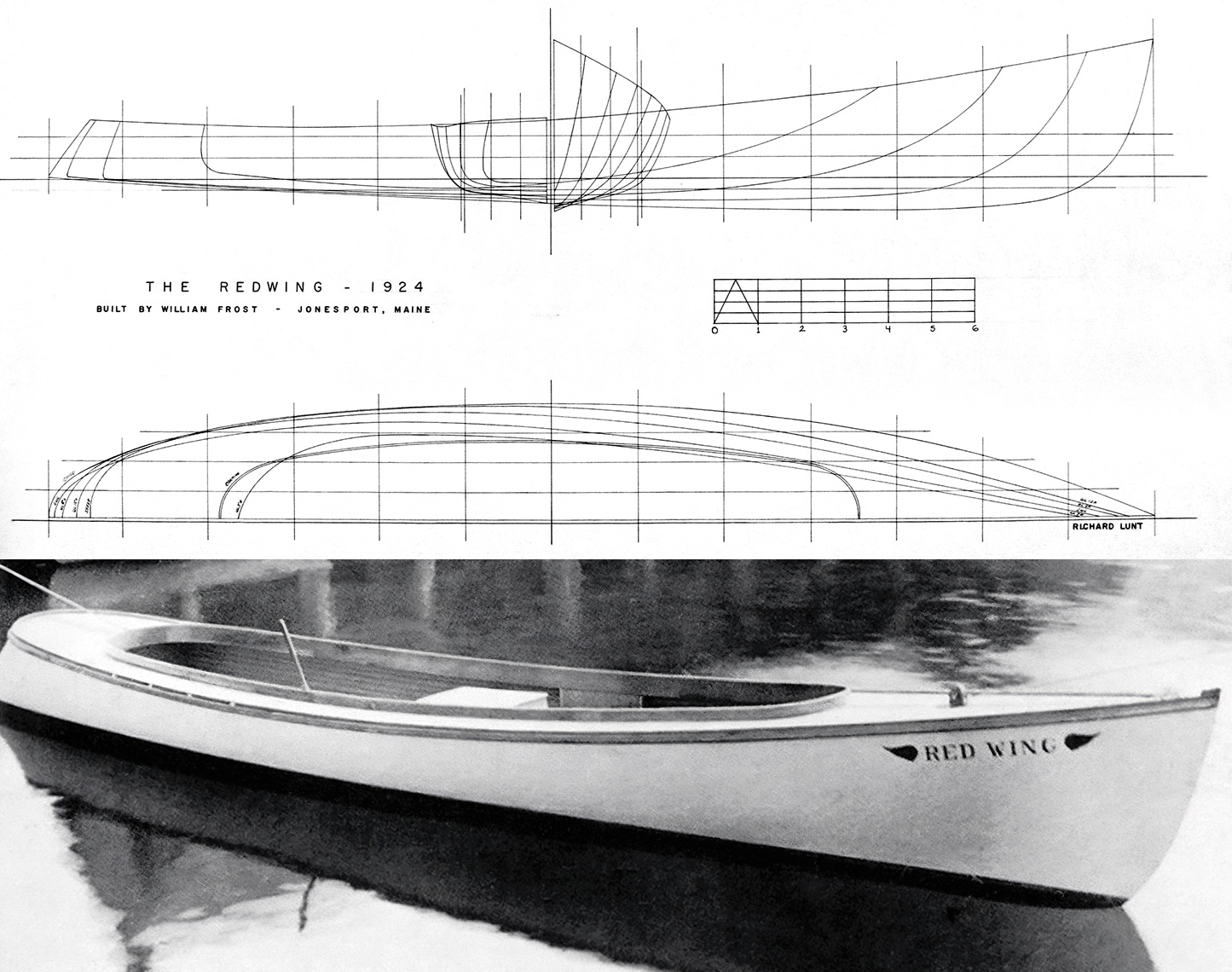
Frost designed boats the traditional way, by carving half models and then directly measuring them for lofting. Lines taken later by others such as Richard Lunt helped document the fine, easily driven shapes. RED WING, built in 1924 in Jonesport, was typical of the lobsterboats of her day, with the torpedo stern that lobstermen preferred for trap handling and buoyancy aft. Note her amidships engine box and starboard stick steering, which leave the interior clear for working.
Frost moved first to Somerville, Massachusetts, and in 1934 opened Frost & Co. Four years later, the business was reconstituted as William Frost Company in Tiverton, Rhode Island, with Frosts’s son Bert leading the business. Will and Marcia Frost moved to Tiverton on September 20, 1938, and Bert arrived with his family on the 21st—the very day of landfall for the famous hurricane of that year, which killed 600 and devastated the coasts of Long Island and southern New England. The Tiverton shop was destroyed. Will and Bert lost everything.
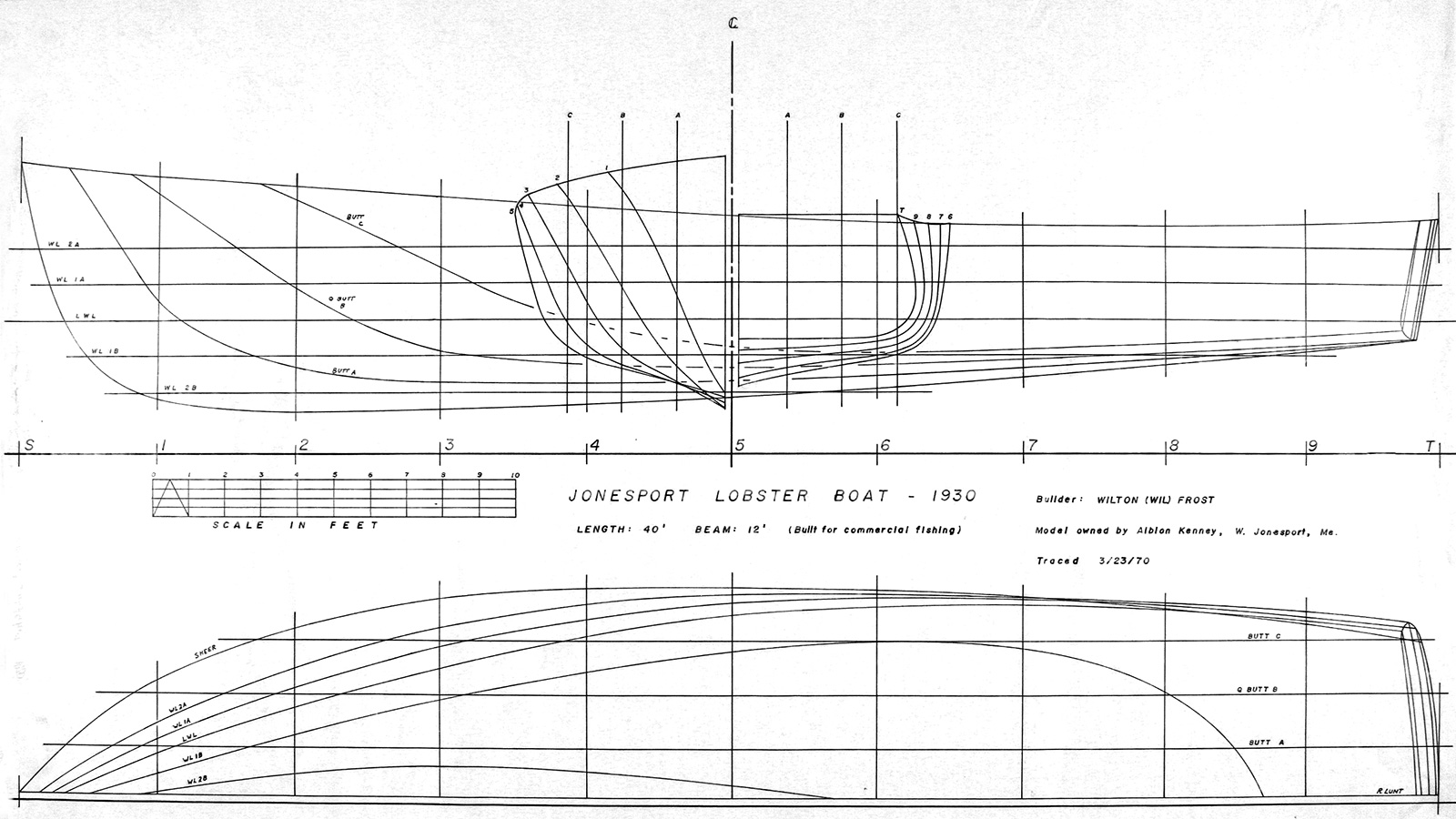 Penobscot Marine Museum
By 1930, the date of this hull, Frost had radically changed the concept of the lobsterboat. He used the powerful engines then available and shaped his hulls to be semi-planing to vastly increase their speed potential. Lobstermen quickly embraced the changing technology, which gave them faster turnaround times and better ability to overcome the powerful currents common in Downeast Maine and Nova Scotia.
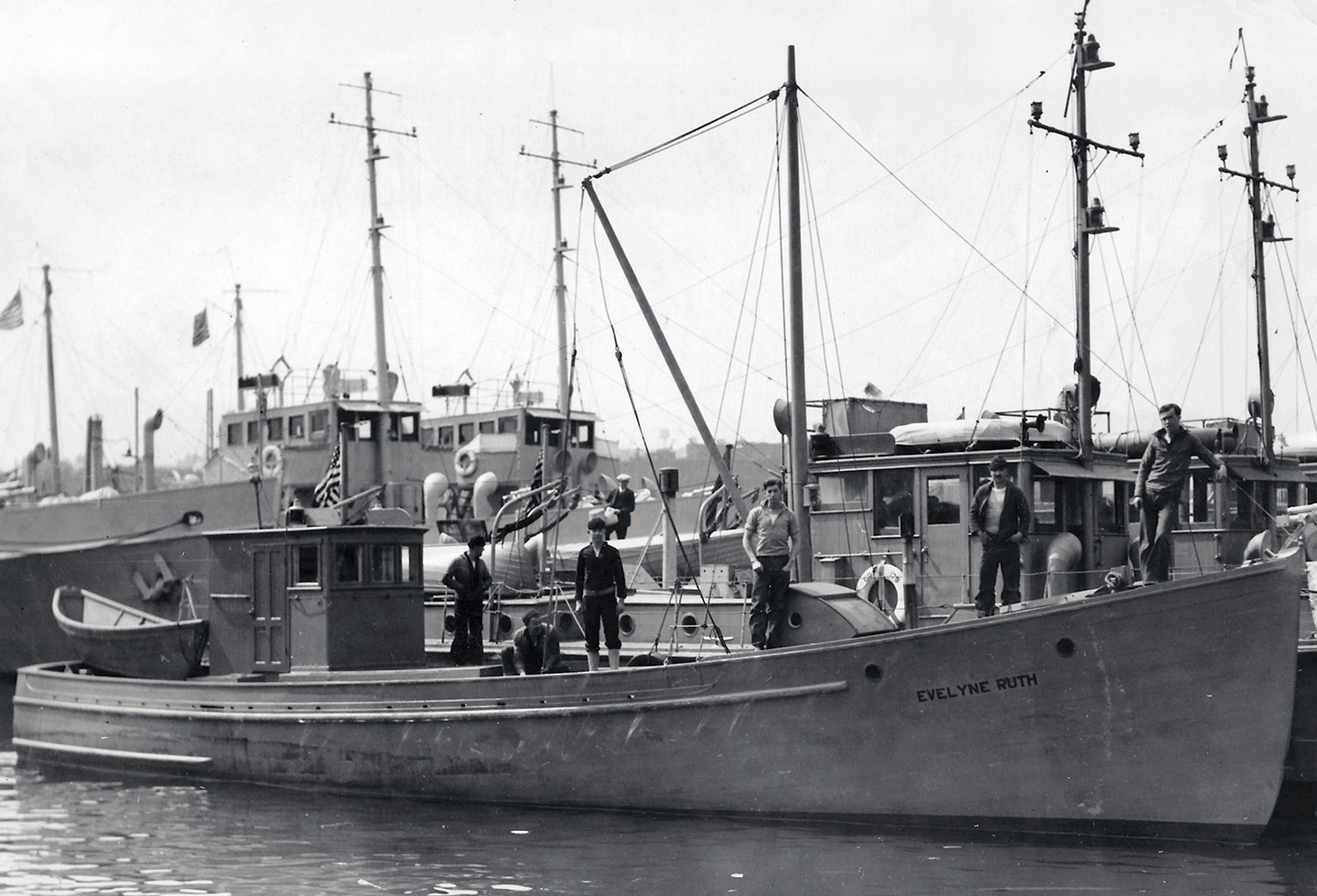 Lowell Family Collections
The 55’ Frost-built EVELYN RUTH eluded the U.S. Coast Guard until running aground in 1930. After she was captured, her role turned to U.S. Coast Guard patrols, and her reputation brought Frost more orders for fast law-enforcement boats.
Though the shop was rebuilt, it never paid its way. Bert stayed in Rhode Island to work at various boatyards while Will returned to Maine, first working in Boothbay Harbor to build barges for World War II preparations. Later, Will opened his own shop in Portland but soon moved to the former Humpty Dumpty potato chip factory on Second Street in South Portland. He eventually retired, for the second time, Downeast to Milbridge, not far from Jonesport.
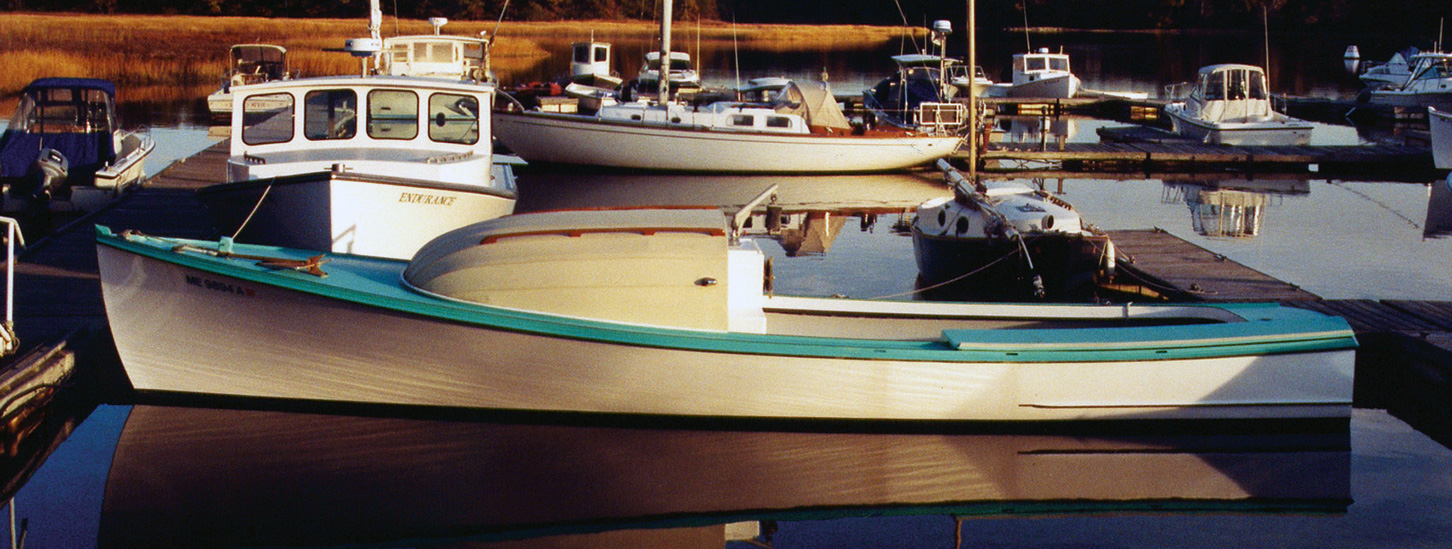 Ruth Lowell
This photo shows a boat called NO NAME (now called GRASSHOPPER), of 1950, with a spray hood and wheel steering; the lobsterboat by then was well on its way to its modern configuration.
Will Frost spent his career creating not only iconic lobsterboats but remarkably varied workboats and pleasure boats bridging the era from wind power to steam, then to make-and-break engines, and finally to aircraft engines for go-fast commuter yachts and rumrunners.
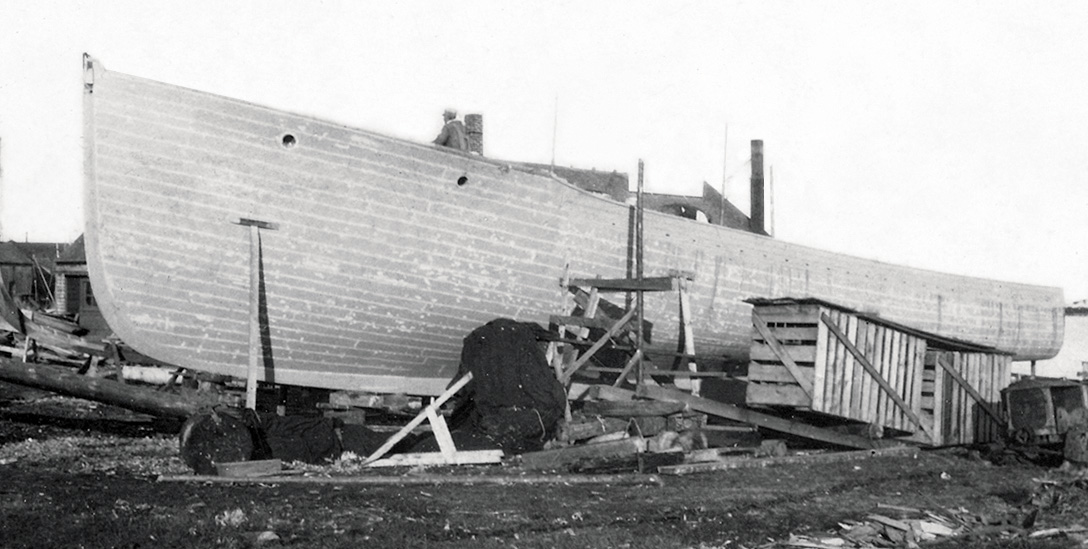 Lowell Family Collections
In the 1920s, Frost’s reputation for building fast boats caught the attention of rumrunners who wanted the ability to carry a load and outrun the authorities while illegally bringing alcohol to U.S. shores during Prohibition. GOOD LUCK, a 65-footer, was capable of speeds of more than 40 mph.
The Next Generation
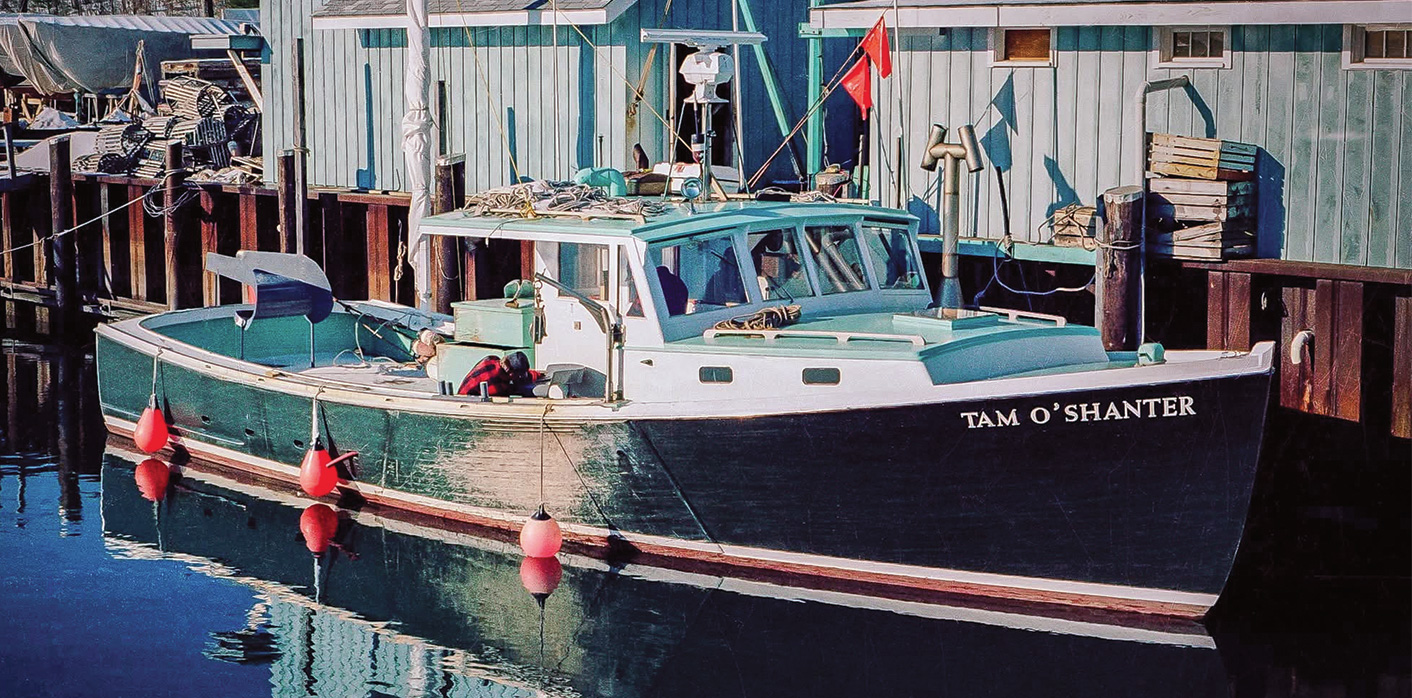 David Etnier
Royal Lowell designed and built boats of a wide variety, many of them, such as TAM O’SHANTER, intended for lobstering.
Riley Lowell, Will Frost’s son-in-law (and grandfather to Jamie, Jess, and Joe Lowell), moved to Massachusetts during the Great Depression and worked first at Baltzer Boats in Medford and then for the Boston Navy Yard. At the end of World War II, he returned to Maine to work with Will, who had been coaxed out of retirement. When Will finally retired, he turned the boatshop over to his son, Bert Frost. In a continuation of the family tradition, in 1952 Riley and his sons—Royal, Daniel, Malcolm, and Carroll—set up a new shop in Gray and later Yarmouth. The Lowell brothers continued and built upon the tradition of Frost designs. Royal, a designer in his own right who produced hundreds of boat designs, is familiar to many for his 1977 manual, Boatbuilding Down East—How to Build the Maine Lobster Boat (republished in 2002 by WoodenBoat Publications with the subtitle How Lobsterboats Are Built), which is found on many a boatshop bookshelf.
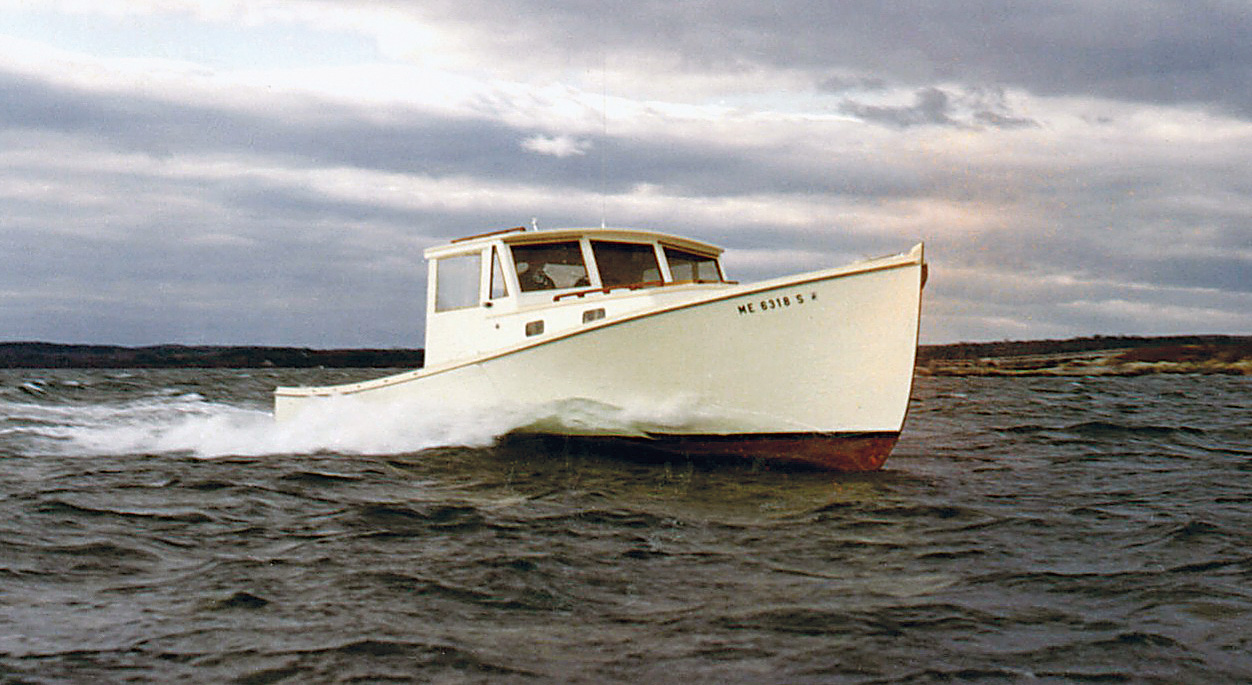 Lowell Family Collections
Lowell used the MARY LEE, a 35-footer that he designed, as the basis for his book, Boatbuilding Down East—How to Build the Maine Lobster Boat (first published in 1977 and republished in 2002 by WoodenBoat Publications).
In 1960, Carroll (Jamie’s father) left the family business to establish Even Keel Marine in Yarmouth. After his brother Royal’s death in 1983, Carroll began building boats of his own design, including the 37′10″ SEA SCRIBE, which the author Daniel Sheldon Lee called “one of the finest lobsteryachts ever built.” Soon he began selling his designs to other builders, including Peter Kass during his first years at Johns Bay Boat Company of South Bristol (www.johnsbayboatcompany.com); Kass went on to design his own hulls.
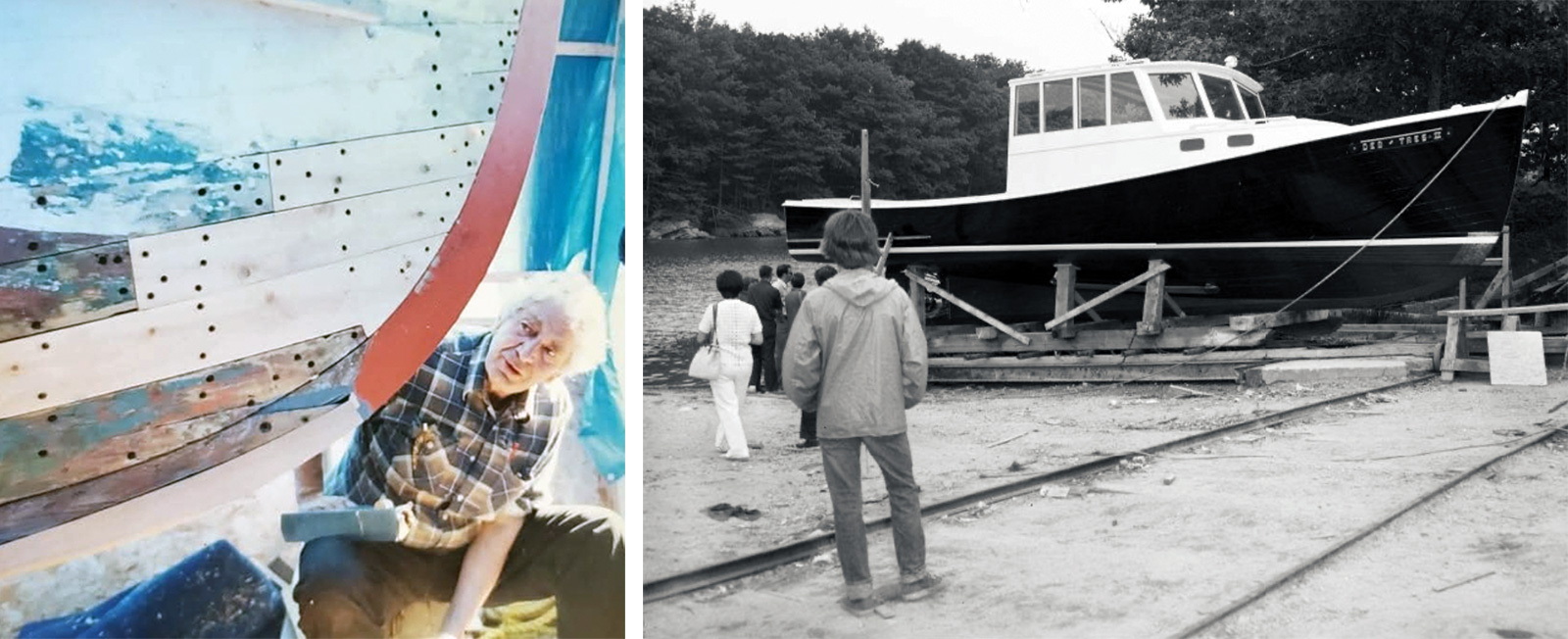 Lowell Family Collections (both)
Carroll Lowell (left), Royal’s brother, also designed and built boats. Among them was DEB AND TRES II (right) a 35-footer he built in 1972.
Like the rest of the family, Carroll’s education was hands-on, assimilating and absorbing generational skills and tricks of the trade. Jamie recounts his father’s story of how Will Frost would rough-out a design model and then have Carroll hold it to the floor as he took an adze and drawknife to it. Gradually the design would emerge, along with Carroll’s understanding of the process. The historian David Getchell notes that Carroll told him that by the time he was 12 he was on the way to becoming a designer and builder. He quotes Carroll as saying, “In the old days, a man would have someone hold something for him; this is how we learned. You couldn’t walk away from it. You were exposed to it.”
Carroll’s sons, Jamie, Joe, and Jessie, the current generation of builders, learned in the same fashion. “You would live it every day—right from when very young,” Jamie says. “Toys were a hacksaw, a coping saw, anything you can make from scrap cedar.” When they graduated from school, they began working with their father full time. As in generations past, they grew up immersed in the boatshop, and it was their playground. “You were there from the time you woke up until going to bed,” Jamie says. “It was non-stop boats. Even in the house, cedar, oak, and cigarette was the smell of Dad when we sat on his lap—he always had that smell of the shop. We never went on vacation. A family outing might be a trip to the woods to select trees for building or to the sawmill to see what might be right for the next boat. The kitchen was the model-carving center.
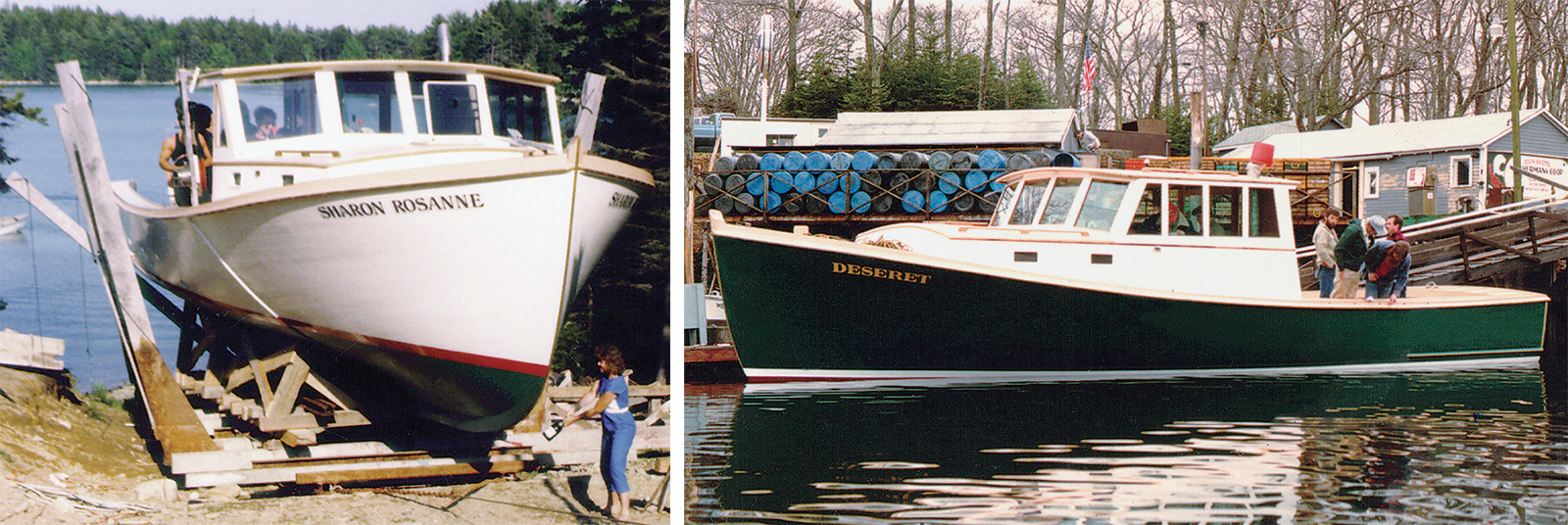 Lowell Family Collections (both)
In 1986, Carroll Lowell designed the 42′ SHARON ROSEANNE (left), the first boat that Peter Kass built at his Johns Bay Boat Company in South Bristol, Maine. Kass built about a dozen boats to Carroll Lowell’s designs, including the 38′ DESERET in 1987 (right), before going on to build boats of his own design.
“When we were little, we were aways there to catch the work as it came off the saws. You’d catch it with the palms of your hands so you can feel its direction as it was being cut. We’d always be painting something with Cuprinol or red lead from a coffee can. We’d be making bungs and installing them (we weren’t allowed to cut them off until we were older); puttying screw holes; and separating caulking strands and rolling,” Jamie says. To get the boys to clean shavings and sawdust out of the bilges, Carroll would throw in pocket change and tell them they could keep all they found in the pails full of detritus. They also were the clamp tenders when it came to steaming planks and frames. And there were always family members stopping by to kibbitz and tell tall tales and jokes.
The boys were also trained on the attributes of Lowell boats: Will Frost’s distinctive stemhead shapes; scallops carved in the skegs to facilitate water flow to the propeller; the rubrails and railcap profiles used by the family for a hundred years; the distinct tumblehome; the swooping sheer; the clipper-bow profile of the stem.
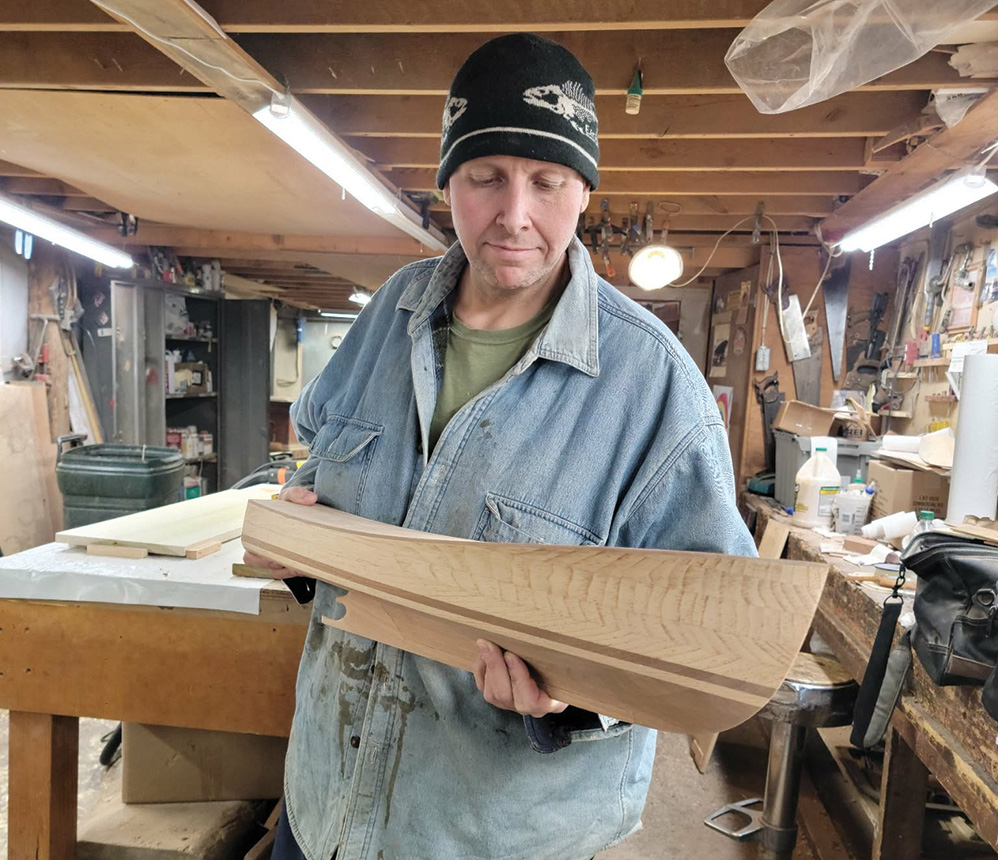 Nathanael Lowell
The Lowell family’s current generation continues in boatbuilding and design, but less so for wooden construction. Jamie holds a half model that he carved for his Lowell 38 design, using the same techniques that Will Frost used a century earlier.
“I’ve always considered myself an autodidact—self-schooled. All my design knowledge was learned from dad and the family,” Jamie says. Jess is more adept at computer design, while Jamie still likes using the drawing board, with pencil and pen on vellum and Mylar. “Dad encouraged us to draw,” Jamie says. “His uncle Donnie would get us paper from the mill he worked at, and the boys would always be drawing or lofting full-size, bending and sighting down splines and battens. To stare at a drawing that is 30′ long is priceless. Hard to do that on a computer screen.”
But times were changing. In 1997, Carroll designed his first hull for fiberglass production, the Lowell 43. Not long afterward, he suffered a heart attack and died, leaving his still-young sons to run the shop without their principal designer.
“We tried to make a strong effort to keep the shop running,” Jamie says, “but it was hard to pay the bills.” Always cyclical, the demand for new lobsterboats was low. “New wooden lobsterboat construction wasn’t possible. We started to introduce composite to pay the bills and for efficiency, marrying the cold-molded superstructure with the wood hull. And there was the repairwork. We couldn’t do production, so one-off boat construction was the mainstay.”
The Lowells and Frosts have been brilliant designers and boatbuilders. But they also seemed star-crossed, with catastrophic fires, disastrous hurricanes, bum contracts, a Great Depression, war dislocation, bankruptcy, and relatively early deaths. Long-term financial success eluded them. Jamie attributes the family’s perseverance to faith: “It’s the Frost and Lowell belief in God. Faith has kept the family together to keep on building. You wash your hands of the worry.”
It gives Jamie faith in his work, also. “You wake up at night, you get inspired and you write. I keep these notebooks of design and innovation for future use. There is the strong desire to create things that are different. The customer who wants something—that’s where innovation comes from, the challenge that just gained you two more knots.”
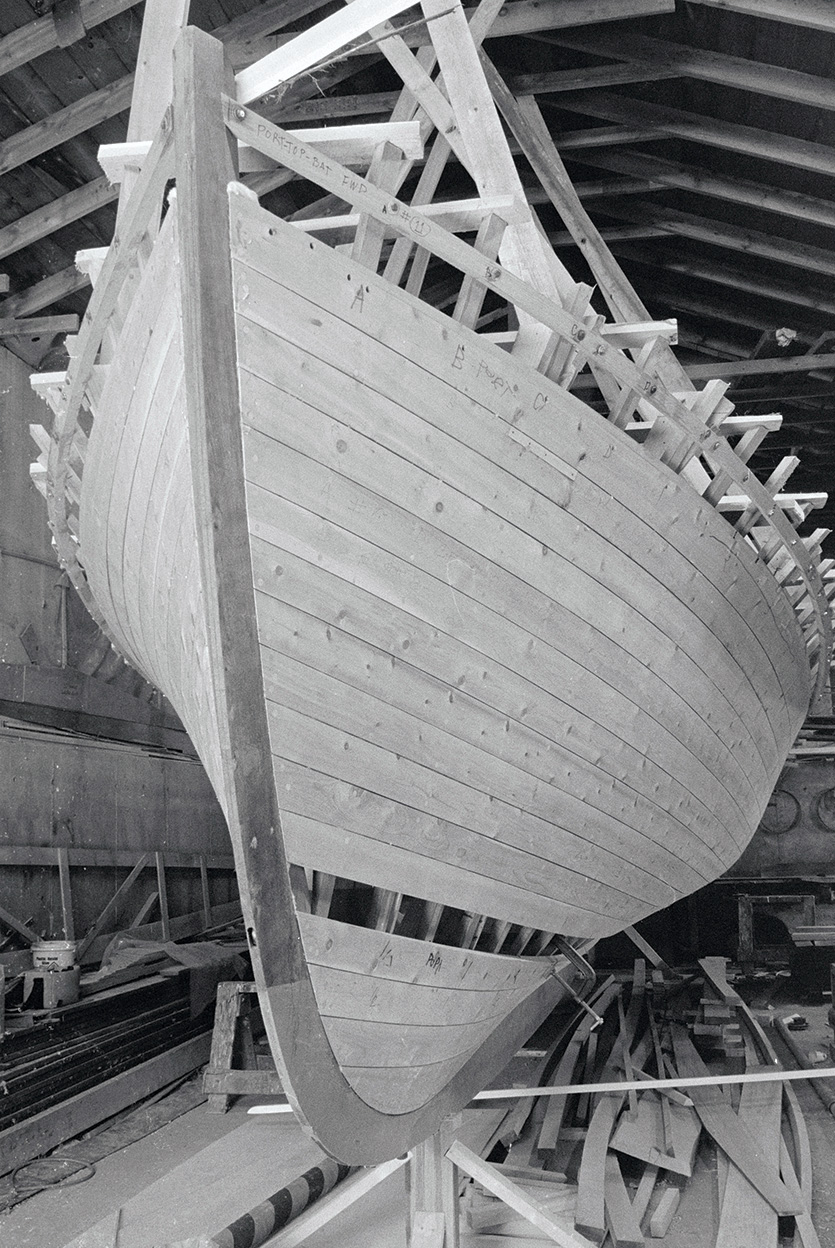 Penobscot Marine Museum/Maynard Bray Collection
Carroll always favored wooden hull construction, for example with TIMBERWOLF, which he built in 1988 as a redesign of Frost’s MERGANSER from 40 years earlier. Bowing to the inevitable, Carroll designed his first lobsterboat for fiberglass construction in 1997, just before he died. The wooden construction for which the family was known now involves mostly repair and joinery—but the skills remain.
Carroll’s sons have gone on to various marine careers. From 1997 to 2020, Jamie and Joe did business in Maine as Lowell Brothers/Even Keel Marine. But as in the past, the family members have settled into their own niches. Jamie’s middle brother Jess’s business is Lowell Boatworks, which specializes in aluminum utility vessels and catamarans. Joe, the youngest, holds up the wooden boat tradition with repairs at his Downeast Custom Boats, often working with Jamie.
Jamie’s shop, Lowell Building & Design, upholds his father’s tradition of design work. “Sometimes I wonder why I keep doing it,” Jamie says. “The family has been at it for so long. People should be inspired to create things. I enjoy calculating time, speed, and efficiency for performance for a patrol or rescue boat. What kind of power would it need? What would it take to build? What would be its limitations? Sure is fun just thinking about it.”
He feels that fretting about the future of wood construction is misdirected. “With wood construction, you can make a bad design good or even great. With composite parts like cold-molded cabins and epoxy and polyurethane paints, a wooden boat can stand up to any fiberglass boat maintenance-wise. And, in a way, maybe shops building in fiberglass have saved custom wooden boat construction, as it has relieved pressure on the lumber resource.”
And what of lobsterboats? “Actually, what we build is a fishing boat, not just a lobsterboat. Forty years ago, they were just fishing boats built to support all the other types of fishing.”
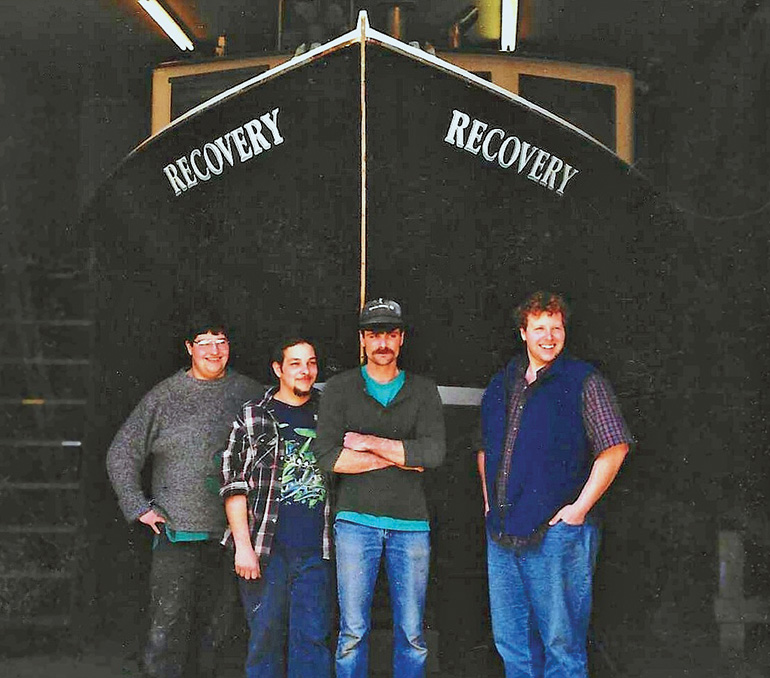 Ruth Lowell
The brothers Joseph (left), Jesse (second from left), and Jamie (right) were photographed with Jim Hanna, the owner of a 1976 Richard Alley lobsterboat for whom they rebuilt the deck and cabin.
He feels that electric power isn’t practical. “I see the business pretty much as always: Efficiency can be gotten by going back to the 3:1 length-to-width ratio. Lobstermen are cheap and are not going to pay more for untested new technology.”
Times have changed quite a bit over the six generations of Frost and Lowell boatbuilding, but Jamie stays firm in his belief in viability of wooden-hulled craft and efficient and elegant design, even though “people now buy from the waterline up and the inside out. I’ll build a yacht, or a plain boat. Whatever it is, it has to be good.”
So what about the future of this business of traditional wooden boat building in these days of composites, algorithms, and 3D printing? Has it gone the way of buggy whips and gargoyle carving? Royal Lowell wrote in his 1977 book that he thought not. “There are those who say that wooden boat building is through. Cheer up, people, there will always be a wooden boat. If you don’t believe me, go to a launching at an old wood boat shop, take a gander at the sparkling lady, smell the fresh bottom paint, and you tell me if wood boats are a thing of the past.” Those words still ring true today.

Greg Rössel is a contributing editor for WoodenBoat.