
 Matthew P. Murphy
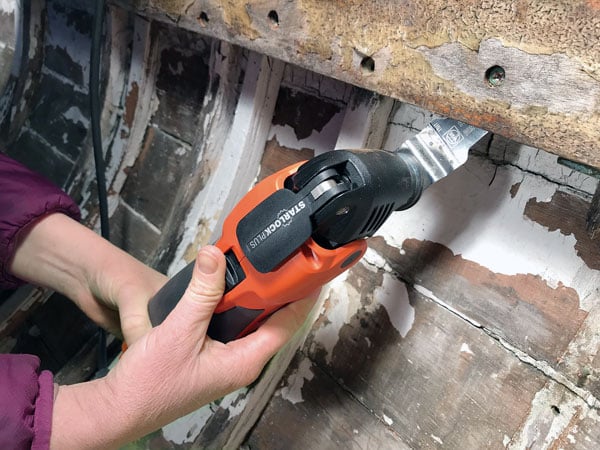
Oscillating tools have many uses in boat construction and restoration. A number of manufacturers make them; the one shown here is by the German company Fein, which first developed oscillating saws for medical professionals to use in removing plaster and fiberglass casts. For boat work, the tools, fitted with appropriate saw blades, are adept at getting into hard-to-reach places, such as behind this coaming to cut off an old screw.
Some of my best discussions on woodworking have been in the dental chair. Granted, given the circumstances, the chats at times have been somewhat one-sided, but mostly they concerned the similarities between the trades of dentistry and boatbuilding. From extricating rot, to mechanical joints, to miracle adhesives, my dentist and I have found a lot of common ground, especially on the matter of appropriate and sharp tools.
I suspect we all have had tried-and-true favorite implements that we swore we would never see the need to augment—they just work so well—until we have taken the challenger out for a spin. A well-tuned slick is a wonderful thing, but a sharp and powerful handheld power planer is just the ticket when attacking the miserably cross-grained face of an oak stem. There are few things as lovely as an antique Disston handsaw, but for fast cutting action with the minimum of effort it’s hard to beat those sharper-than-hell, piranha-on-a-stick Japanese saws. As an old friend once said, “I resisted them for years, but after trying one, there’s no turning back.”
Which brings us to the matter of the popular oscillating power tool.