

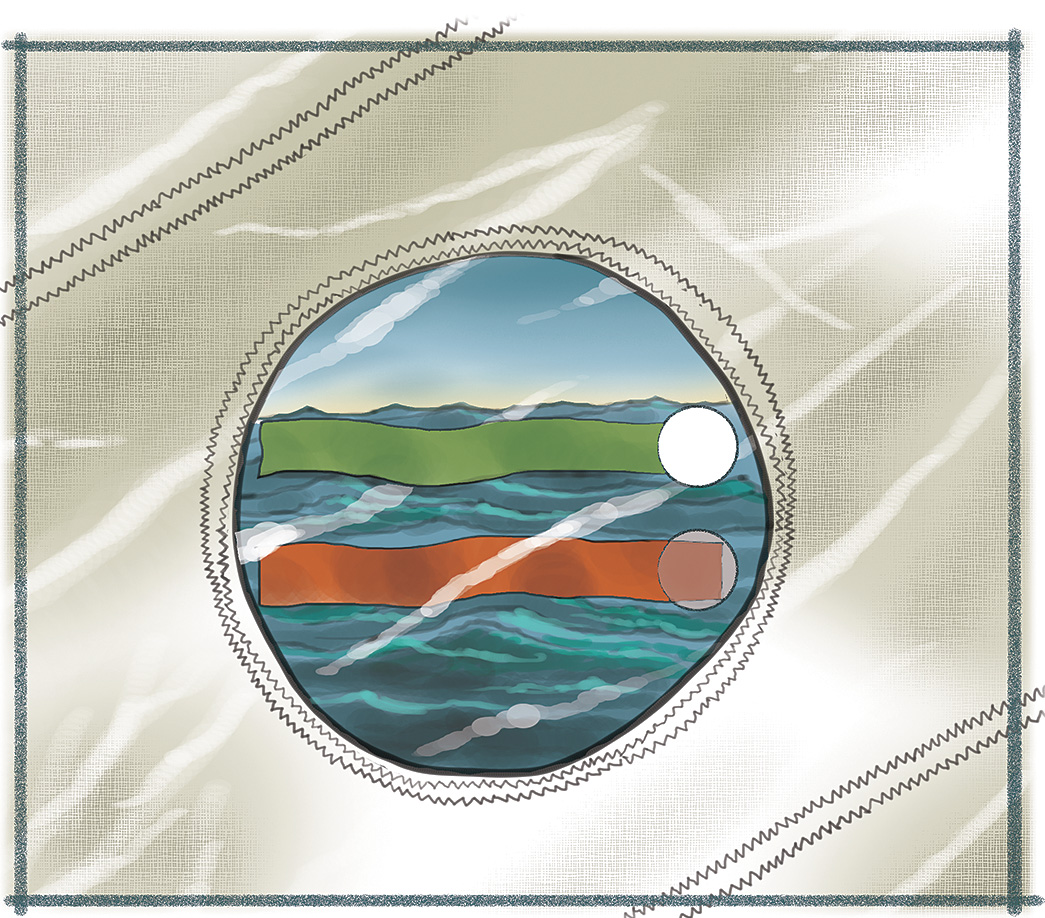
The telltales on both sides of the sail must be visible to correct sail trim. Normally, the red and green tapes can be seen through the sails with light behind them, but many sailmakers sew-in a see-through window to make sure.
Boating presents too many variable and unpredictable situations for mathematical analysis. It’s an art. As such, it draws on all your senses. You must see, hear, feel, smell, and perhaps even taste the inputs around you and your boat. You must open yourself to every clue available to every sense. You process them in a kinetic, focused response to moment-by-moment conditions.
Telltales can be the bits of yarn, ribbon, or tape fixed to a sail to serve as visual reporters of the sail’s performance—how efficiently it’s using the wind. Here, we’ll take the definition of “telltale” a step farther, to include some of the less-mechanical ways good skippers shape their performance. You may have learned theory, but until you “listen loud” to the clues all around you and your boat, the whole experience of becoming part of your boat and the wind and the water will be abstract. This is seat-of-the-pants business.
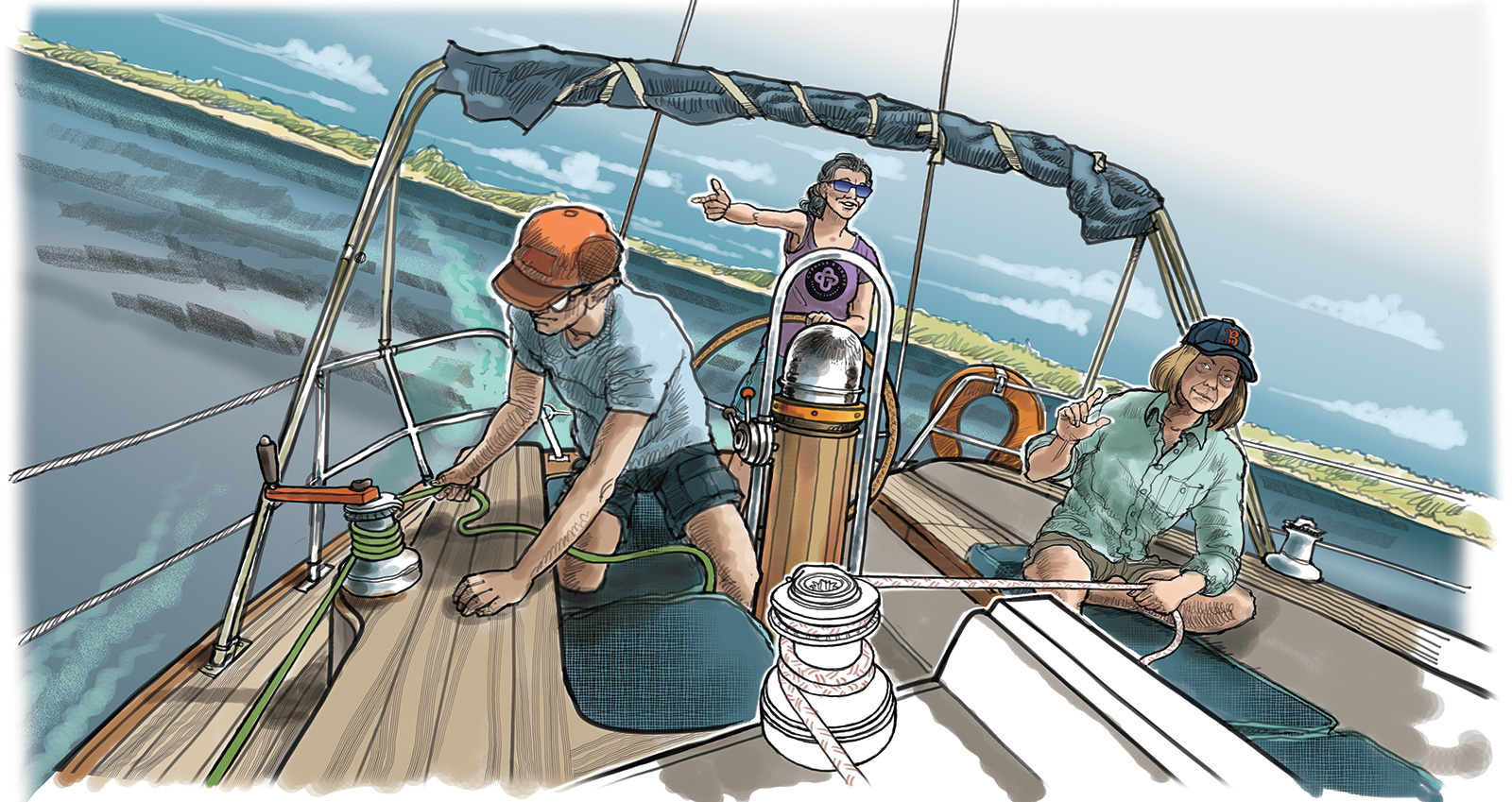
The helmsperson’s responsibility is to drive the boat on the navigator’s course swiftly, nimbly, and safely. The object isn’t perfectly trimmed sails, but optimum progress toward your destination.
The Helm Circuit
What informs the helm? A basic circuit of focus, a continual steering mantra: vane, sail set, compass, traffic. And repeat. Over and over.
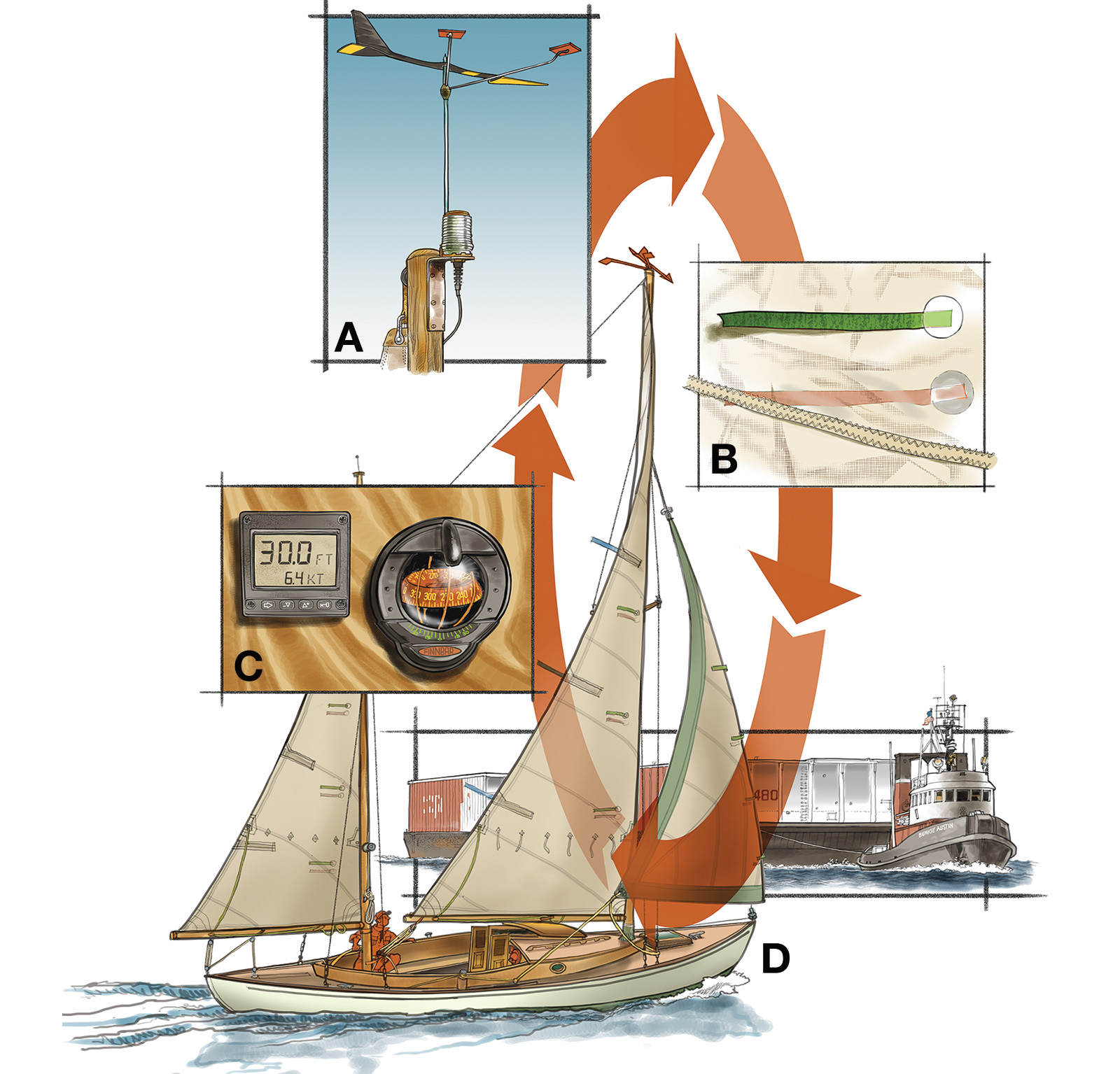
A. VANE: A brief glance at a masthead wind vane, with its two 45-degree reference guides, declares your relative angle to the wind. Your vane might be a light piece of material, attached to a shroud. Both this and the masthead variety report the wind’s angle relative to the boat.
B. SET: Judge the shapes of the sails and how well they’re trimmed for the conditions, especially the wind’s speed and relative angle. An out-of-trim sail might flutter in the luff. Excessive heeling could mean your sails are overtrimmed. Tape, yarn, or twine telltales installed on a sail can relay immediate performance factors. On the next spread, we’ll discuss how to read them.
C. COMPASS: Steering a straight course with economy requires a steady hand that feels the feedback from wheel or tiller and the impassive scend of the waves. This is a skill gained through experience.
D. TRAFFIC: Conditions change momentarily. Other boats can be hidden behind your sails. Your responsibility to your vessel and your shipmates is to avoid any encounters that are even remotely close. This is the heavy burden of duty to be shouldered conscientiously. Look out for trouble.
Laminar Reporters
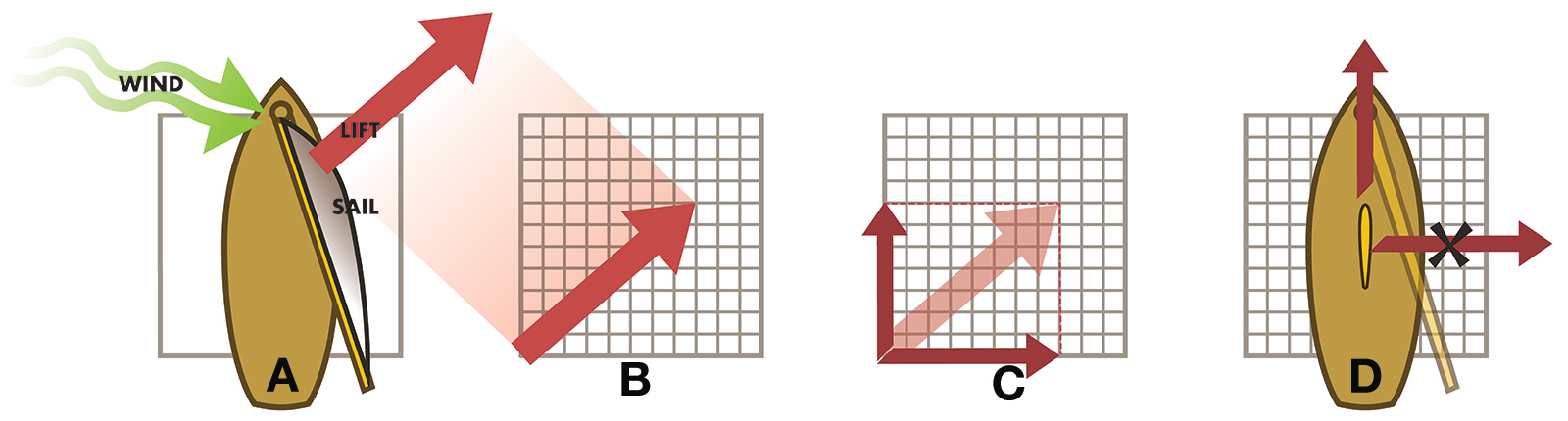
(A) Airfoil—the sail—redirects force of wind to generate a diagonal force: lift.
(B) Diagonal lift may be expressed as a vector.
(C) A boat under sail has two component vectors; one forward, one sideways (90 degrees).
(D) Sideways force is resisted by the keel, the centerboard, or leeboards. The boat is driven in the direction of forward vector.
A sail is a wing—specifically, an airfoil—that works to propel with complex physics. This wasn’t always so: early sails were more or less fabric baskets relying mostly on the physical principal of drag, and not lift, driving vessels with the impact of air molecules on their surfaces.
Fore-and-aft sails and more sophisticated sailmaking changed ship handling in the early 19th century. Privateers using Baltimore pilot schooners ran rings around the Royal Navy in the War of 1812, managing perhaps 35 degrees to the wind.
Several principles combine to make the airfoil generate lift, or for sailboats, forward drive. We use the living force of the wind to travel toward the wind’s eye. It’s like plugging into the sea’s electrical outlet. Two vectors: Essential to the understanding of sail forces is expressing a diagonal force as a pair of right-angle vectors—commonly, a forward component and a sideways component.
Lift: Several scientific principles explain the sail’s ability to redirect the wind’s force and produce a net force forward. Consult and ponder a physics textbook for the details, but accept that air rushing around a sail produces lift at a diagonal in relation to the boat.
Countering leeway: We cancel out the side force on a boat’s hull with centerboards, leeboards, or keels, and use the resulting forward force as drive.
Smooth moves: We want a smooth, unperturbed airflow around our sail. This ideal double blanket to windward and leeward is laminar flow, and it wants to be orderly, without kinks.
Laminar reporters: Strategically attached lengths of light tape, yarn, ribbon, or twine can gauge the smoothness of laminar flow. When the laminar flow is whole and orderly, these strips follow it straight along the sail. If the laminar flow becomes disturbed and loses its ability to generate force, the tapes jig, fidget, or droop. We place port and starboard pairs of these telltales 8″ to 10″ behind the luffs of our sails to report on the laminar flow. We also attach single ribbons to the sail’s leech to report on the orderly exit of flow from the sail. When telltales dance, they locate a force-robbing lack of laminar flow.
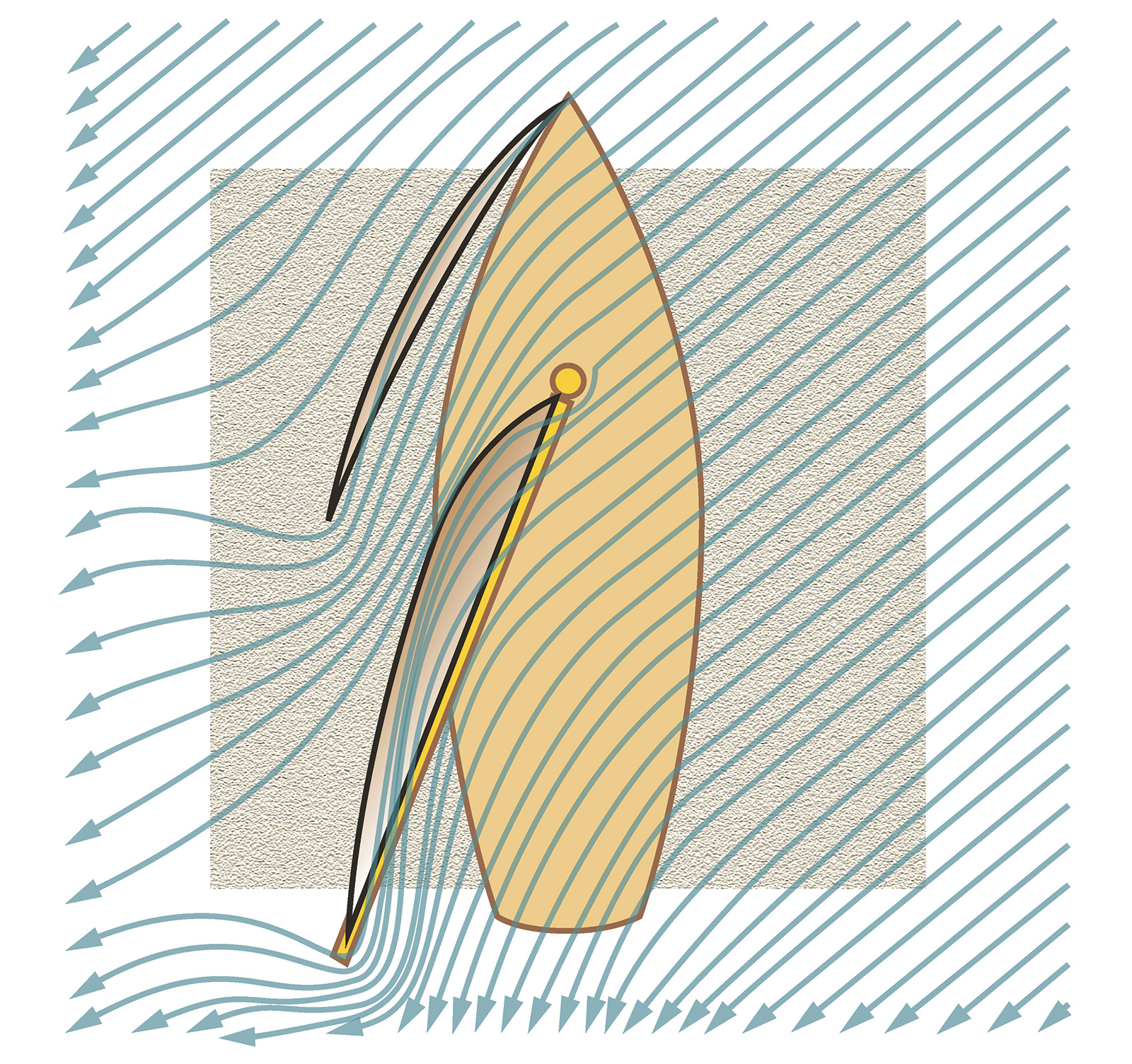
The slot between jib and main is a Venturi: a narrowing that increases the velocity of fluids (in sailing, air); when the fluids speed up, fluid pressure decreases. This change of pressure between jib and main improves performance of both sails. Optimizing slot geometry requires careful sail trimming. Telltales will help.
Works for old and new: Sail shape changes with age and condition. Telltales help you get the best from sails old or new.
Placement: Normally, there are three sets of port and starboard (red and green) telltales for headsails, main, and mizzen. Conventionally, the starboard sets are higher than those on the port to side so they can be identified through the sail. Three or four leech telltales on the main are most often attached at or near the batten pockets.
Geometric limits: Telltales lose reliability as the wind direction moves aft, especially when you’re running.
Rough-to-fine adjustment: Sail your desired course, then adjust your sails roughly, sheeting sails from aft forward until each luffs, easing a trifle, then fine-tune using telltales.
Laminar Flow
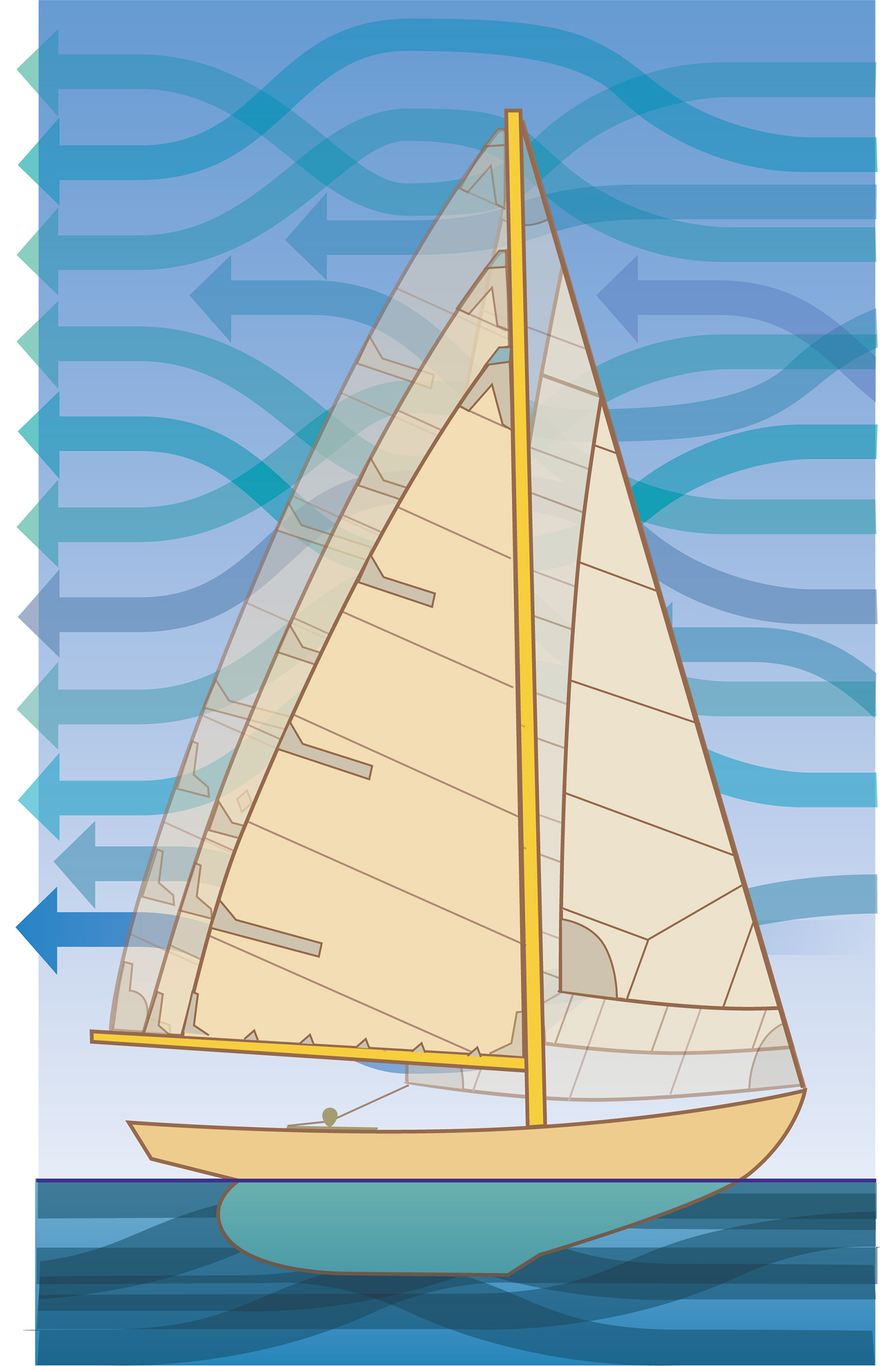
Overpowering: The most common mistake made by fresh skippers (and some that should know better) is overpowering the boat. If the wind picks up, reduce sail, and do it earlier rather than later. Reef down, sail your boat at its best angle of heel, and handle it easily. In heavy air, pay more attention to heel and weather helm than to telltales: both of these excesses are telltales themselves, telling you to reef. (See Getting Started in Boats, Volume 54, Basic Reefing.)
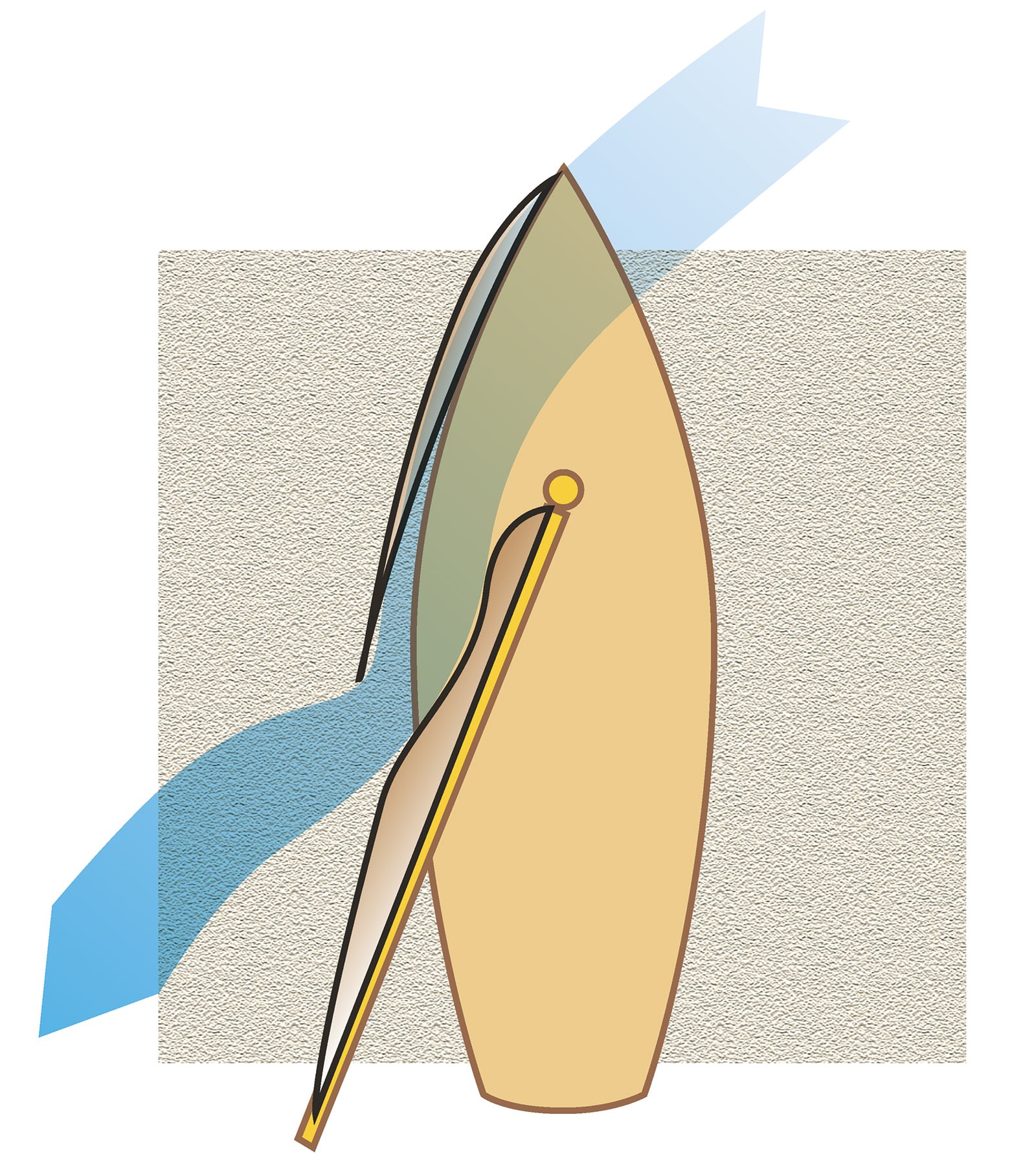
Overtrimming the jib can backwind the main and sabotage performance. Only trial-and-error experience can guide you in setting your sail balance. Recall the dictum, “You can never learn anything from doing it right.” Make useful mistakes and learn from them.
Reading Sail Set
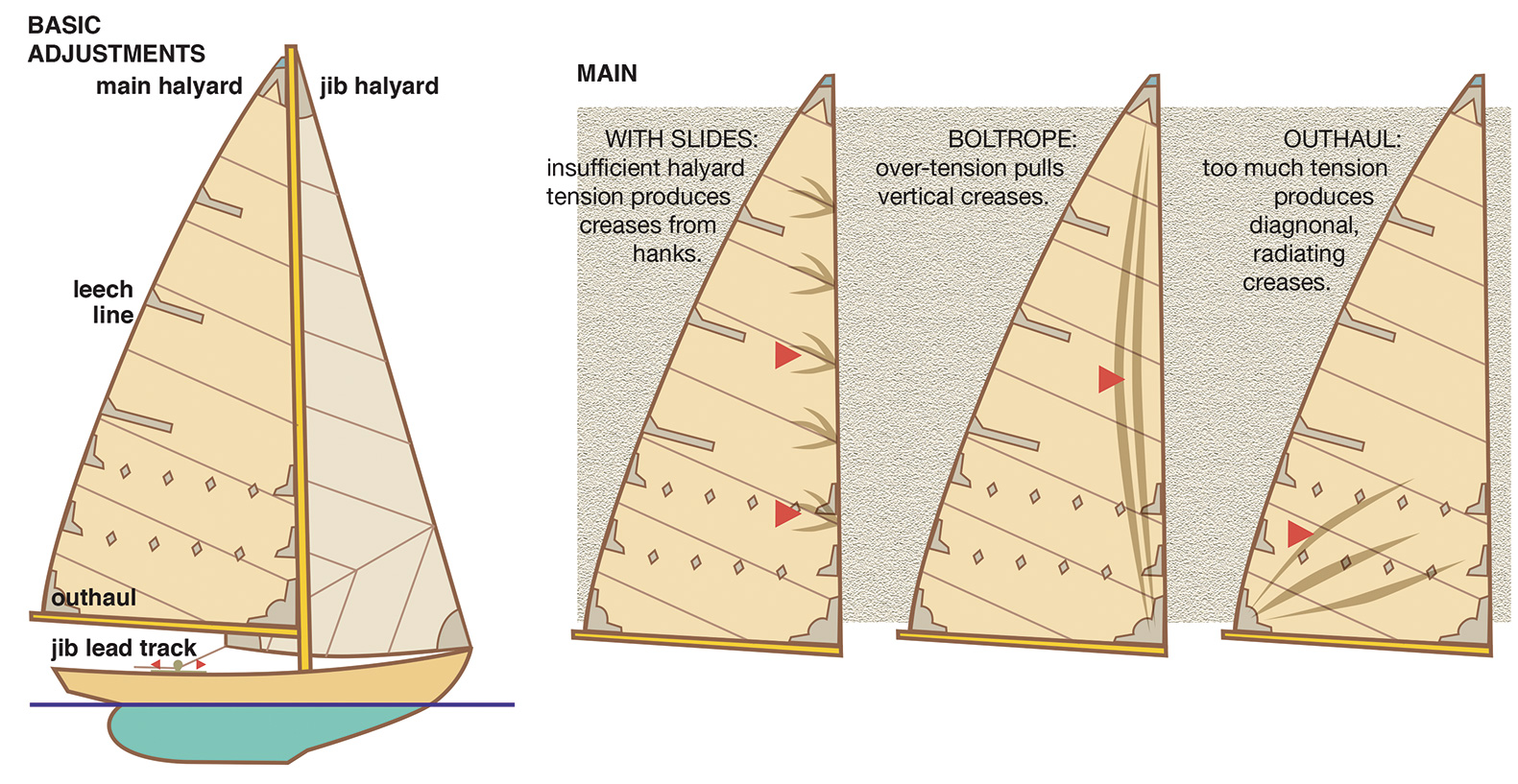
Let your boat speak to you. When you set your sail, over-stresses appear as wrinkle patterns. Every sail is a sophisticated airfoil: control its three-dimensional shape with halyard, outhaul, leech line, and (if you have one) the fore-and-aft adjustable jib-lead track that controls the angle at which the jibsheet pulls.
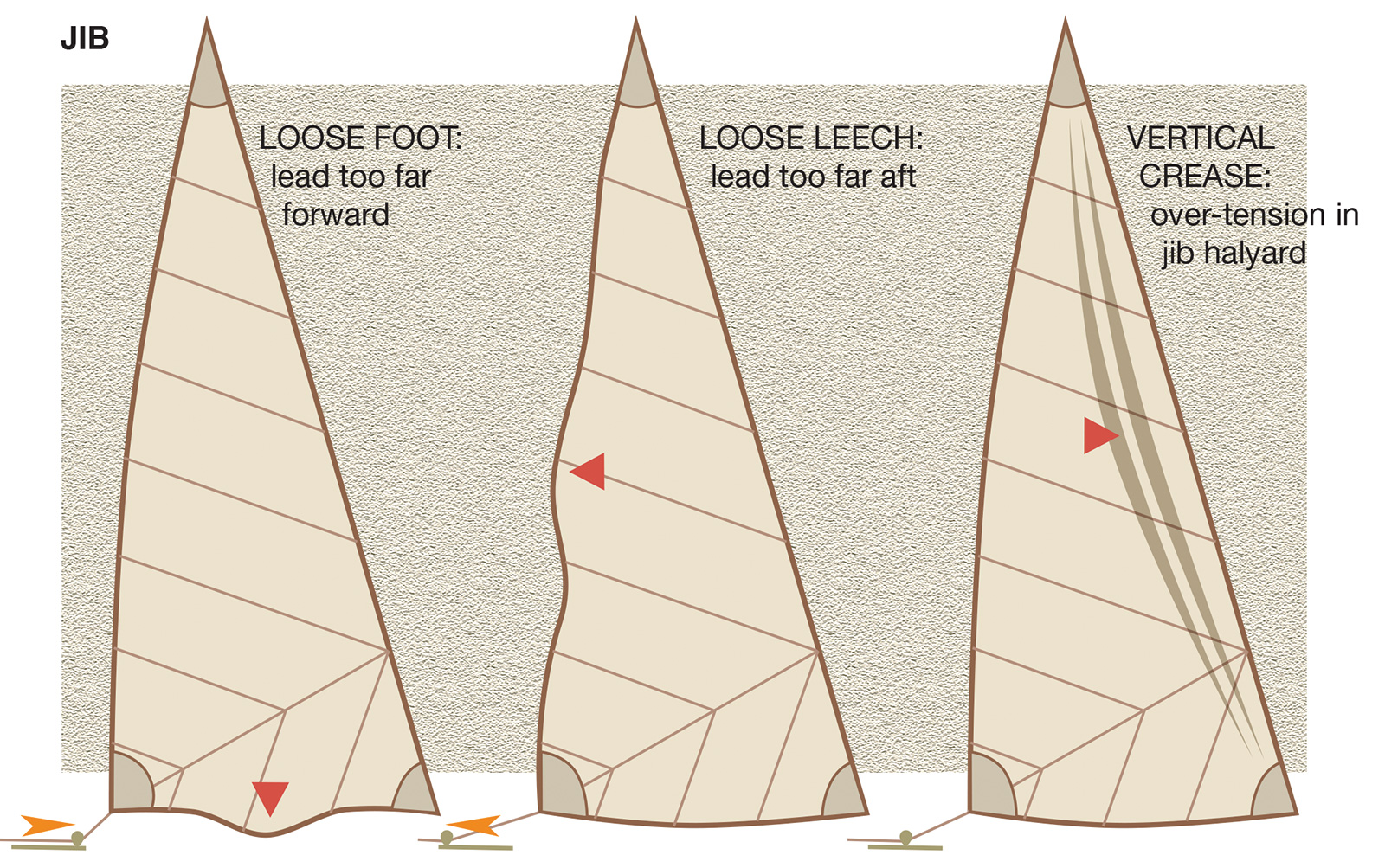
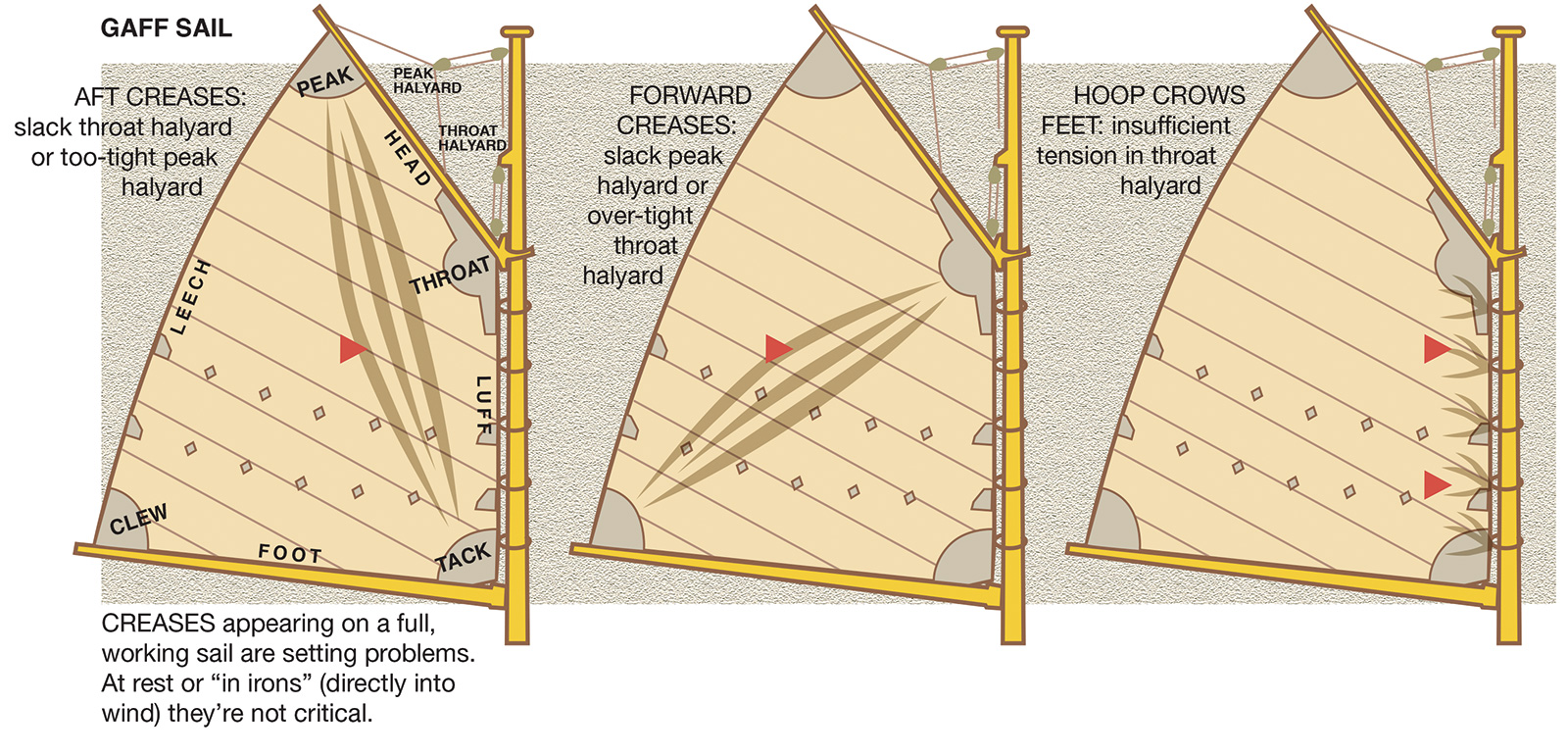
Reading Sail Trim
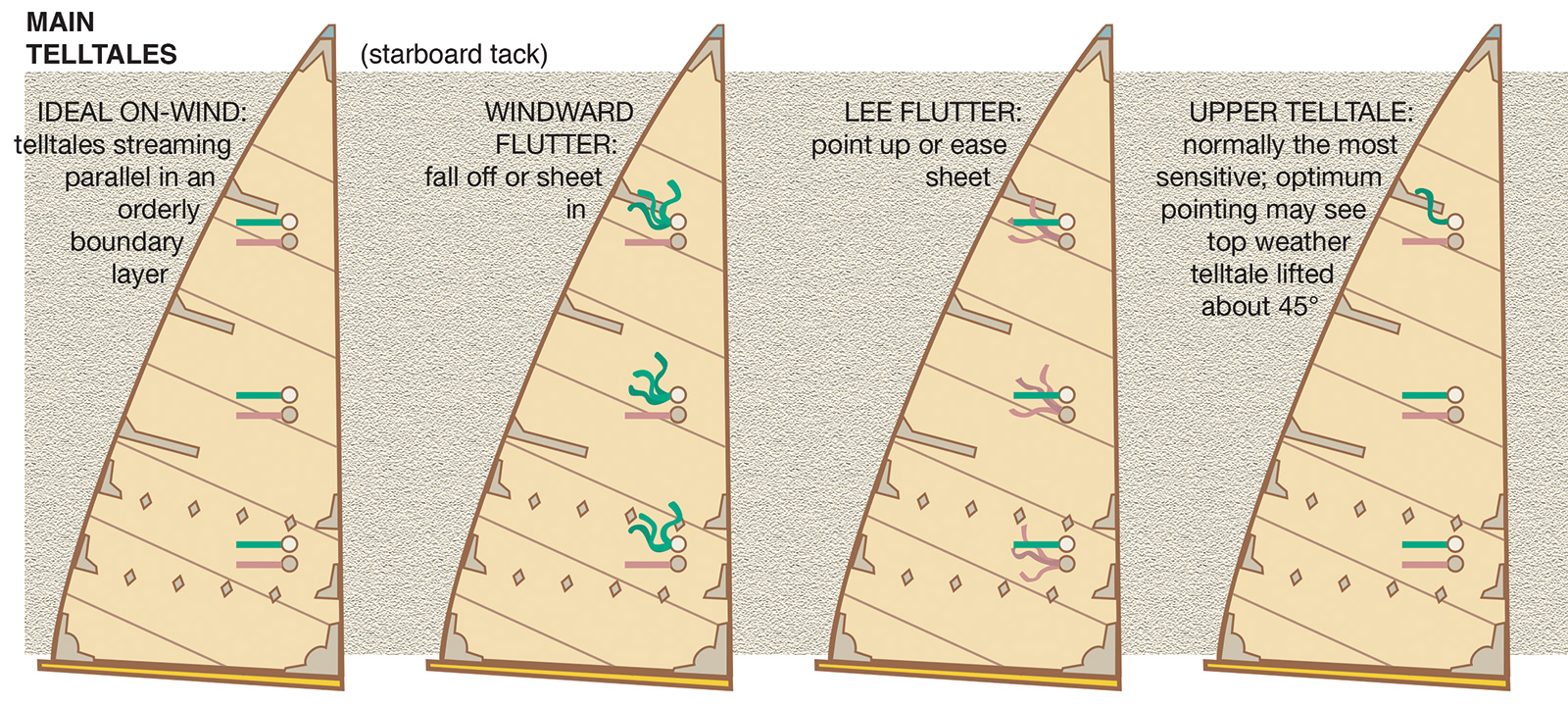
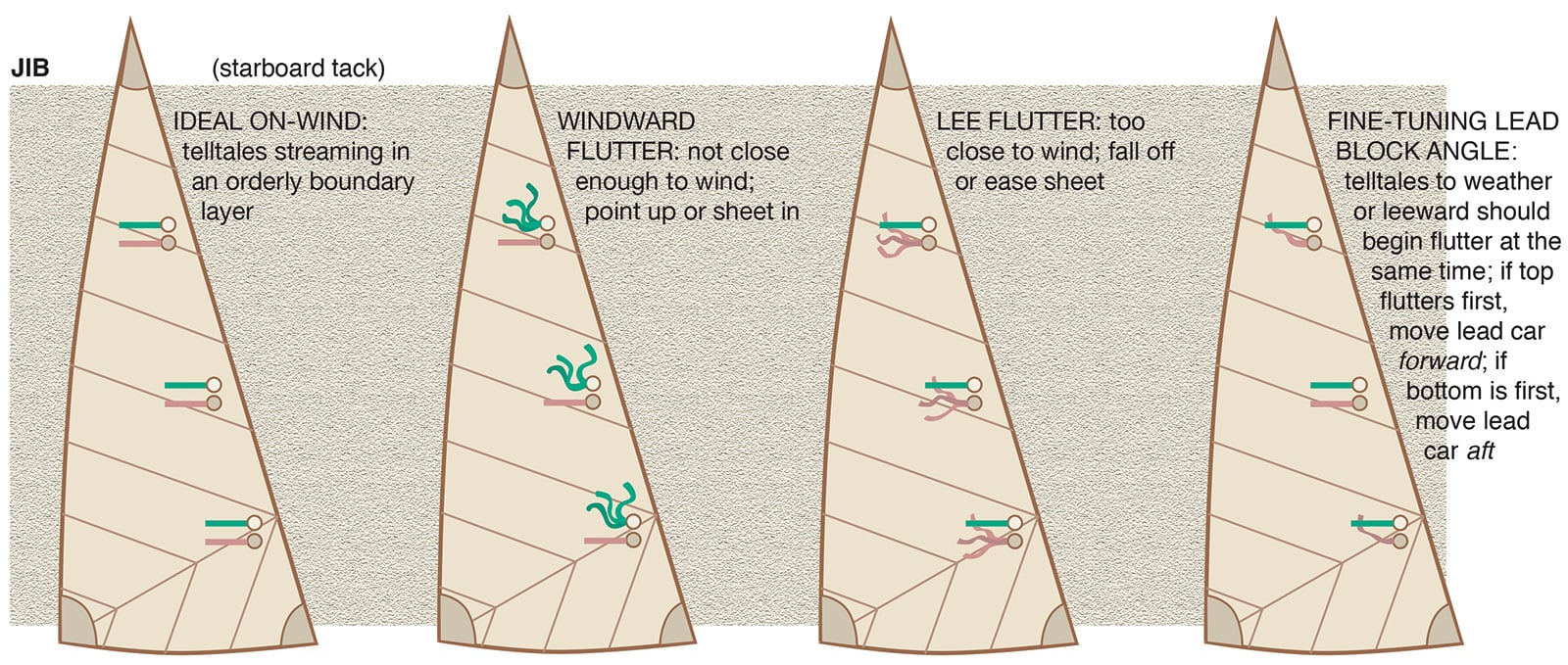
In short: If lee strip flutters, head up or ease sheet
If the windward strip flutters, bear off or sheet in
In light airs, bottom telltales often flutter—pay more attention to upper strips
EYE of the wind: the direction from which the wind is coming.
FALLING OR TURNING OFF: an incremental turn away from the wind’s eye.
POINTING OR HEADING UP: a cautious turn toward the wind’s eye.
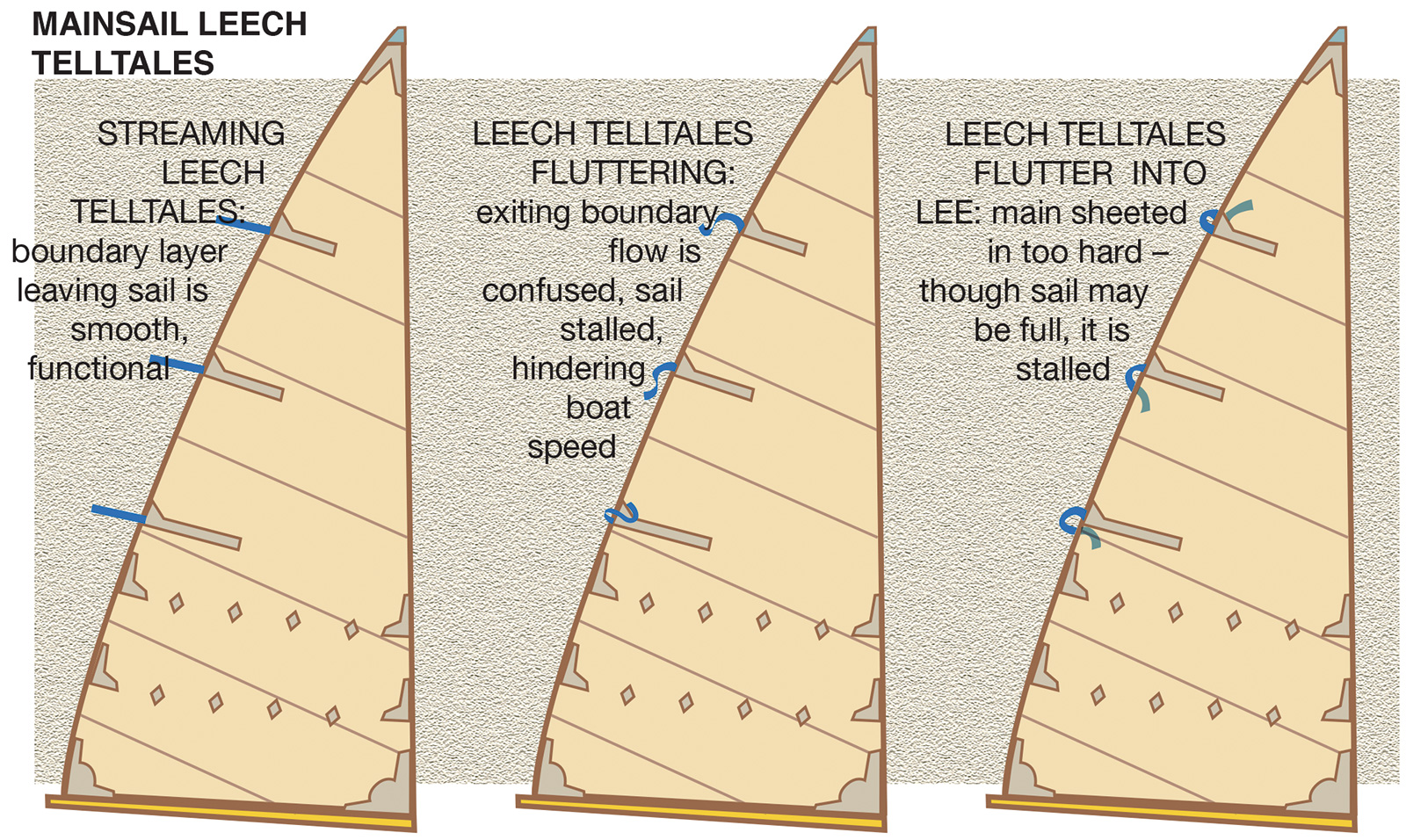
You can also tell you have a stalled mainsail when speed is reduced. If you don’t notice your speed, you’ll still observe that the boat either crabs, meaning it makes excessive leeway, or weather helm increases. Correct the sail trim to gain speed.
If the telltales flip, droop, or flutter behind the lee side of the mainsail, the sail is stalled; ease the mainsheet.
You aren’t born with good judgment or the ability to read all the signs; experience is the only source. Use every telltale to guide you. Remember that the goal is not perfectly set and shaped sails, but is progress—in other words, making your boat sail toward your mark. Choose boat speed and ease of handling over perfect shape. For example, you may fall off a bit and have fluttering telltales with good speed, rather than stall out upwind with perfect sail-set and telltales streaming. Fall off how much? Use your judgment.
Cruising Telltales
We were in a smoky sou’wester, visibility about 500 yards, when a tern flew past carrying a small fish. “Ah,” my old-school skipper murmured, and checked his compass for a direction. “What?” said I, asking myself if my friend was in communication with mystical bird friends. “Terns. They nest on Bird Island. He had dinner in his beak so he was headed right for Bird. It’s a good bearing.”

Lobster pots and shore bearings talk to you about currents and crabbing courses. Watch trees and buildings ashore for parallax clues to how your compass course differs from your course-made-good.
A dog that doesn’t bark was a clue in one of Sherlock Holmes’ adventures. Lights that don’t appear when sailing at night may indicate an anchored tanker, a barge, a black hole in normal light distributions filled by something hard and dangerous.
Friendly rocks are local-knowledge telltales—gauges of tidefall and depth. If “The Ox” or “The Anvil” isn’t awash, the tide is high and you may be able to infer depths over other submarine obstacles.
Diesel exhaust color indicates performance variables: White: fuel not burning. Black or gray: incomplete fuel combustion. Blue: burning oil.
Crew telltales: On a hot day, with too much sun, your crew’s performance will suffer if they’re not hydrated. On a heavy-weather day, with the associated pitching and rolling, a seasick crew member is courting dehydration, as well. Dehydration is serious business affecting performance and even logic.
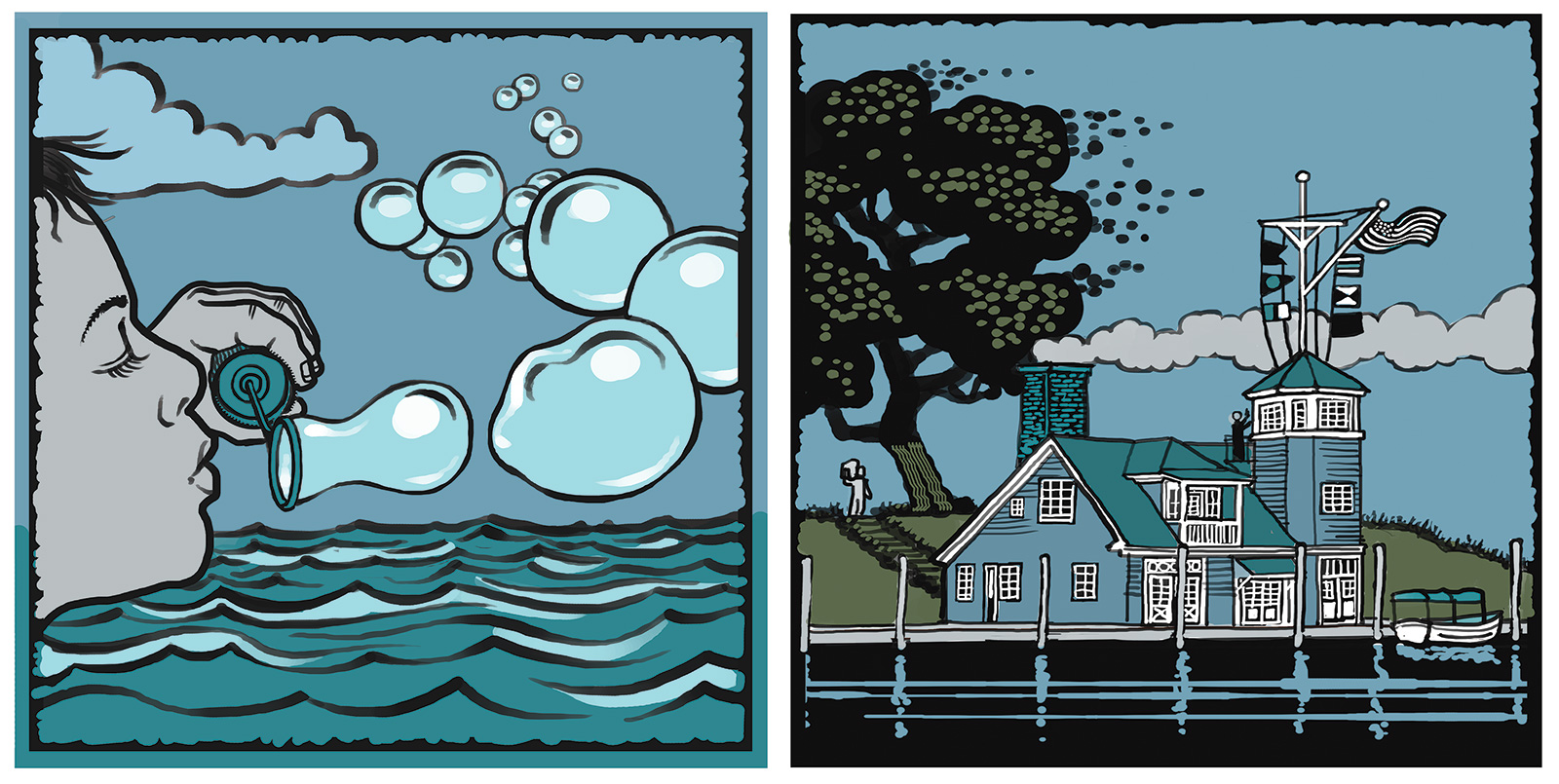
Telltale for dead calm: When you can’t feel a breath of air, a jar of kids’ bubble-blowing liquid and a wand make can give you the most delicate of wind indicators.
Red alert: Reflection of the sun from water doubles the danger of sunburn. SPF 50, spare hats, dodgers, and biminis are the prescription. Recently we’ve dealt with the grief of friends’ deaths from skin cancer. This is a non-trivial threat. Sunstroke is also a serious matter.
Dire symptoms: A good skipper is responsible for everyone aboard, and for telltales of impending trouble. Be aware of early symptoms of heat stroke, dehydration, heart difficulties, asthma attacks, stroke, and diabetic imbalance. The first step in first aid is to head for port.
Flags on shore, smoke from chimneys, cat’s-paws on the water: be aware of the three-dimensional quality of the wind and how it’s moving.