
“But where, after all, would be the poetry of the sea were there no wild waves?”
We’re beguiled and held by the spectacle of surf leaping at the shore, yet the surf is a magician’s trick, a sea’s deception. We’re persuaded that the ocean is rushing to the beach, and though the biggest waves tear and reshape the sand, we’re not seeing a landward flow of water. Local currents may transport water, but waves don’t. A single molecule of water in a wave lifts with a wave, rotates down and back up in a circle of a few feet, but stays in place. The energy travels, not the water. We mariners live with the waves, travel through them, and think of them as our sea, so we should understand the answer to this question: what is a wave?
A wave is a packet of energy moving along the interface between water and air, using the water as a transport medium. Where does a wave start? It can start around your boat. With sails hanging limp in a dead calm, we see and feel a catspaw, the first breath of a breeze, as it ruffles the surface. The friction between wind and water creates the first capillary waves. As the wind picks up, we might hear the slap of waves built by stronger winds.
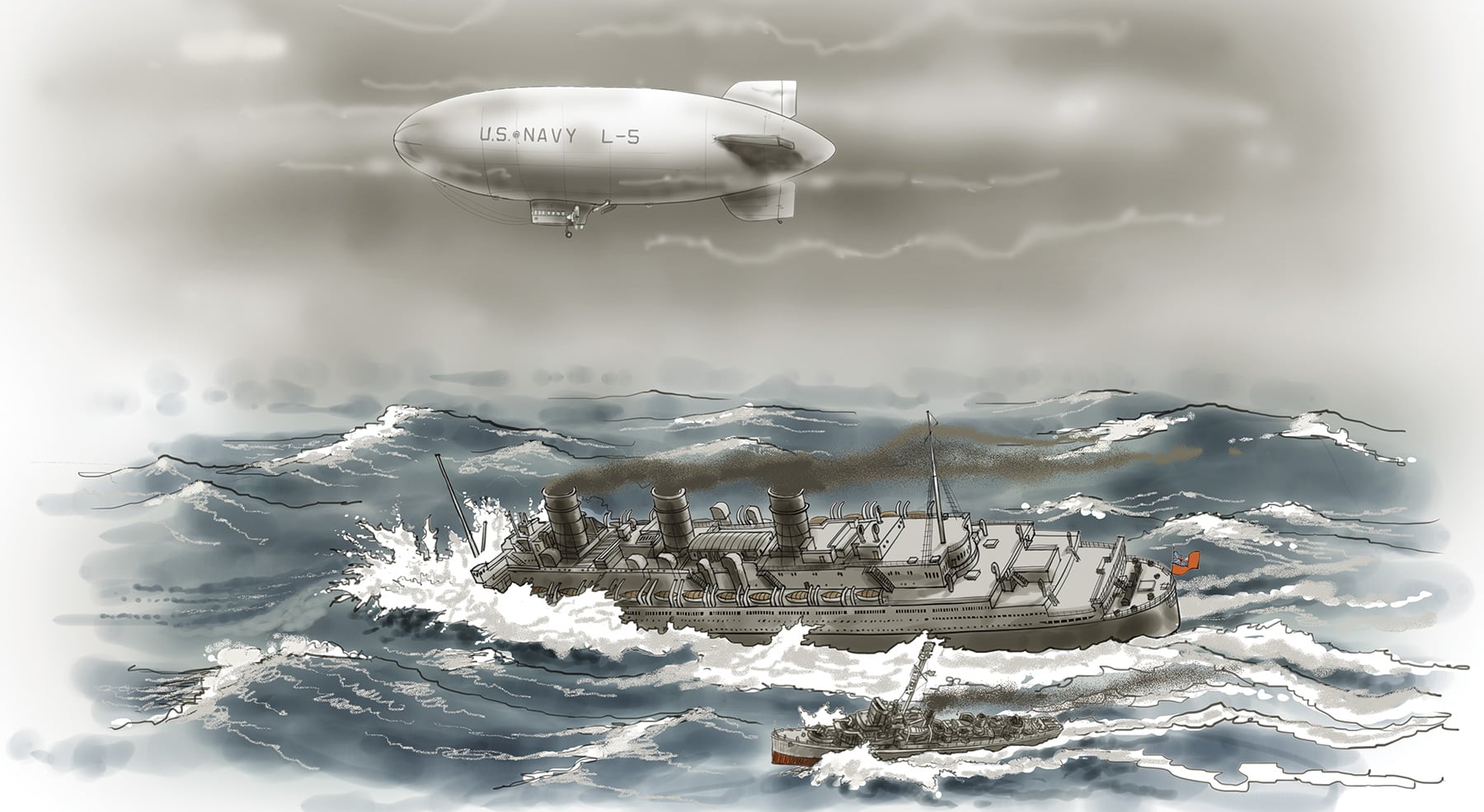
In December 1942, QUEEN MARY I, a luxury ocean liner serving as a World War II transport with 16,000 troops aboard, encountered a rogue wave. Brief and dangerous, the wave was photographed by a Navy K-1 antisubmarine blimp; it was a deep trough in the water followed by a nearly vertical wave that broke green over the bridge deck, 90′ above the water’s surface. Before this, the maximum wave height recorded had been estimated at 60′.