
 BRUCE SCHWAB
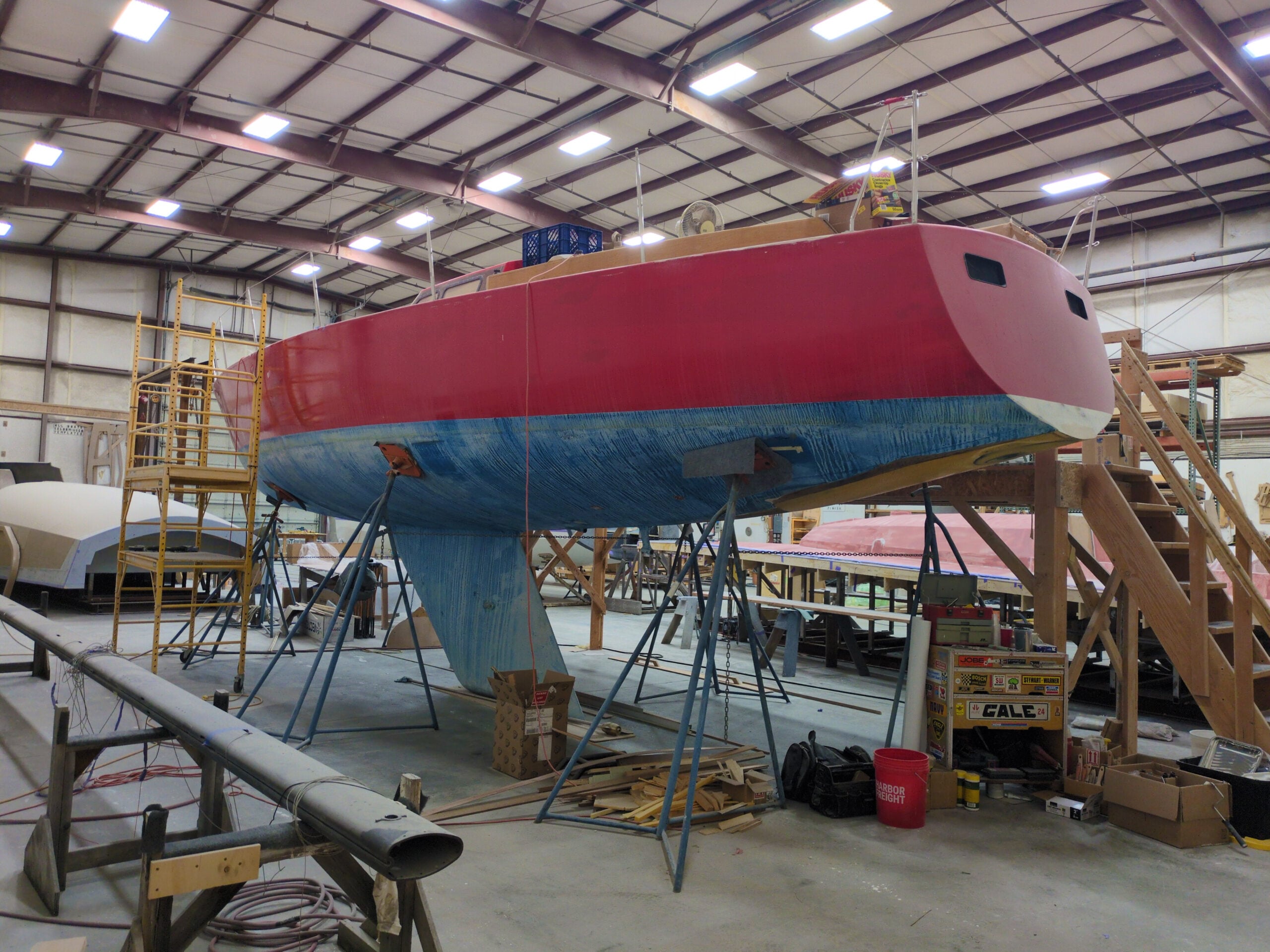
IMPROBABLE, a Gary Mull–designed 42’ racing yacht cold-molded of kauri in New Zealand in 1970, is undergoing a thorough refit in Anacortes, Washington, under the hands of Bruce Schwab, whose family has owned her since 1976.
—Noted ocean-racing sailor Bruce Schwab has been regularly traveling from his home in Maine to the James Betts Enterprises boatyard in Anacortes, Washington, where he is largely singlehandedly restoring—and reimagining—the 42’ racer-cruiser IMPROBABLE. The 1970 cold-molded yacht, designed by Gary Mull, is the boat that started Schwab on his long career as a professional sailor, boatbuilder, rigger, and systems developer.
Schwab’s father bought the yacht in 1976 in California at the end of a three-year family cruise that started when Schwab was just 13 years old. Schwab’s first alteration of the boat—done when he was still high-school age—was to reconfigure its rudder to make it lighter and more efficient. On the 2018 death of his father, a prominent engineer who alternated between Boeing in Seattle and Lockheed in California, Schwab inherited IMPROBABLE, which his father had continued to sail in Puget Sound well into his 80s.
Schwab’s refit of IMPROBABLE (see www.projectimprobable.com)—including another rudder reconfiguration that he had been thinking about for decades—draws on his years of experience in California, Maine, and Washington, which has included considerable ocean racing and his founding of first a rigging company and then a boat systems company. Among his own projects was a 1993 refit in California of the 1930 Abeking & Rasmussen–built 30 Square Meter RUMBLESEAT, modified for offshore racing. In 2001, he also famously had Schooner Creek Boat Works in Portland, Oregon, build an Open 60 racer to a design by Tom Wylie with Schwab’s input. In that boat, OCEAN PLANET (see WB No. 188), he completed a solo circumnavigation in the 2002–03 Around Alone Race and went on to be the first American to complete the Vendée Globe nonstop solo circumnavigation race, placing ninth in 2004–05 in what was the climax of his work with ultralight ocean sail racing.
“IMPROBABLE was the boat that got me going,” Schwab recounted in one of the nearly 30 videos (so far) on his website, www.bruceschwab.com. “I’ve learned a lot since, so I’m finishing the job that I started 40 years ago.”
 BRUCE SCHWAB
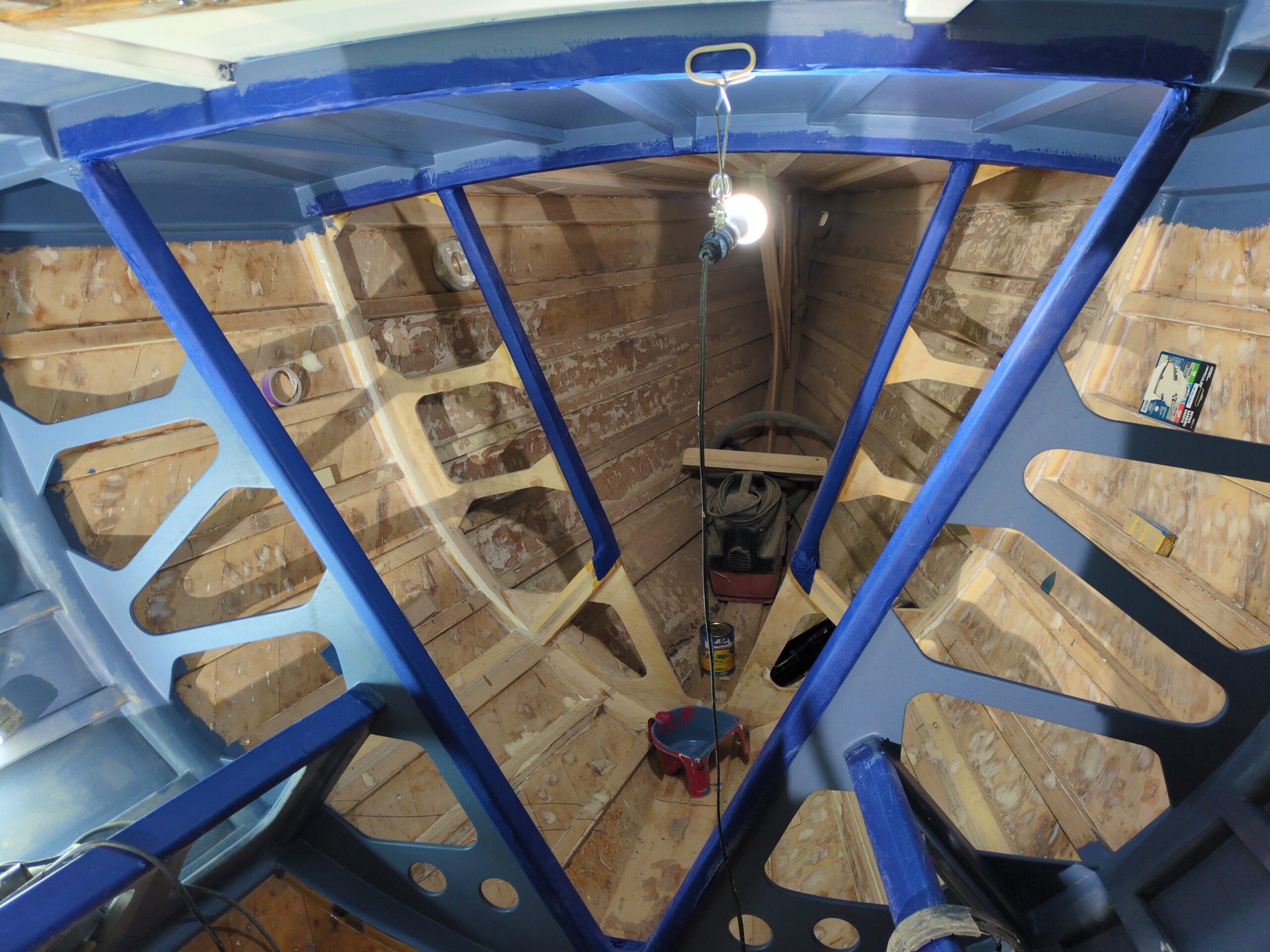
Belowdeck, Schwab has reworked existing bulkheads to retain strength but save considerable weight—a theme that has run through every facet of his restoration. The interior work involved first painstakingly grinding off paint to expose bare wood for refinishing.
IMPROBABLE was cold-molded in New Zealand in 1970 using three layers of kauri, two inner diagonal layers and a final longitudinal outer layer, over longitudinal stringers. Schwab aims to make the yacht stronger than original but 1,000 lbs lighter. The new rudder is one example of something strengthened but saving weight: its bearing rides in a shaped G-10 tube laminated into the hull along with a robust carbon-fiber hull section faired into place. He had design and engineering help, including from Larry Tuttle, who also designed OCEAN PLANET’s rudder. Otherwise, the hull will remain the same.
The rig will be entirely replaced with a repurposed Farr 40 carbon-fiber mast taller than her original aluminum one but much lighter, with a boom 17’ long instead of 15’. Her mainsail will be larger than original, and she’ll have almost no overlapping headsails, which will simplify tacking and minimize jib changes when shorthanded. Instead of 14 winches on deck, many of them for the yacht’s complex but heavy cross-sheeting system, she’ll need only six, saving weight. Further weight savings on deck extend to such things as an anchor roller much lighter than her previous one and a flush-mounted foredeck hatch replacing a scuttle. “This boat’s going to be absolutely lethal in light air with the taller rig, and that’s key for Northwest cruising,” he said.
Schwab has most recently been focused on reworking the interior—first with a seemingly endless task of grinding paint back to bare wood. He is reworking chainplates, framing, and blocking to suit the new rig and reconfiguring bulkheads—always with weight savings in mind. His company, OceanPlanet Energy, specializes in battery systems, so he’s planning to have a 51V lithium-iron-phosphate bank with an American Power Systems 130-amp, 56V alternator on the existing Yanmar 3JH2-TE diesel engine. The system will save weight by negating the need for a stand-alone generator and also open the way for updated appliances, such as an induction stovetop and an electric oven.
“My dream with IMPROBABLE is to make it as fast as I think it can be,” he said, with another Transpacific Yacht Race possible. “This was a famous raceboat, and I want to do it justice, to be all it can be and reach the potential of what its initial concept was or was supposed to be.”
Written by Tom Jackson for WB No. 314, January/February 2027.