
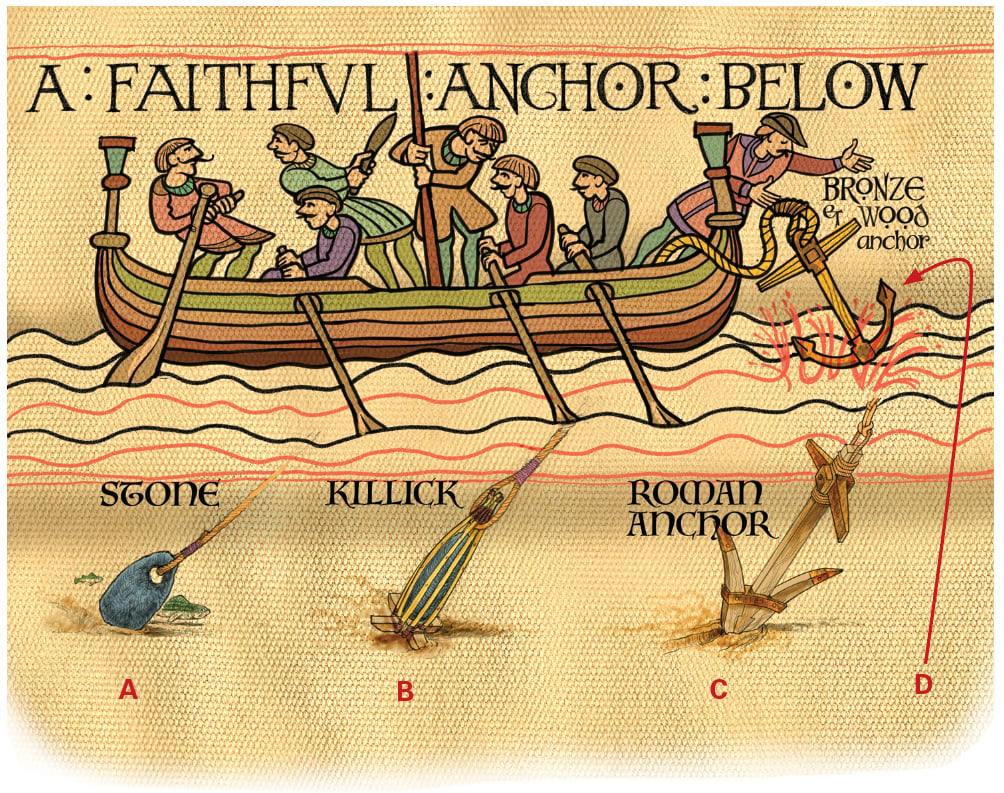
Learning how to make a boat go is hard enough. How does one make it stop, safely, all night, even when the weather intrudes? It’s an ancient problem. Xerxes took his army across the Hellespont (about 1,250 meters, or about three-quarters of a mile) in 480 B.C. on a pontoon bridge, each bireme and trireme anchored bow and stern. The march took seven days and nights. They had good anchors. Xerxes also had good engineers.
What about rural fishermen who found a likely spot for jigging flounder and wanted to stay there? Stone Age anchors were killick stones A, heavy and smooth, with a hole bashed through to bend on a rode (anchor line). Did they hold their ground?
Here’s the first and ultimate lesson in anchoring: what kind of ground, or bottom, will the anchor encounter? If the bottom were alluvial mud, the weight of the killick stone and the tug of the boat would sink it into the ooze, so the rode tension would amount to more than the stone’s weight; the boat would be pulling against the additional weight of the mud around the stone.
But bottoms may be gravel, stones, big rocks, coral, weed, or sand. That killick stone would skate right across a weed bed. Primitive fisherfolk weren’t ready to cast metal, so they used what they could shape into a killick B: heavy rocks bound into a withy basket—flexible branches lashed to a helpful geometry of wooden grabbers that might catch a rock or a root. It was a big improvement.