
 Gloucester-Mathews Gazette-Journal, Gloucester, Virginia
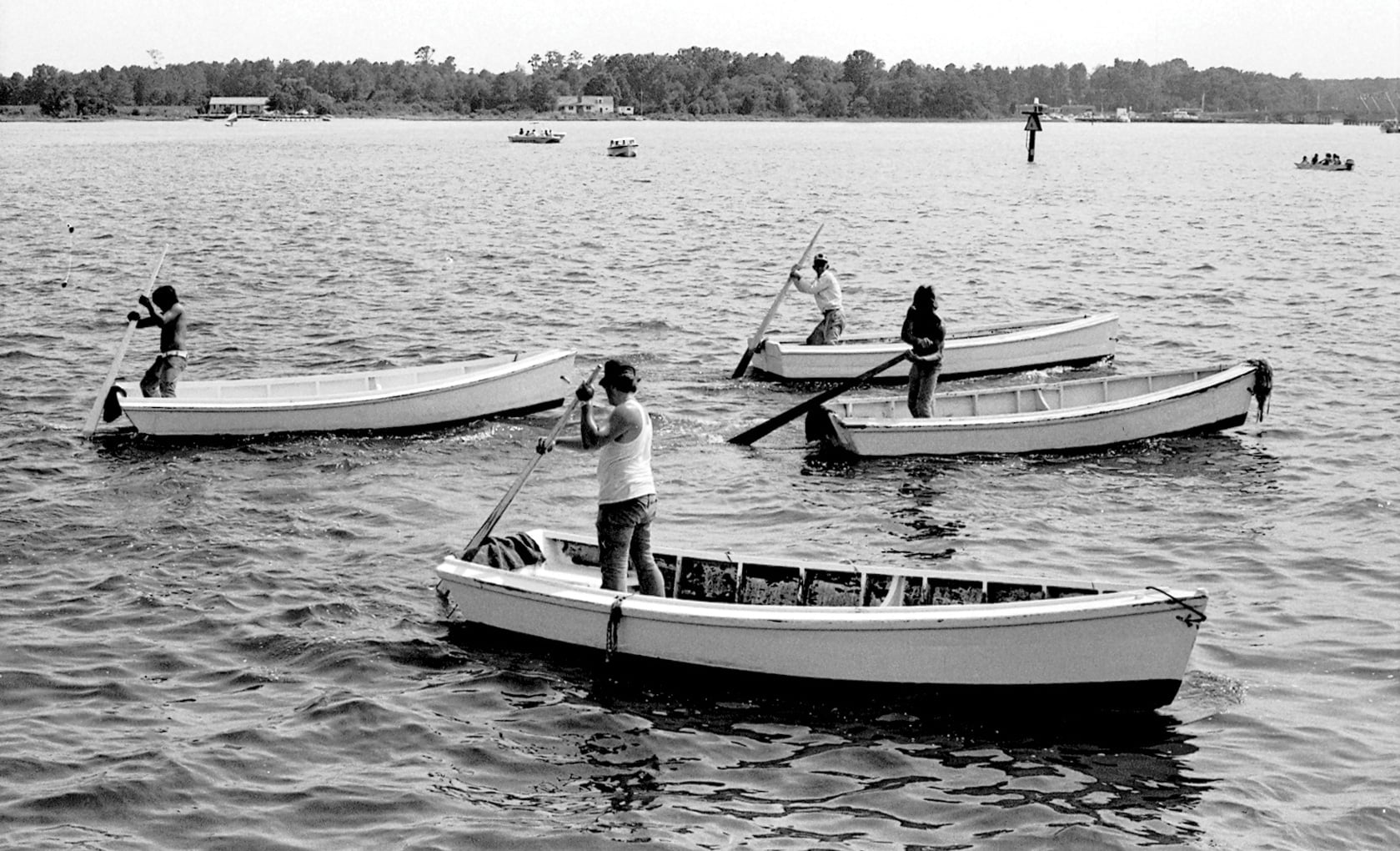
From the early 1960s through the 1970s, fishermen showed off their sculling skills at the Gwynnes Island Festival in Mathews County, Virginia. Note the use of burlap sacks to provide friction and help improve purchase on the sculling post.
I have the good fortune of being from the same tiny town on the Chesapeake Bay shore where my dad grew up and my grandfather farmed and planted oysters. When I was growing up, that meant hearing lots of stories from “back in the day,” and one that stuck out was how my dad learned to scull in the manner of local watermen.
As a boy in the early 1950s, my dad could walk out his back door and see the bustling world of the Rappahannock River on Virginia’s western shore. The river’s bottom was sandy and the tides mild. Almost every creek had a dozen oyster-shucking houses and rafts of shedding floats. The family’s dock was not far from my grandfather’s oyster lease, a bottomland so productive that it later paid for Dad’s college education. And so, with no supervision, as a towheaded boy he got on a small, leaky skiff and learned to scull by mimicking local watermen.
 Deltaville Maritime Museum/Larry Chowning (left), Chesapeake Bay Maritime Museum (right
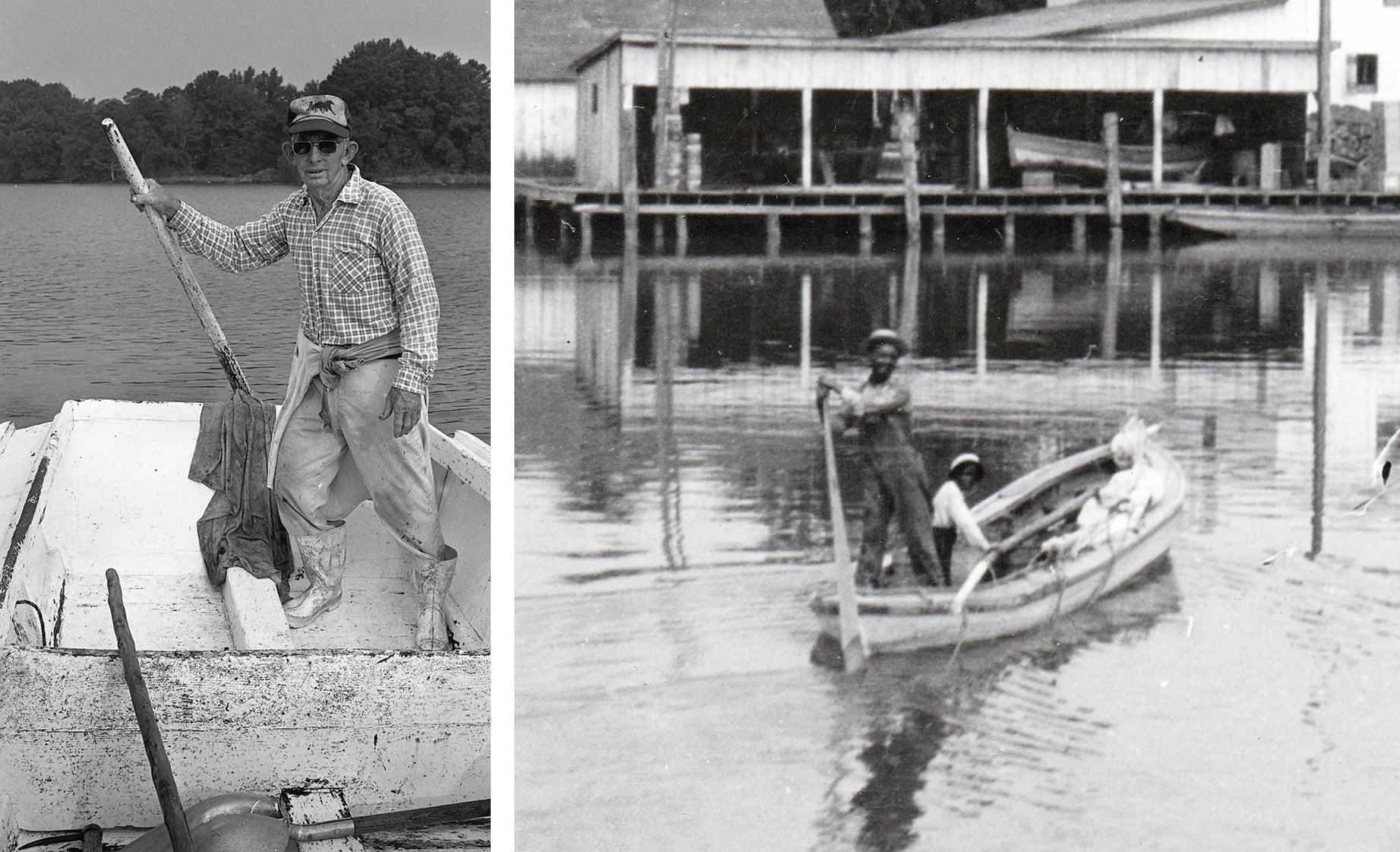
Left—Mathews pound-netter Wilson Rowe, shown in 1988, sculls his trap skiff with just a post and flat paddle. Right—A log canoe being sculled off a post at the Kinsale Virginia Cannery sometime in the early 20th century. Even after Chesapeake Bay watermen moved to square-sterned vessels, they added a post to enable the method of sculling they knew best.
He used a flat paddle, maybe 10' or 11' long, resting it on a short post coming off the transom. He wagged the paddle back and forth against the post trying to balance it and to discover the right pressure to keep purchase. For several days, he practiced, being blown onto shore or into the shucking house across the creek. Eventually, he could keep the paddle on the post and maneuver into the wind. He’d mastered the pressure of the sweep as the paddle pivoted on the post without an oarlock, tholepin, or transom notch.