
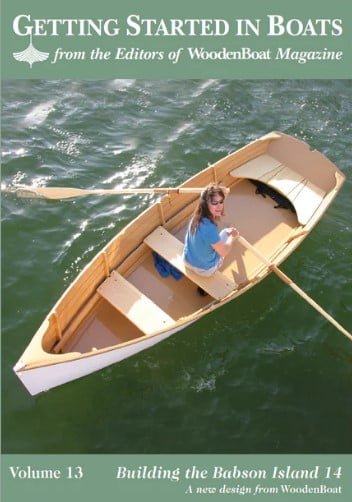
John Gardner, the dean of American small-boat builders, once wrote, “Flat-bottomed skiffs are the easiest of all boats to build and the hardest of all boats to design.” Thousands of poorly designed but easily built “sharpies,” “flatirons,” or “flatties” as they are sometimes called, have given the type a bad name over the years. I’m talking about boats that have no rocker (fore-and-aft curve in the bottom), straight sheerlines (fore-and-aft curve in the rails), and are wedge-shaped in plan view. They were often built with low-grade Douglas-fir plywood, which checks or splits. The ones with the straight sheerlines are not pleasing to the eye. These unfortunate models are almost always disappointing performers. Boats without rocker will not row or sail well because their stems and transoms are partly submerged, making them slow and reluctant to turn. These boats have convinced many people that plywood is not a good choice, and that a flat-bottomed skiff cannot make a great workboat or beautiful tender.
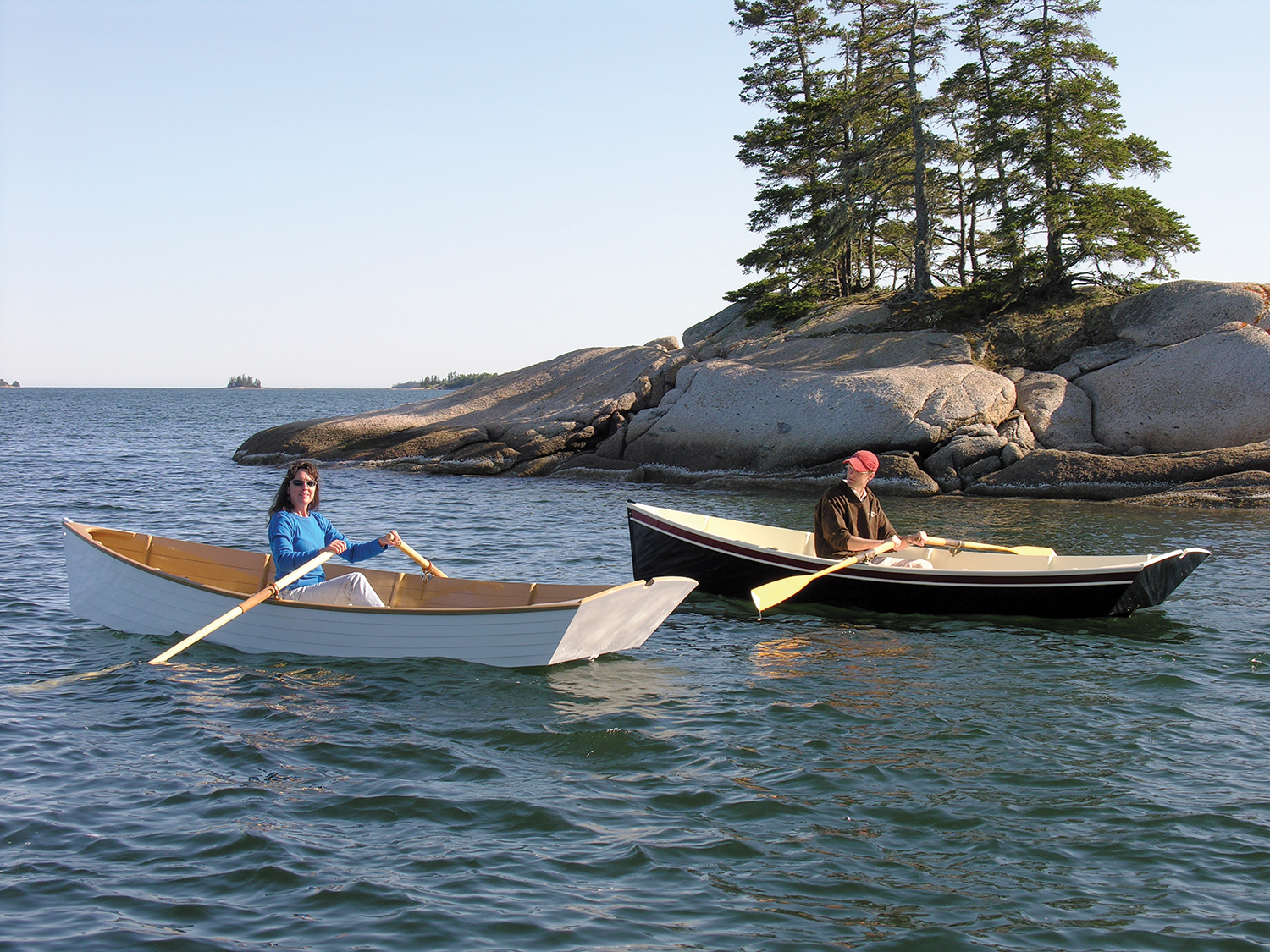
Babson Island 14
Our challenge at WoodenBoat was to design a simple skiff for entry-level builders. The boat had to be stable enough to be considered family-friendly and light enough for two to lift. We wanted an affordable kit that could be shipped on a UPS truck. Most important, she had to have sweet lines and row well. A friend of mine who is an accomplished rower and oar maker once told me he could see an advantage to using spoonbladed oars in performance rowing boats, but with a flat-bottomed rowing boat there would be no advantage to spoon blades over flat blades. Rowing the Babson Island 14 changed his mind. We knew people would want to sail this skiff, and power it with an outboard, so we adapted a sail plan from the Nutshell pram. Also included in the plans is a slightly different version with a more vertical transom and no rocker aft of amidships; these changes will allow her to be used with a trolling motor or small outboard. A drawing showing how to build her lapstrake is also included in the plans.
Sailing a well-designed flat-bottomed skiff is exciting. Downwind it can plane and surf on the waves. Upwind, with the boat heeled, the immersed section becomes a V-bottomed shape that can point to windward better than you might think. Flat-bottoms are the most stable of all hull shapes and, with flat sections, require less horsepower and plane more quickly than their round- and V-bottomed cousins. This efficiency comes at a price, since flat-bottoms pound and slap going to windward.
If you are an amateur builder with limited skills, tools, and space, a flat-bottomed skiff built with marine plywood is a logical first boat. Today’s high-quality marine plywood is easily obtained. It comes presanded from 1⁄ 16" to 3⁄ 4", and panels can be glued together face-to-face if a thickness greater than 3⁄ 4" is required. Panels can also be scarfed together to achieve greater length or width.
In this first of two parts, I’ll take you from the setup through fiberglassing the bottom of the hull. Although the information you’ll need to build the Babson Island 14 is provided here, I would recommend purchasing a set of plans, which includes many full-sized patterns, the sail plan, and the details of the outboard-powered version.
Let’s get started.