
The Sanctity of 16
There’s probably only one major commandment for , though there may be many corollaries: Channel 16 is sacred. There are many “working” channels to choose from, so before hailing another station on 16, check your options (there’s a list below) beforehand to make sure that the channel you have in mind is free of traffic. Hail, and right after hearing a response, ask to move your radio traffic to the working channel. Channel 16 needs to stay free for emergency communications and hailing.
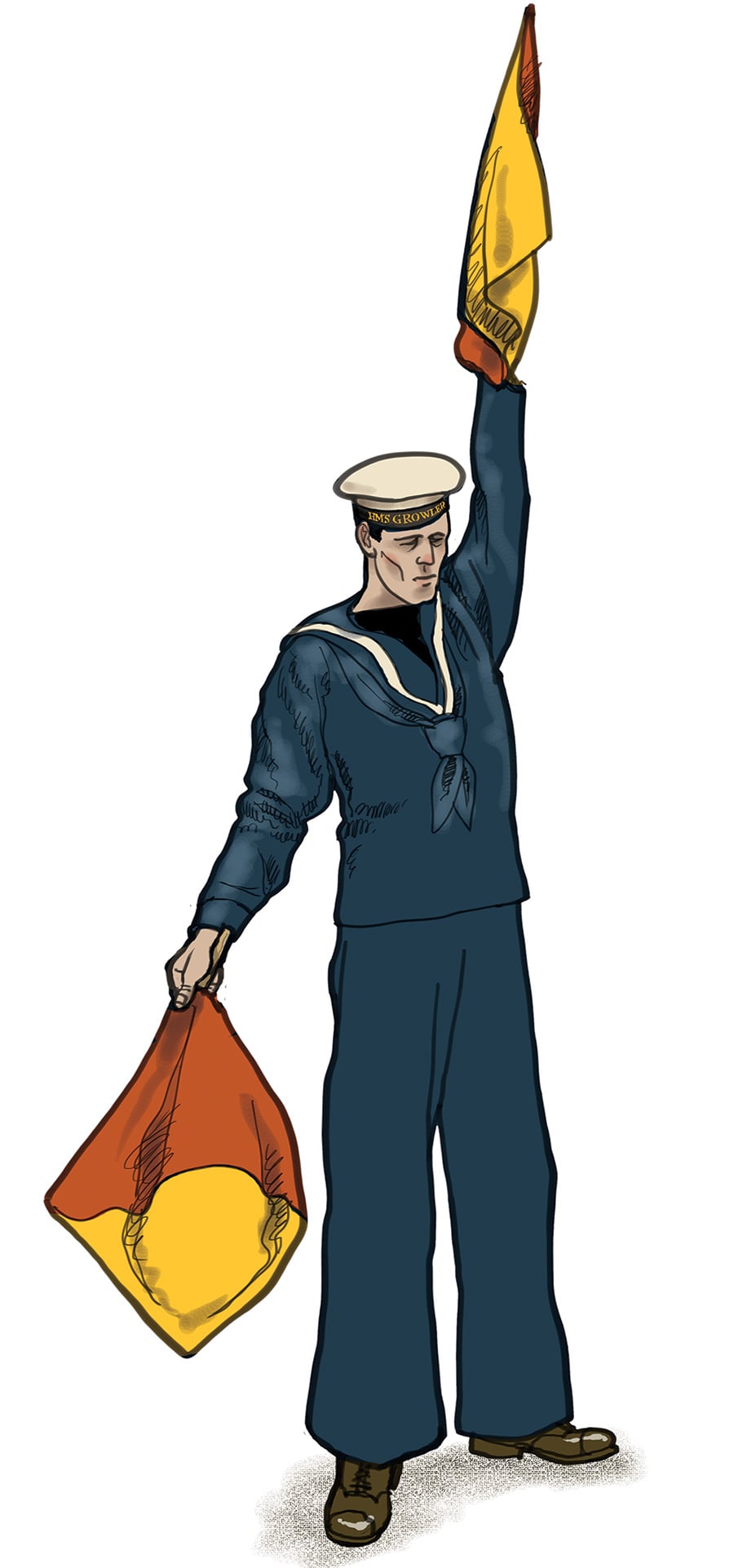
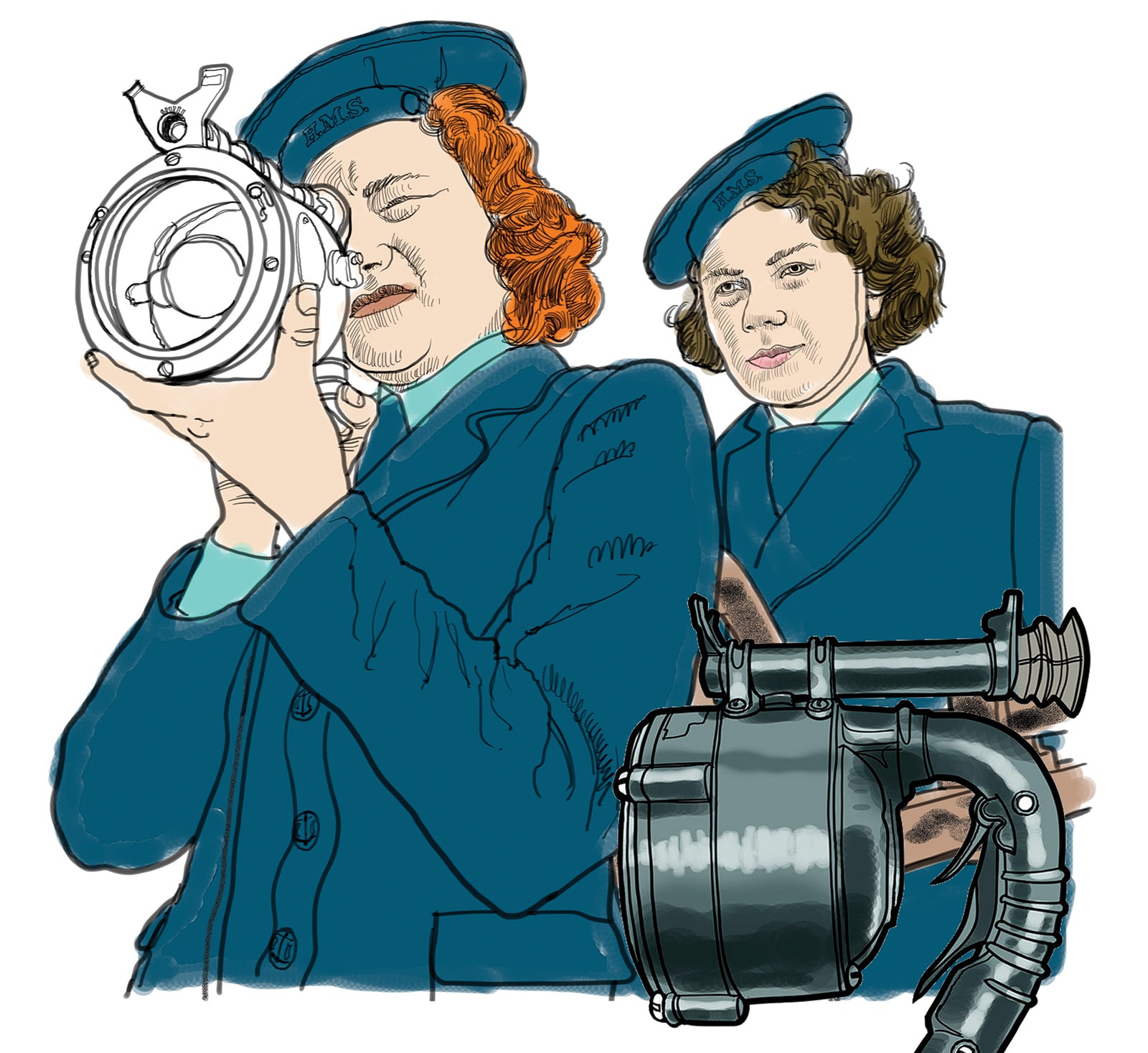
Semaphore, signal flags, Morse code, flashing lights, and very-high-frequency (VHF) radio have something in common: Within range of sight or signal, communication can happen even if you don’t know or can’t yet identify the person at the other side of the conversation. Despite the ubiquity of cell phones, VHF remains the most reliable way to get in touch with people on the water. After all, cell phones are only useful if you know the phone number of the person you’re trying to reach. A cell phone’s limitations become very clear when you’re looking to speak with that blue-hulled sailboat over by can 21—whether to warn them of imminent danger or to connect over the familiar burgee they are flying.
VHF, though its signal functions by “line of sight,” becomes even more powerful when you understand all the functions it offers, the limitations or reasonable expectations of your setup, and the proper way to hail surrounding stations.
Who Needs a VHF?
Everyone from kayakers to cruise ship officers, that’s who. Because most of the time, VHF radio is more about listening than it is about talking. Out in a small boat, for example, you’ll want to hear sécurité advisories from larger, overtaking boats or to receive the latest weather forecast.
Be a good citizen with a VHF
Have you just set your anchor? If you’ve got enough juice in your batteries, don’t shut down your VHF. Keep an ear out for neighbors who may need assistance, listen for Coast Guard advisories, and have it on in case you need to communicate or respond.
VHF Anatomy
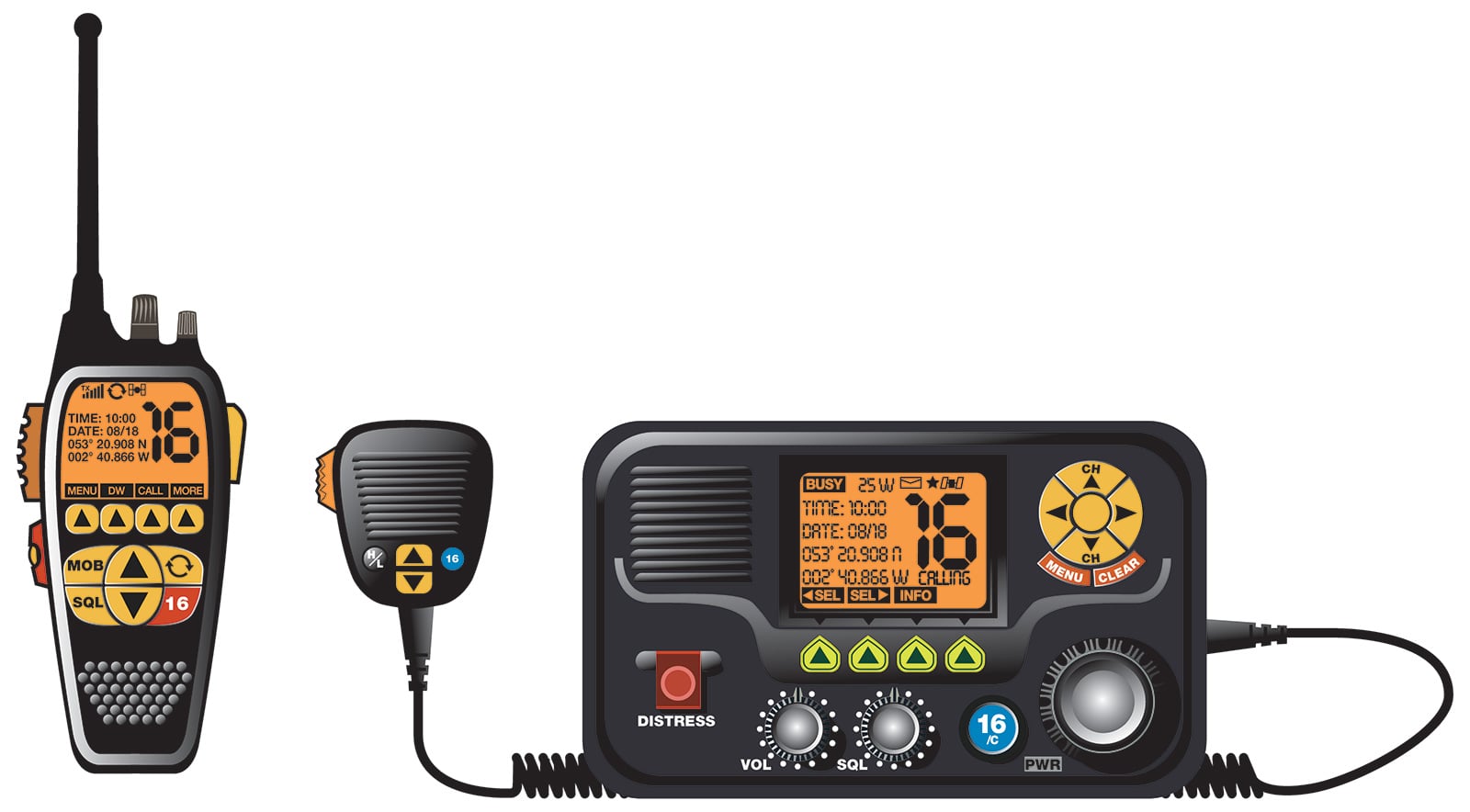
Check your owner’s manual to see exactly how all of these functions work or how to engage or disengage them. Here’s a rundown of the handiest features you’ll see on nearly every VHF radio.
1. Squelch: Turn the knob to the left or press the down-arrow button a few times; you’ll discover a sharp boundary with aggressive static on the low side, quiet on the other. Keep the squelch adjusted to just a hair above that boundary, and check it from time to time, or every time you turn on the unit. After adjustment, you may pick up the occasional static from other conversations just at the edge of your range, but don’t adjust the squelch too high; you might exclude things you should be hearing.
2. WX: This function , activated by a specific button or found in a menu, scans for the closest or best weather station. When you start a day listening to the NOAA robots, you know you’re cruising. Some radios receive weather alerts and give a tone when one is available, or some will even change over to the WX channel automatically when a weather alert is available.
3. Low Power/High Power: The low setting, often 1 watt on a handheld and 5 watts on an installed unit, should be used for all local radio communications, and the high setting, often up to 25 watts on an installed unit, is for hailing and longer-distance communications. Default to low, and switch to high if needed. It’s courteous to use the lowest setting.
4. Dual: Some VHFs can monitor more than one channel at a time; heck, some can monitor three. If you’re near a shipping lane, for example, you might monitor both channel 16 and 13, 16 being the universal hailing frequency and 13 being a channel mostly reserved for commercial vessel communications. It’s also useful if you’re boating alongside friends. I tend to pick channel 69 as an agreed-upon place where we’ll keep our traffic, and then we don’t even need to hail on 16. You’ll always say what channel you’re hailing on, and we’ll get to that shortly.
5. Distress: If your VHF has a button for distress protected by a little red door (old units are slightly different), you can use digital selective calling (DSC) to report distress. To be useful, it needs to be set up correctly: you need to register for an MMSI number (see sidebar), set it up in your radio using instructions from the user manual, and then hook up your GPS if your unit doesn’t already have one internally. Upon activating the distress button, Coast Guard and all other vessels within a line of sight will know your identity, your location, and that you need help.
The most underused, amazing thing that VHFs do: DSC and MMSI
When registered properly, your nine-digit Maritime Mobile Service Identity (MMSI), when broadcast through your VHF via DSC, can do a lot of work to identify who you are even if your signal isn’t good enough to carry out a conversation or if any crew member, even an inexperienced one, needs to make a distress call. Register for an MMSI and keep it up to date!
Expectations and Limitations
How far can a VHF reach? If you are coming to boats from land, or to VHF from telephones, the most important concept to grasp about VHF is that range is dependent on line of sight. Three main things become very important with their installation and use: the height of their antenna, the transmission power of the radio itself, and the antenna’s “gain”—a key measure of antenna power (see page 5).
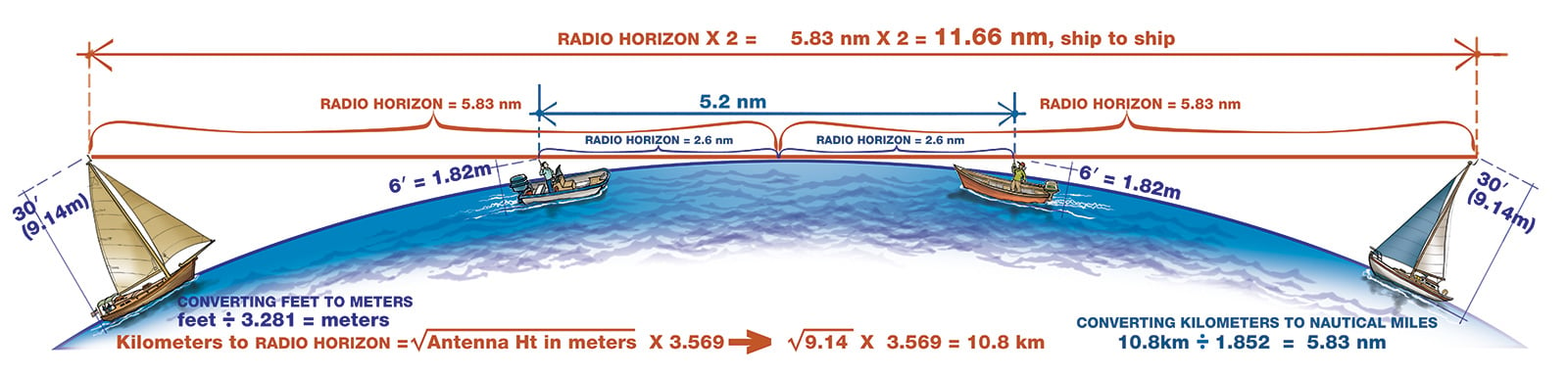
Height is much more important to the quality of a signal than gain. At the bottom of this page, we demonstrate with an exaggerated horizon and with real numbers the reach of VHFs with an antennas installed at different heights.
Given this information, you know that the higher you get with a handheld VHF, the farther it may reach.
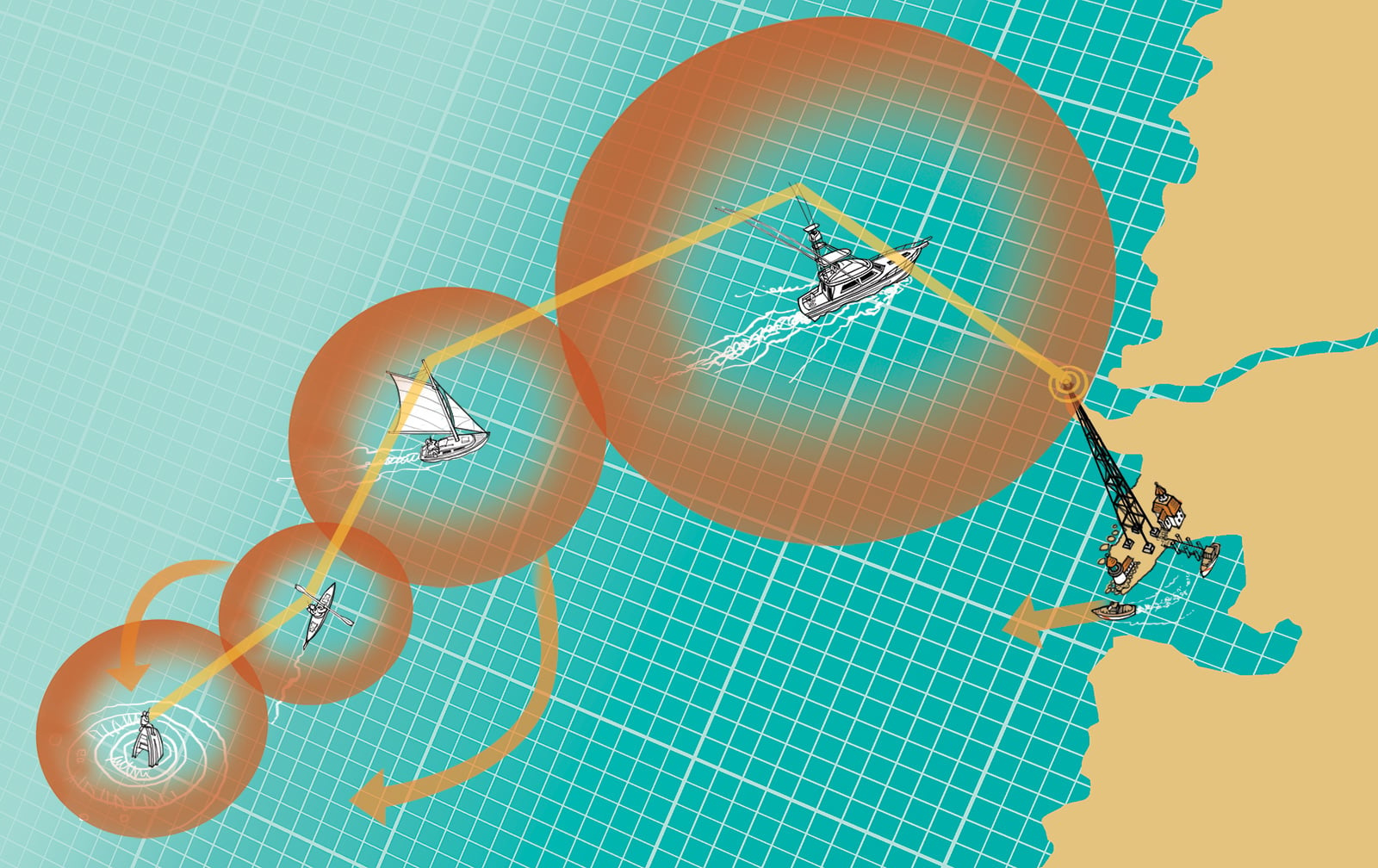
The kayaker’s range doesn’t quite reach the Coast Guard station on shore, but the sailboat and sportfishing boat in between them can. Intermediate boats might perform the duties of a relay, listening to the traffic and reiterating it to each party as needed.
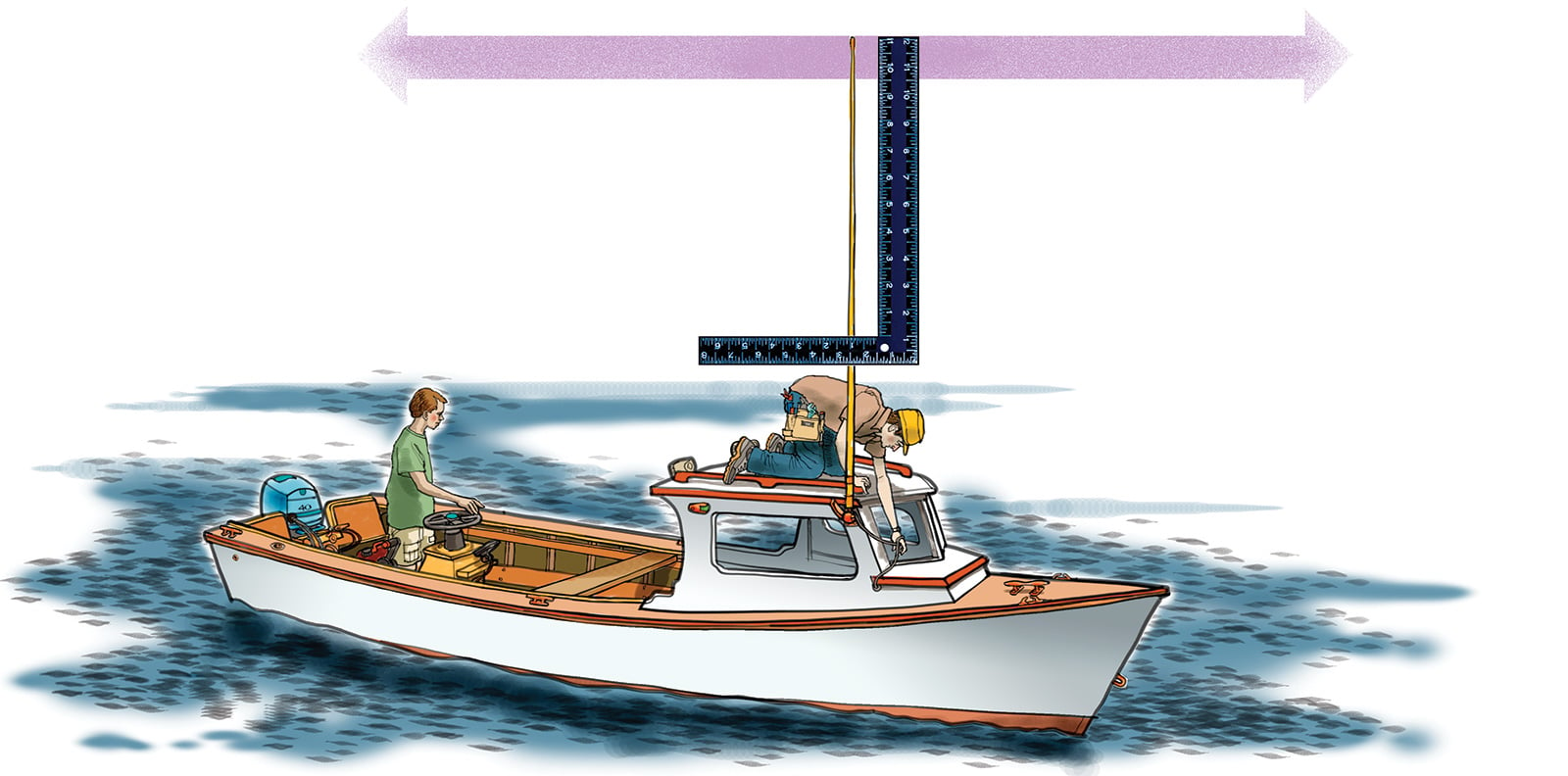
On a motorboat, perpendicular installation at the highest point is key. It’s tempting to go for a place that’s discreet or visually pleasing; VHF is for more important things.
In Nigel Calder’s Cruising Handbook, Calder recommends that a sailboat have a VHF antenna with a gain of 3 dB; it compromises distance for some wider shape to the signal in case the boat is rolling. He recommends a 9 dB gain for powerboats, as they can’t have their antennas installed as high.
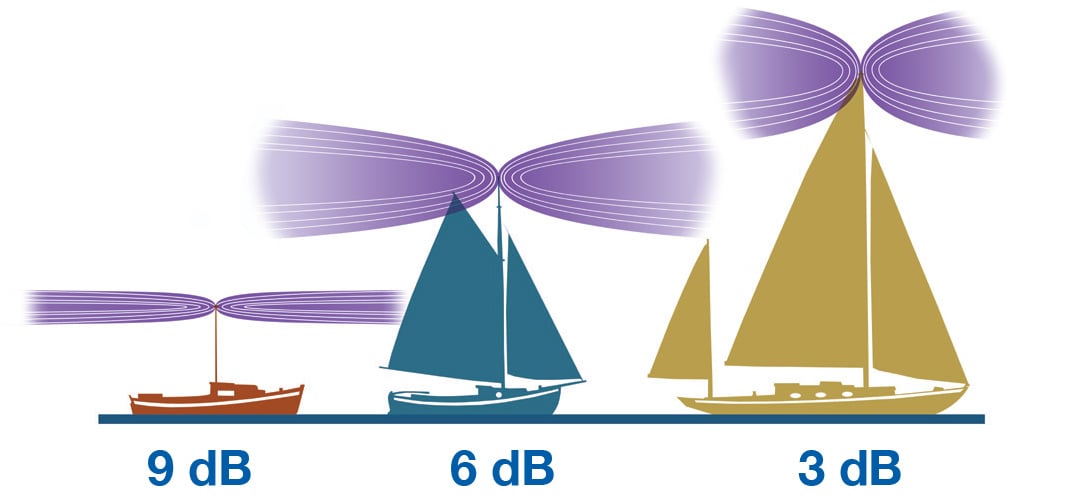
Gain, to put it simply, is an attribute of the antenna itself, stated in dB (decibels) that describes the shape of the signal coming from the antenna. A higher number means a squished and long signal (not ideal for heeling sailboats, better for low-to-the-water motorboats); a 0 dB gain radiates out in a circle from the antenna, as with the kayaker’s handheld unit. Gain is sometimes a limitation and sometimes a positive attribute that can help improve the range of your signal.
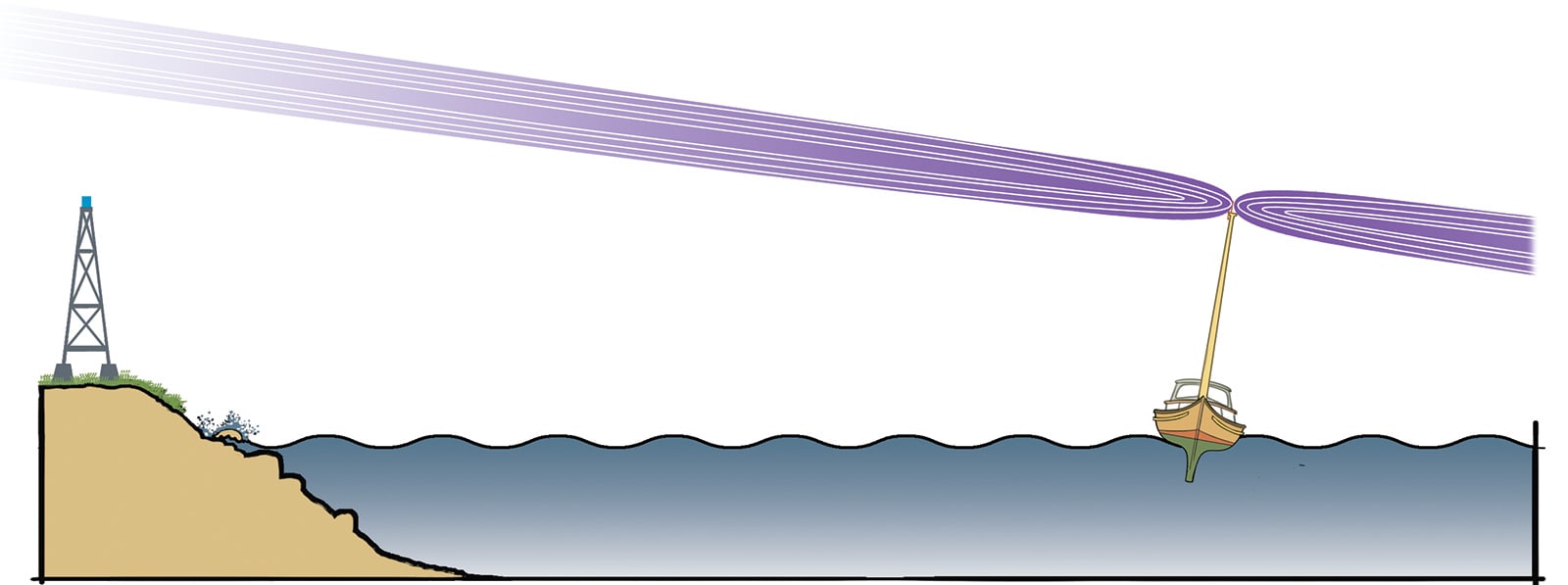
Here’s why a high-gain antenna, even if it’s installed nice and high, is a bad idea on a boat that heels while underway. The range is compromised on each side of the boat. A gain that gives a broader signal is better here.
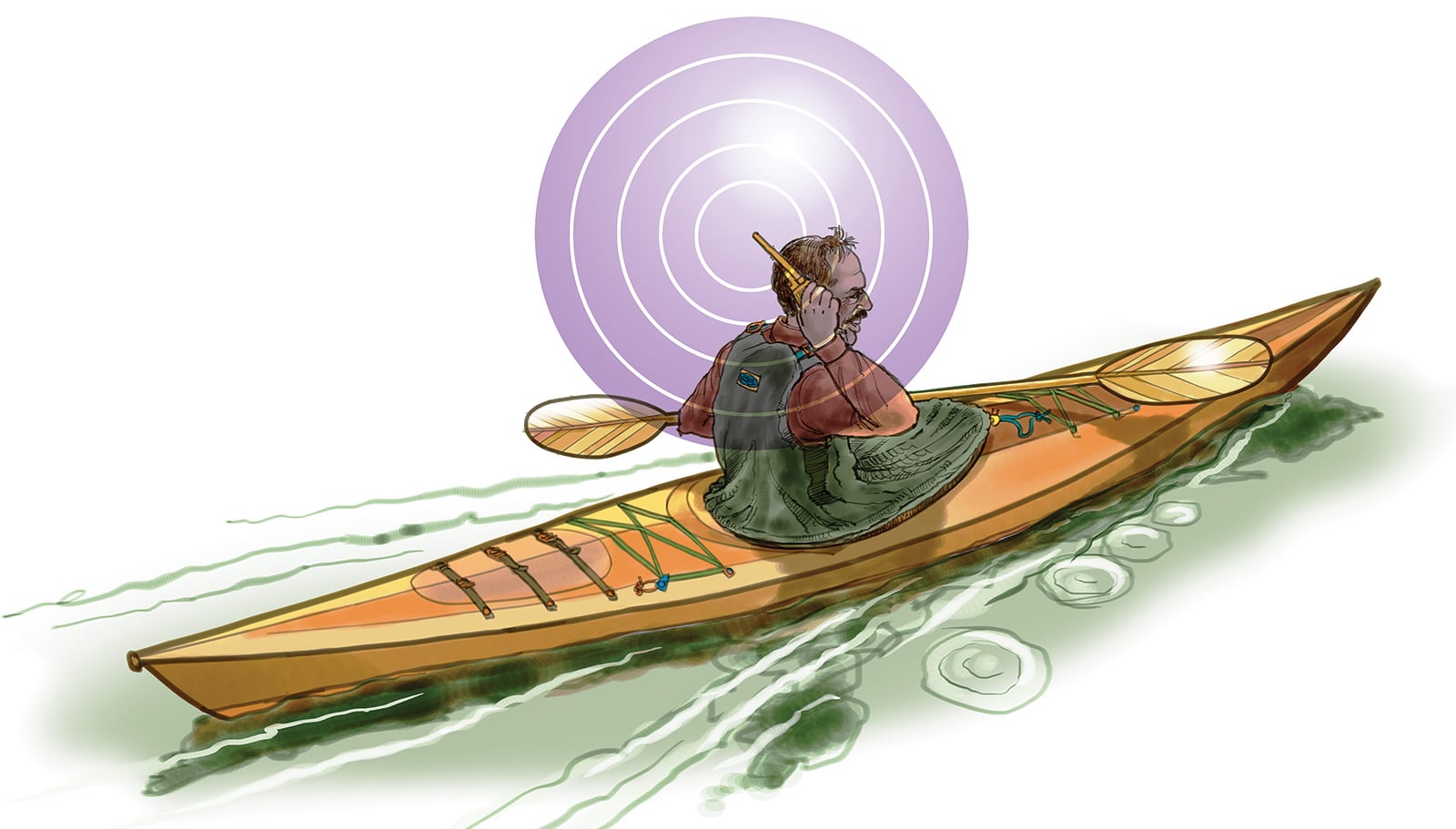
Gain is largely dependent upon the size and particular characteristics of an antenna itself. Handheld VHFs, therefore, have very low gain because of the size of their antennas. A small boat utilizing a handheld, low to the water and with that small amount of gain, will have a very limited range. With a low power output of 1 watt and 5 or 6 watts at the high setting (compared to an installed unit having output at 5 watts and 25 watts, respectively), kayakers will not hear or transmit nearly as far as their taller, higher-powered counterparts, but might expect the help of a relay. That same handheld would perform better at higher ground, if calling from shore is possible.
OVER: I Speak THEN You Speak
Because most normal VHF communications are transmitted and received on a single channel, only one side of the conversation can be heard at a time. I call; I speak slowly, clearly, using short sentences; then I say “OVER,” meaning, “Now it’s your turn.” There is more about protocol below.
For installation guidance, we recommend Nigel Calder’s Boatowner’s Mechanical and Electrical Manual and, of course, consulting the manual for the specific unit to be installed.
Making the Call
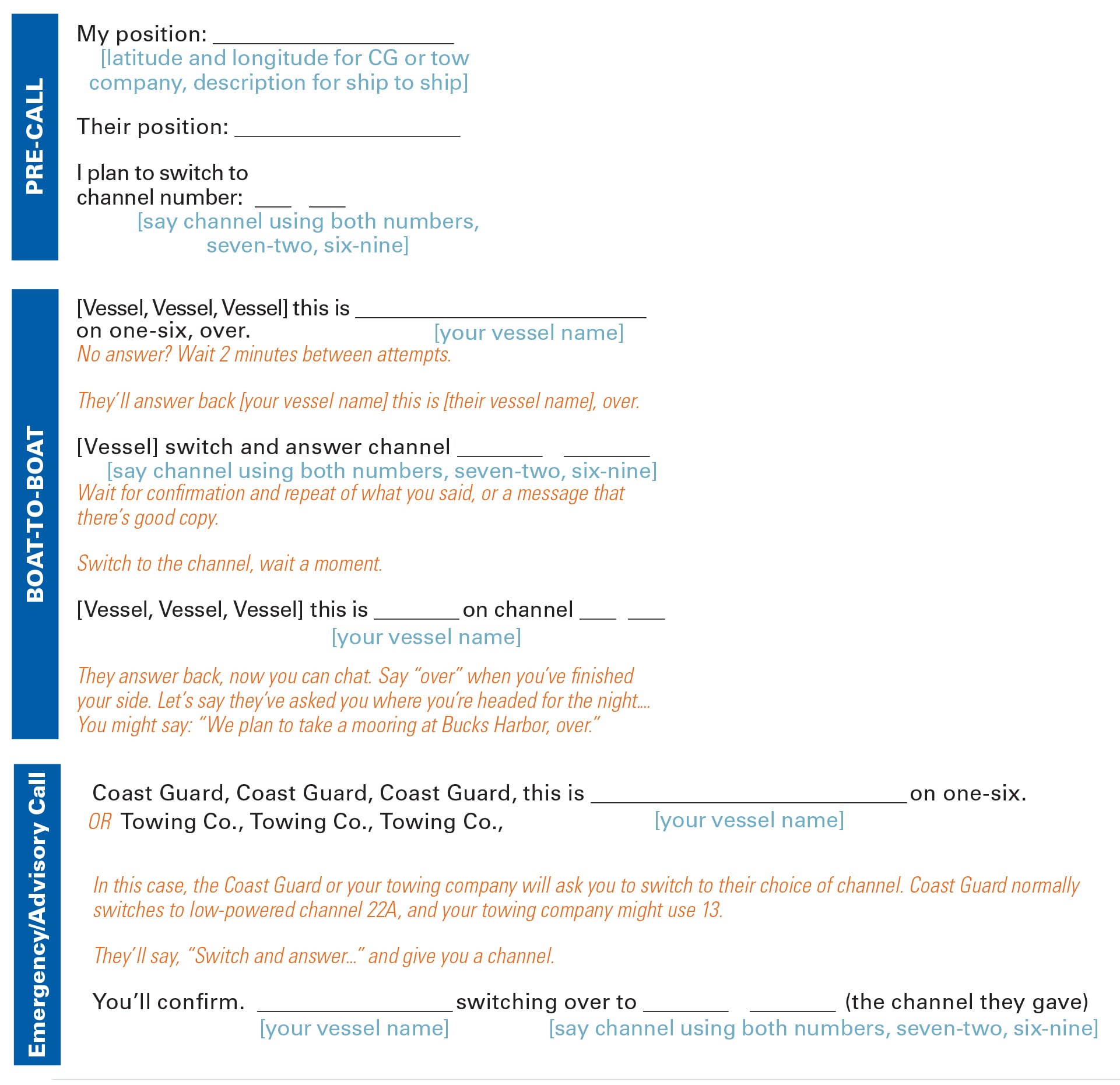
This sheet, laminated and marked with a dry-erase marker, will ensure that you sound like a seasoned pro over the radio. Speak clearly and enunciate, holding the microphone about 3″ from your mouth. Jot down a few details before your call. Be calm and slow. The aim here is to get your traffic off channel 16 after hailing the other boat.
Reference Resources: Phonetic Alphabet, Channels, and Their Uses
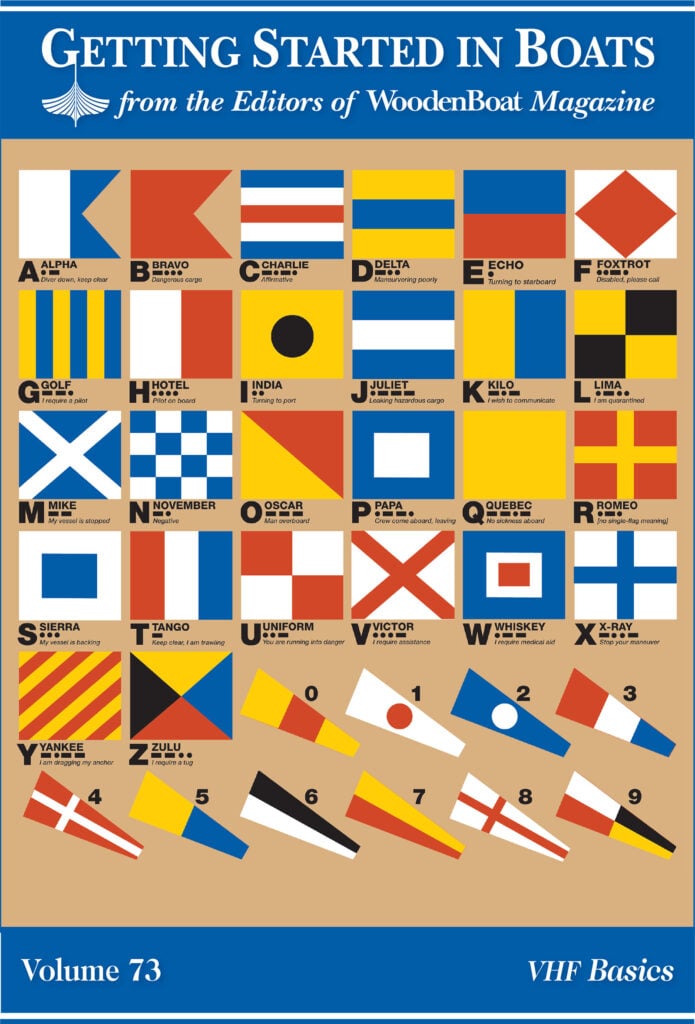
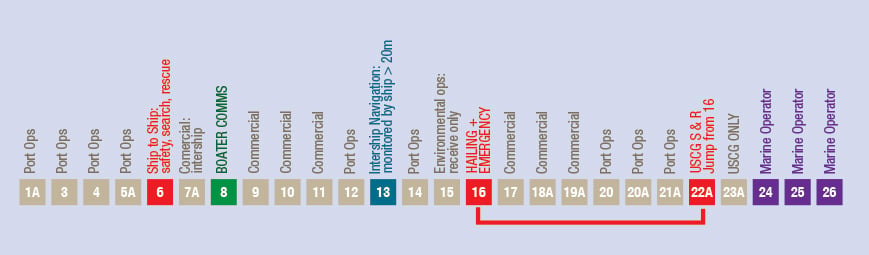
Over a rough connection, you may need to spell something out using the standard phonetic alphabet on the cover of this issue of Getting Started in Boats. Practice spelling out your boat’s name phonetically, and learn the rest of the alphabet. Below are VHF channels and their assigned uses. This may change regionally, but only slightly. Channels in green are recommended for boat-to-boat communication.

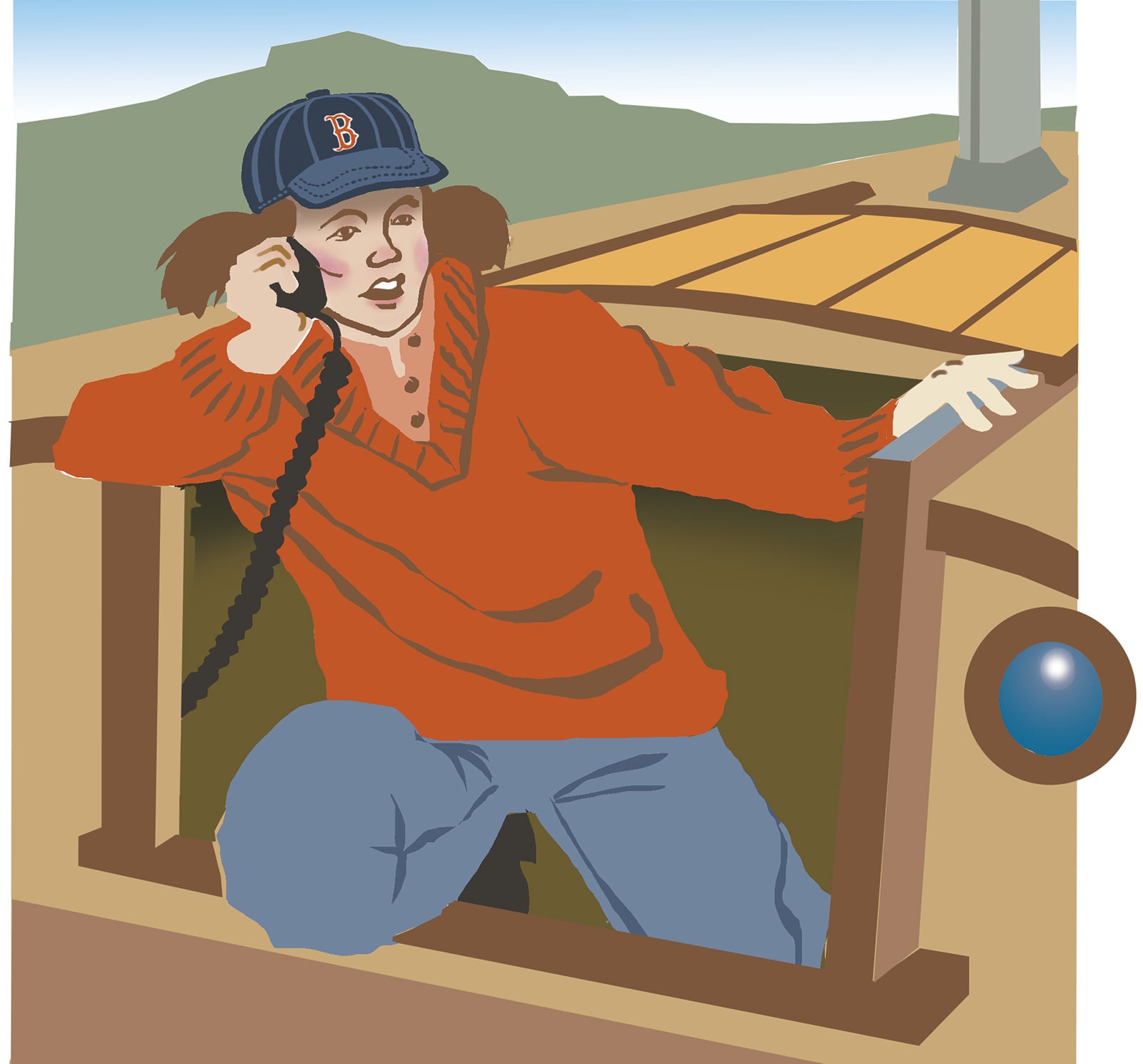
Engine noise can make communicating belowdecks difficult for both sides of your conversation; making a call with your head popped out of the companionway might be necessary.
When You Don’t Know Their Name
Sometimes you can’t see or don’t know the other boat’s name, but you’d like to check on someone’s intention. Describe their position or the color of their boat. “Sailboat just northeast of buoy 21, this is sailing vessel NEW MOON on one-six,” you might say.
I got a call once in Norfolk, Virginia, I’ll never forget. “Sailboat approaching nun 30 in Elizabeth River Channel, this is Warship Delta 55 on one-six.” I popped my head out of the companionway to see where we were. A big gray hulk was gaining on us, only about 50 yards behind, and we were hugging and passing a red buoy with a 30 on it. They were talking to me, all right.
Sécurité, Pan-Pan, and Mayday
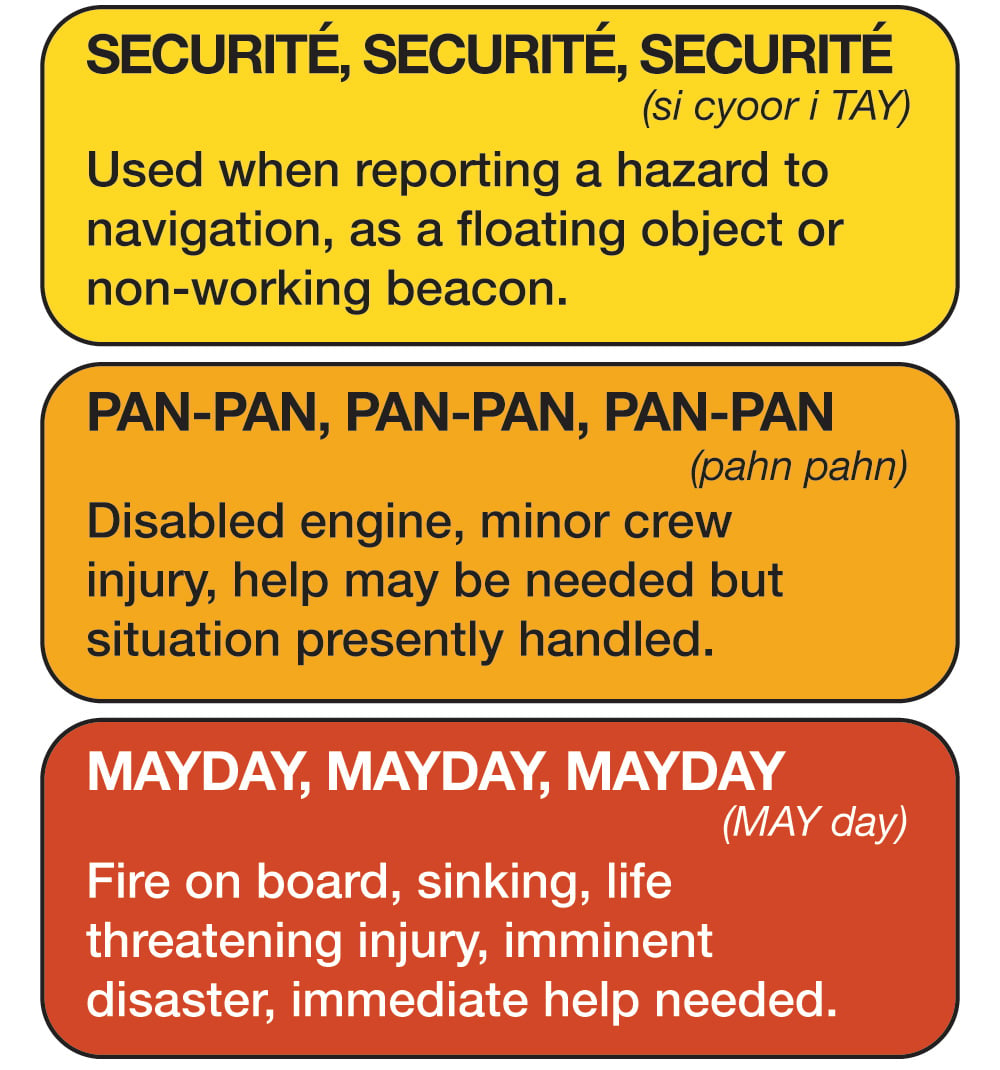
Coast guards around the world use these special calls the most, and will often preface a security call with “Sécurité, sécurité, sécurité,” perhaps advising about a navigational caution: a regatta and its planned course, a fireworks display near the water, for example. A call prefaced with “Pan-pan, pan-pan, pan-pan,” will be about an emergency on the water that is not life-threatening and is being handled by the people in distress themselves or by nearby responders.
You might hear one of these and find you’re near a boat that has signaled pan-pan, and you’re close enough to help. That’s up to you: only respond if you can do so safely.
Mayday (the term comes from the French m’aidez, or “help me”) is used only for imminent, life-threatening distress; you’ll start the call to anyone around with a simple:
Mayday, Mayday, Mayday, this is [_________] on one six. Our position is [lat _________] [long _________], there are [#____] people aboard, [and the nature of your distress].
Distress calls on modern VHF units are best made with digital selective calling (DSC) as discussed on page 3. You’ll need your MMSI number registered, but after that, pressing the button communicates your position and other information about your boat automatically.
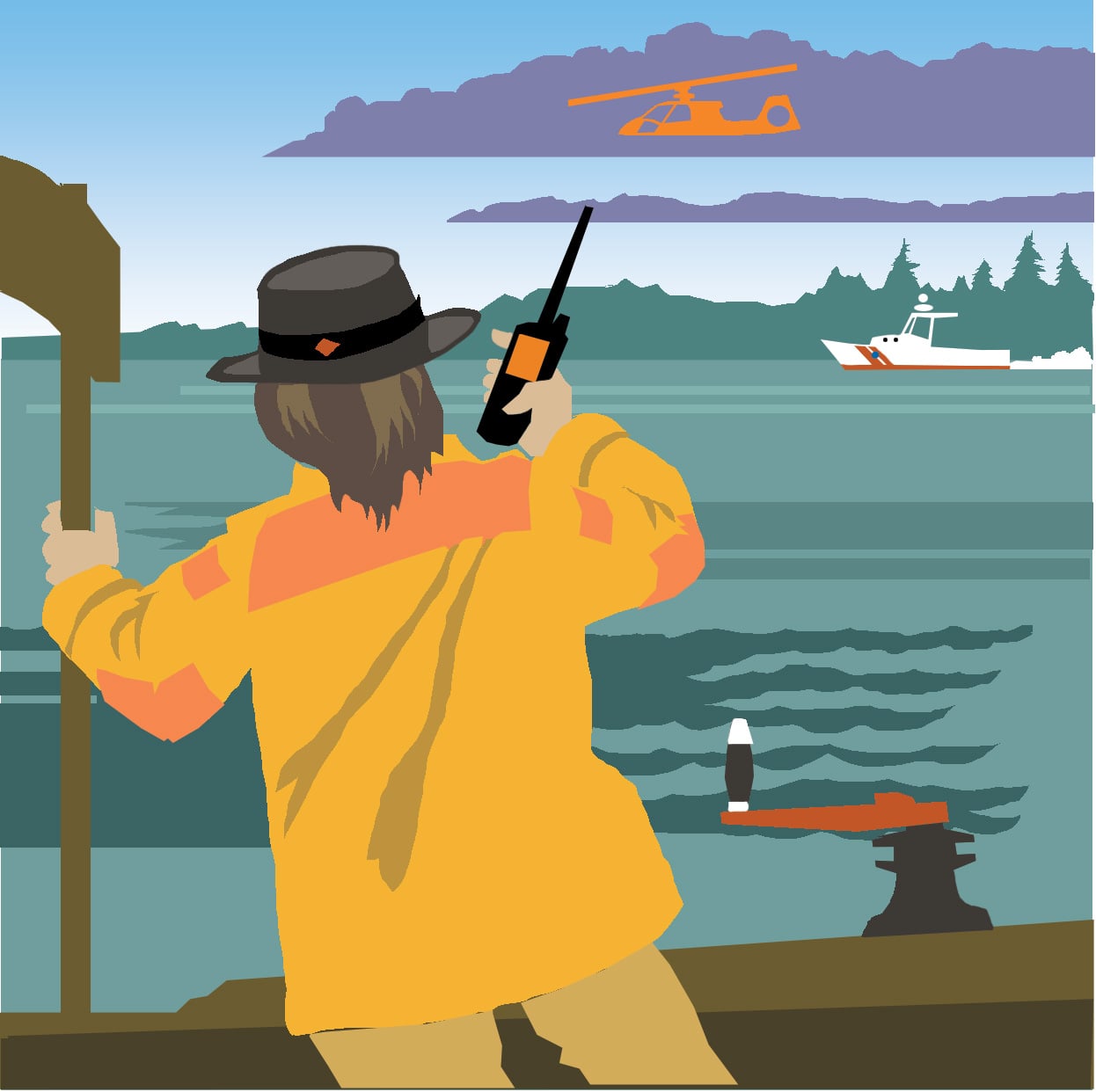
After calling for help, you’ll need to direct the first responders to your exact location.
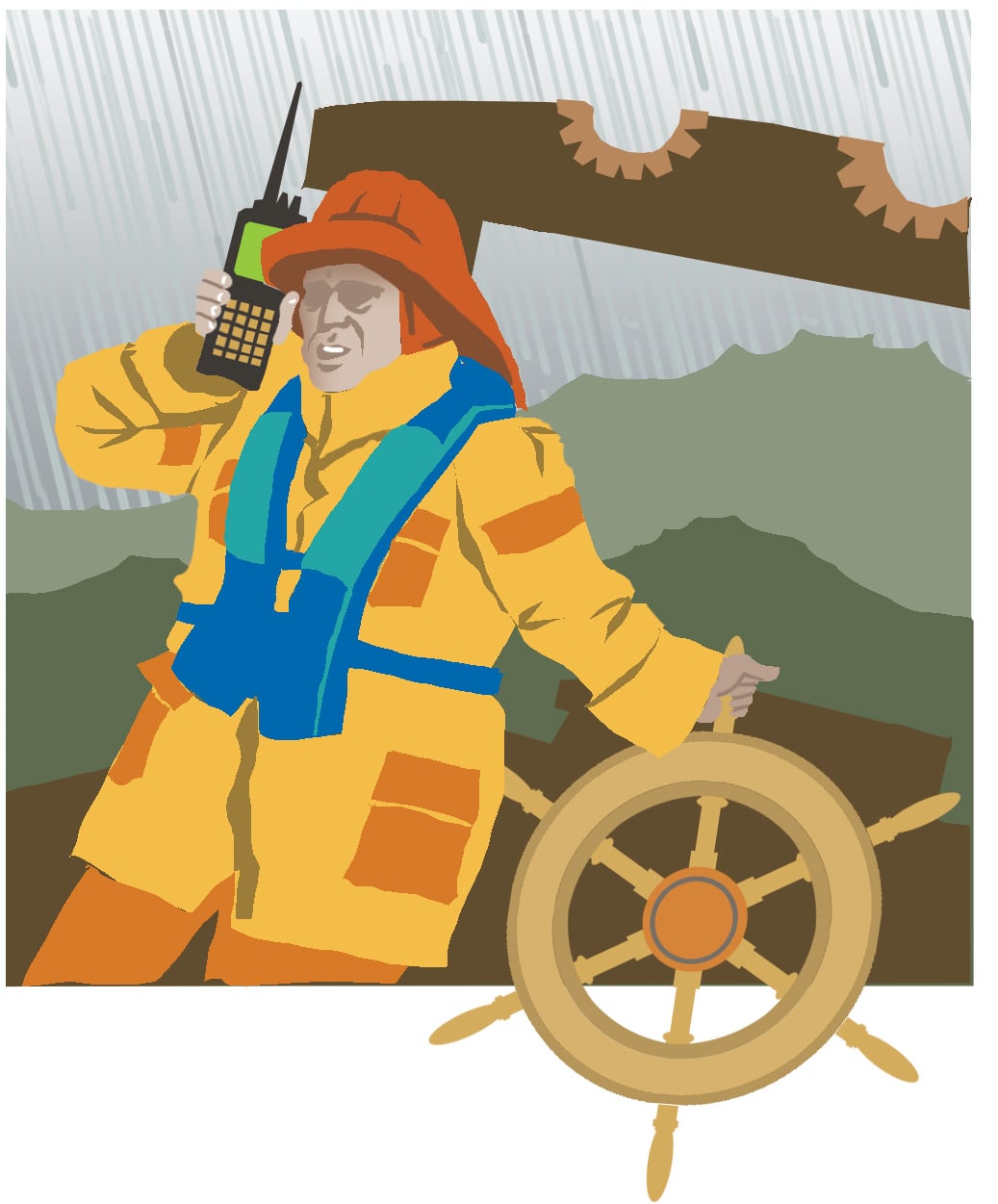
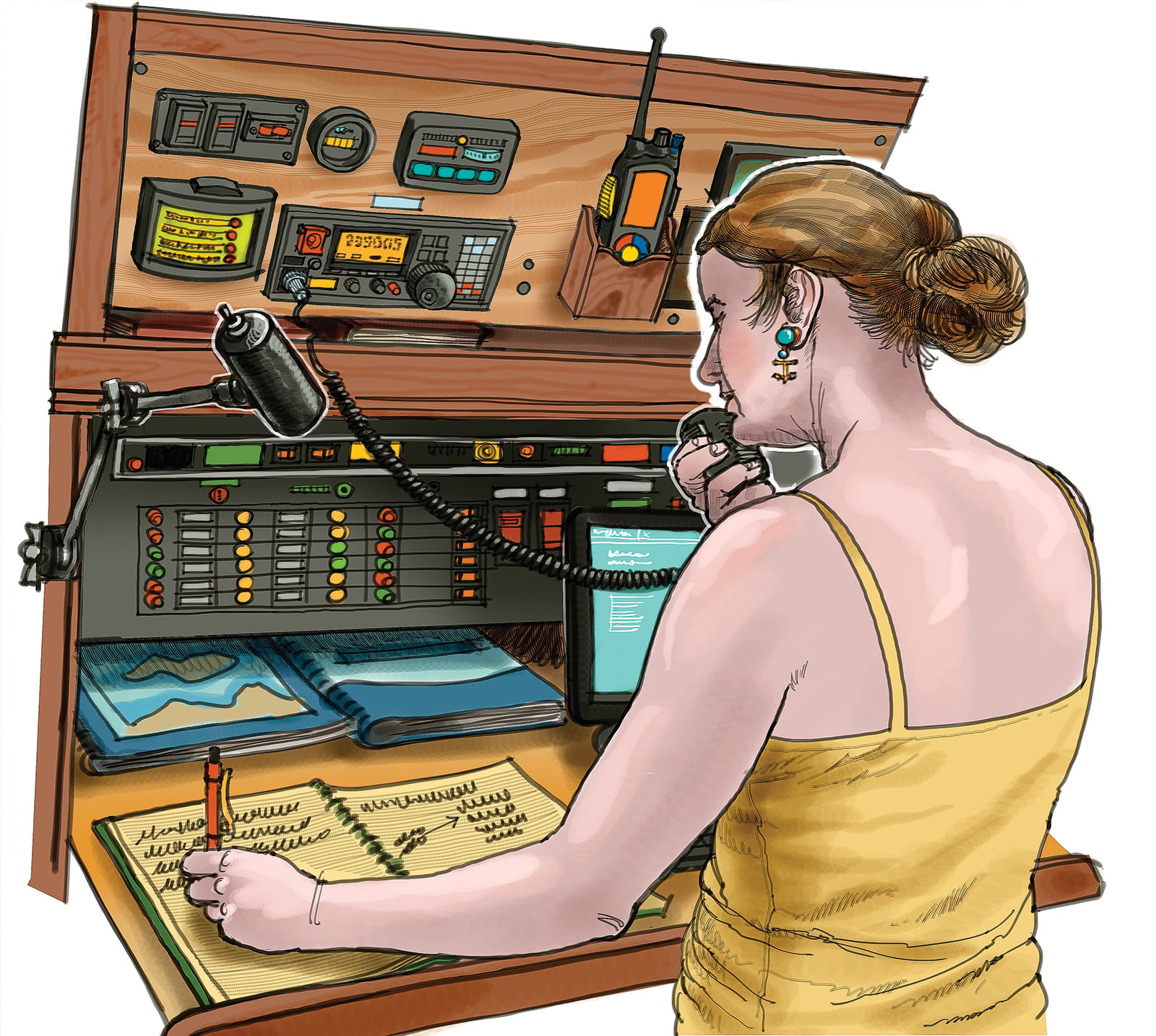
An installed, high-power VHF may be inconvenient if you can’t leave the helm. Consider having a handheld backup for difficult weather or when shorthanded.
Getting Social with VHF: Cruiser Nets
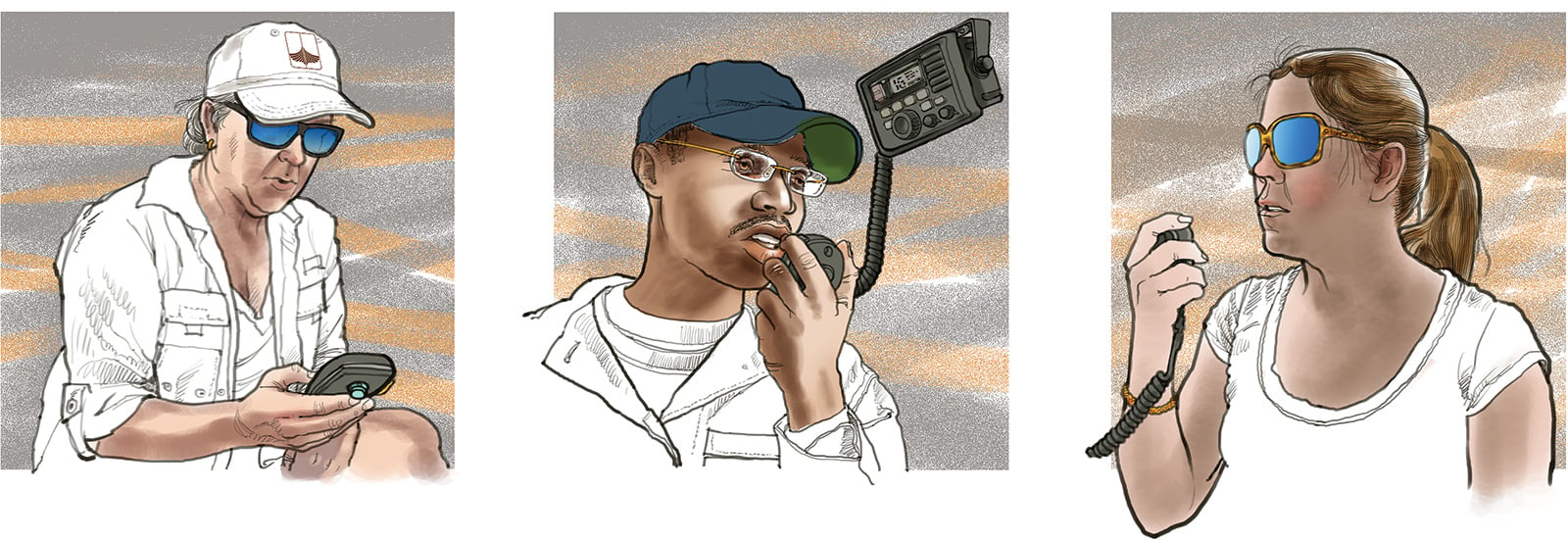
If you’re cruising in the Abacos, Bahamas, be sure to get your coffee ready by 0815, tune to channel 68 on your VHF, and enjoy the cruiser net. Boats call in to say that they’ve just arrived or that they’re planning a passage to another place, or to share weather news or information about conditions in particular anchorages, and local businesses give details about special events they’re having. I’ve also heard of people needing tools, materials, or local knowledge, and the next day they’ll do a “thank you” shout-out to the cruisers who helped them.
There are cruiser nets all over, and they truly are one of my favorite things about cruising and the cruising community. To find a net where you are, ask a fellow boater when you arrive or search one up on the internet.