
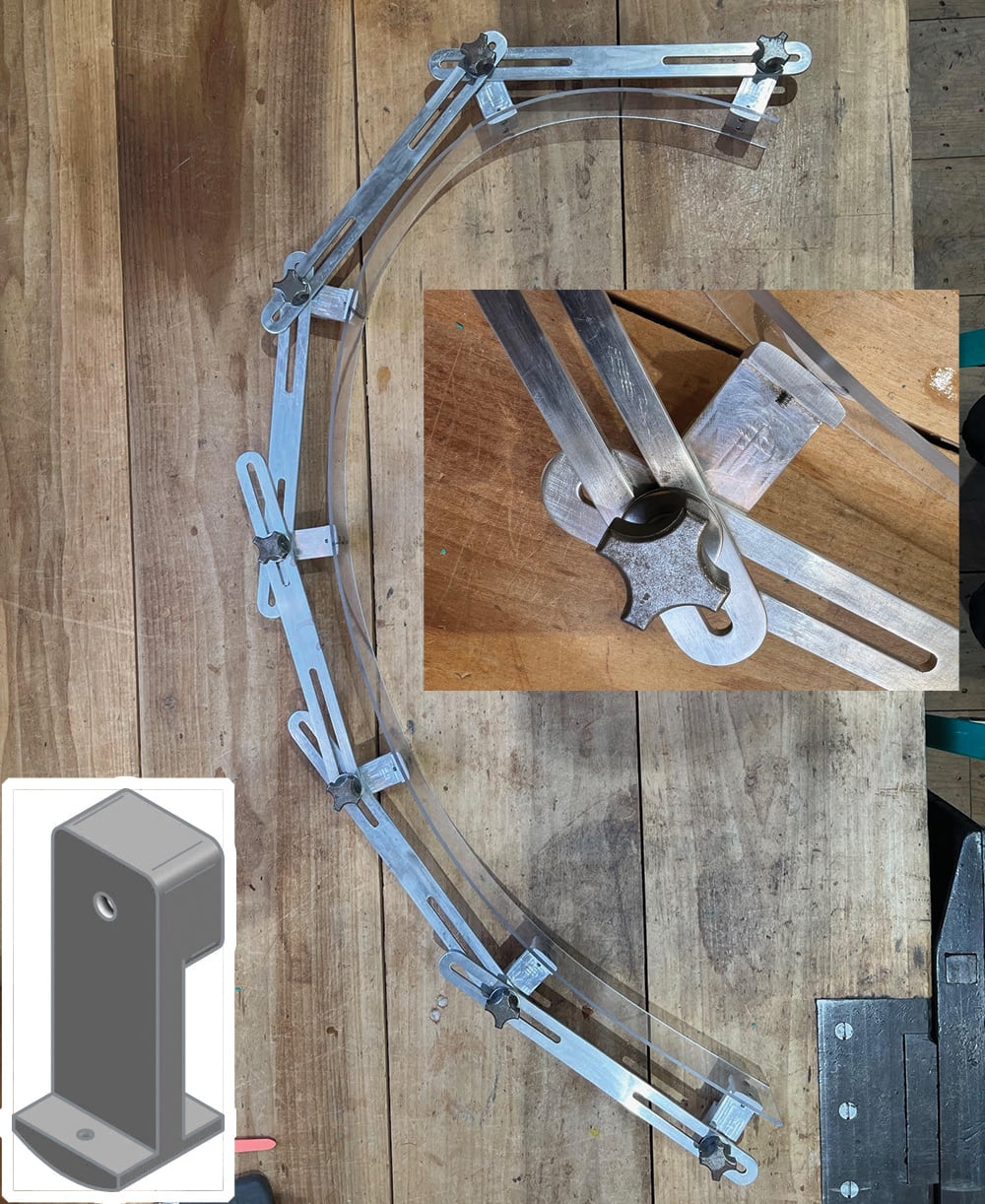
When he first encountered a flexible curve template many years ago, the author was unable to locate a commercially available one, so he designed and built his own. Although such templates can now be purchased from woodworking stores, they have some limitations compared with the author’s design: they cannot be shortened to fit into tight spaces, and they are not fitted with clear polycarbonate battens, which make the tool much more versatile. The tool’s aluminum parts may be machined or hand-cut.
Years ago, a boatbuilder friend of mine showed me a flexible curve template. It consisted of a thin spring-steel plate about 8′ long connected to a series of stand offs that in turn were connected to a number of slotted flat pieces of metal. The slotted pieces were tightened to the stand offs with thumb screws to hold the spring-steel batten in place, thus picking up whatever curve the batten was formed into.
Over the years I kept my eye out for one of these gadgets but was unable to find one—although there are now commercially available ones that have some limitations as described below. While trying to install some curved frames inside a cockpit, I got frustrated enough to build my own version of the flexible template. I had previously made spline battens out of polycarbonate to use with some lead drafting ducks I made. I found them to be very useful and nearly indestructible. I therefore used this material for the batten part of my shop-made template.
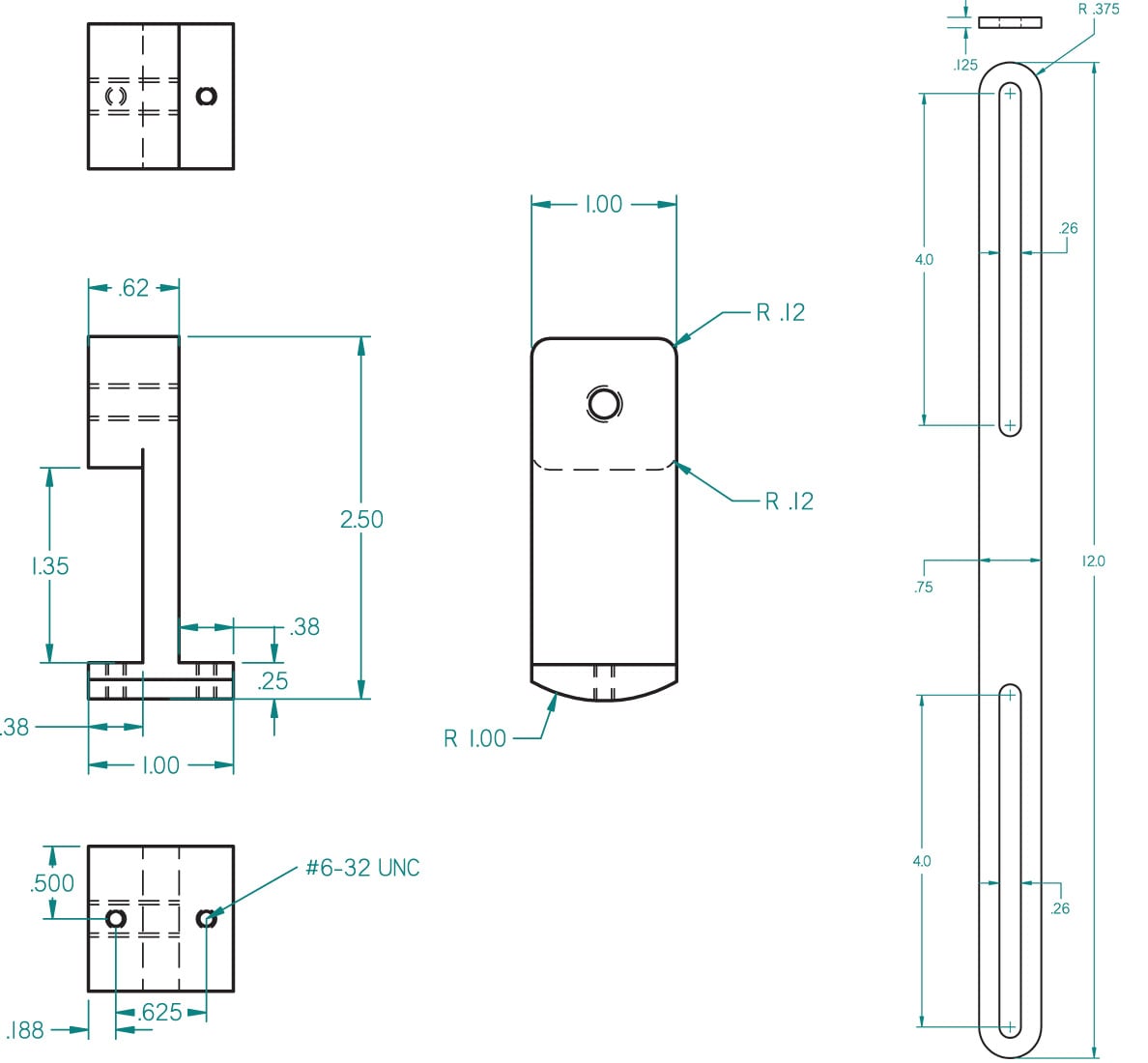
Aluminum parts for the template.
I drafted up some aluminum parts for the template on the computer (see drawings below) and set to work making a group of them, using a milling machine, although the same work could be done by sawing, drilling, and filing. At the same time, I made several polycarbonate battens of various thicknesses—¹⁄₁₆″ for tight curves and ¼″ for gradual curves. Most of these were 2″ wide, but I made some narrower and wider ones, too. One advantage of polycarbonate over steel is that it can be cut to length, limited only by the length of the sheet of stock. In my cockpit framing operation, I could not use a long batten. The commercially made Flexible Curve Template by Powertec is 107″ long, but it is a single width and can’t be cut to a shorter length.
I discovered when I came to assemble the template that the bottoms of the connectors needed to be rounded slightly to prevent flat spots in the batten. Also, because polycarbonate does not do well with constant stress, the No. 6 flat-head machine screws that attach the uprights to the batten must be left slightly loose.
I picked out some thumb screws and fender washers from McMaster-Carr (thumb screw part number 93005A55). I got all the aluminum from McMaster-Carr, too, and the polycarbonate from the local glass dealer who was kind enough to sell me small pieces.
The template’s assembly is simple, and depicted in the accompanying photographs. It does a fine job of recording the shape of a curve, and the clear polycarbonate allows you to confirm that it is lying flat against the surface. The polycarbonate can also be written on with a marker or grease pencil, allowing for reference and alignment marks to be recorded. 
Bart Chapin is the sole proprietor of a machine automation and design company. He has owned, repaired, built, rowed, and sailed boats from a young age. He and his wife, Lucy, own a 1947 Herreshoff 12½, two kayaks, a Nutshell pram, and a 34′ sloop.